Encore Thursday, Oct. 27, 2022 at 7 p.m. on KPBS 2 / PBS Video App
The Great Migration in East Africa is a spectacle that can be seen from space. More than one million wildebeest, alongside zebra, gazelle and elands, journey in a quest to find fresh grass. Witness this annual phenomenon in NATURE “Running with the Beest.”
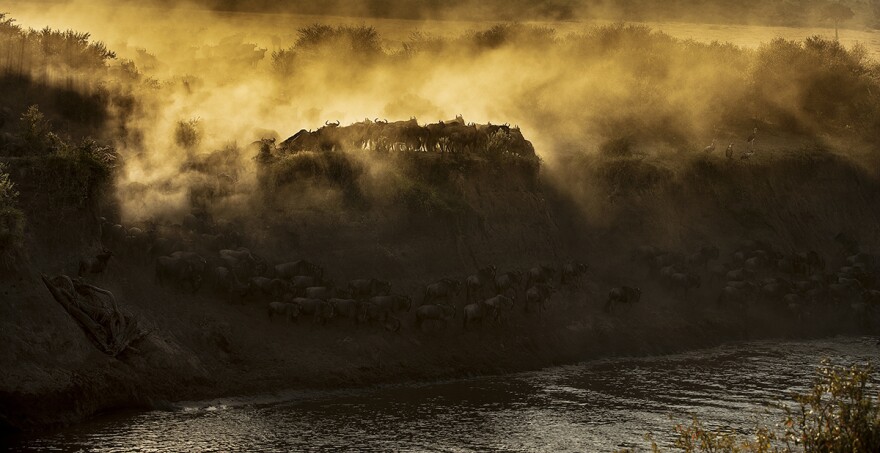
Witness the great wildebeest migration in East Africa, the most impressive mass movement of land animals on Earth. Travel with two Maasai guides who expose today’s conflict between people and wildlife and share new ideas for co-existence.
1 of 8
Herds of wildebeest at dawn crossing the Mara River. Maasai Mara National Reserve, Kenya.
Courtesy of Clement Kiragu / © Atlantic Productions Ltd.
2 of 8
During migration, hundreds of tourist vehicles crowd into the Mara to witness the migration river crossings firsthand. Maasai Mara, Kenya.
Courtesy of © Atlantic Productions Ltd
3 of 8
Wildebeest plunging into the Mara River during the Great Migration. Maasai Mara, Kenya.
Courtesy of Adam Bannister / © Atlantic Productions Ltd
4 of 8
Thousands of wildebeest migrating north through the grassy plains of the Maasai Mara in Kenya.
Courtesy of Adam Bannister / © Atlantic Productions Ltd
5 of 8
Derrick Nabaala, a wildlife guide of Maasai Mara, Kenya.
Courtesy of Jo Scofield / © Atlantic Productions Ltd.
6 of 8
Evalyn Sintoya, a wildlife guide of Maasai Mara, Kenya.
Courtesy of Jo Scofield / © Atlantic Productions Ltd
7 of 8
Female lion and her cub. Maasai Mara, Kenya.
Courtesy of Alisa Karstad / © Atlantic Productions Ltd.
8 of 8
Hyena family at a dead end. Maasai Mara, Kenya.
Courtesy of Alisa Karstad / © Atlantic Productions Ltd.
The documentary, which kicks off Nature’s 41st Season on PBS, follows two Maasai guides, Derrick Nabaala and Evalyn Sintoya, who have spent the last 10 years tracking the wildebeest as they migrate through Kenya’s Mara ecosystem.
As the wildebeest herd moves north through the border regions with Tanzania, it faces a human threat: an invisible web of wire snares. Poachers sneak across the fenceless border from Tanzania to hunt animals for bush meat, using wire snares.
However, climate change, tourism and modern-day conflicts are threatening the delicate balance between the environment and wildlife. The Great Migration is part of the Maasai’s cultural heritage, and Nabaala and Sintoya share new ideas for co-existence in a changing world.
The wildebeest migration across the river has become a premier tourist attraction in Kenya. While tourism is vital to wildlife conservation, vehicles in these numbers disorient and intimidate the wildebeest’s behavior.
“Wildebeest are a keystone species that support the entire ecosystem around them,” said Fred Kaufman, executive producer for NATURE. “Their conservation is critical to the survival of the natural landscape of East Africa. Our hope with this film is to shed light on the issues facing the Great Migration and spotlight possible solutions.”
As the wildebeest migration approaches the river, they know there is danger lurking in the water. Nile crocodiles move towards the herd's crossing points at this time of year and wait for the big arrival.
Watch On Your Schedule:
NATURE is available for streaming concurrent with broadcast on all station-branded PBS platforms, including PBS.org and the PBS Video App, available on iOS, Android, Roku streaming devices, Apple TV, Android TV, Amazon Fire TV, Samsung Smart TV, Chromecast and VIZIO.
Credits:
NATURE is a production of The WNET Group. Fred Kaufman is executive producer. Bill Murphy is series producer. Janet Hess is series editor. Danielle Broza is digital content & strategy lead. A production of Atlantic Productions Limited and The WNET Group in association with ITV Studios. The documentary is written and directed by Joanne Scofield. Bob Poole is director of photography. Produced by Anthony Geffen and narrated by Nyambi Nyambi.