

This story was originally published by CalMatters. Sign up for their newsletters.
For decades, parking lots at San Diego’s Balboa Park were packed, with lines of drivers snaking through lanes in search of a rare open spot.
Last Saturday there were plenty of open spaces, and on Wednesday several lots were half empty, while people lined up behind kiosks to pay newly imposed parking fees.
This month San Diego city imposed the first parking fees for the century-old cultural site, provoking confusion and contempt. Museums reported that visitation dropped 20% immediately, vandals defaced the meters and San Diego County mayors urged the city to reverse the unpopular policy.
“The negative impacts paid parking on Balboa Park have been immediate and they have been measurable,” Jessica Hanson York, executive director of the Mingei Museum and president of the Balboa Park Cultural Partnership, which represents the park’s museums, said at a press conference Wednesday. “Our visitors are feeling it and our cultural institutions and our museums are feeling it across the park.”
San Diego Mayor Todd Gloria has said the parking fees will provide stable revenue for the park and its museums, and help close a city budget gap of roughly $300 million this fiscal year and $110 million next year.
“Mayor Gloria, with the support of the city council, made the difficult decision to put the program in motion last year to create a dedicated source of funding so that Balboa Park, the city’s crown jewel, remains a special space for future generations,” Dave Rolland, a spokesman for Gloria, said in a statement to CalMatters. “We understand this is a major change, but it is a necessary one.”
Instant backlash
The parking program got off to a rocky start. The city’s current estimates for parking revenue this year are now about a quarter of its original goal. Meanwhile museum directors warn that lost admission fees could far outweigh the gains, as the new fees hinder access to the park.
“I think we’ve always looked at parks of our city and region as a little more sacred than a way to balance the budget,” said Jim Kidrick, president and CEO of San Diego Air & Space Museum.
Even free days took a hit. On Tuesdays the park offers free admission to select museums for San Diego County residents. This month, participation dropped 25 percent compared to January last year, making it the lowest “Free Tuesday” attendance in a decade, said Judy Gradwohl, president and CEO of the San Diego Natural History Museum.
Park staff and volunteers are exempt from fees, but they have to park in distant lots. Museum officials said that’s a safety issue for staff who work nights and a burden to volunteers.
“My volunteers are almost exclusively senior citizens, and they bring trains and tools and everything that they use daily to operate the layouts,” said Michael Warburton, executive director of the Model Railroad Museum. “It's a challenge for them to bring all these things, and then find a place to park.”


The San Diego City Council is feeling the pressure. Two council members who voted for the program now call for suspending resident parking fees. Councilmember Stephen Whitburn, whose district includes the park, voted against parking fees, arguing they would discourage families, students and seniors from visiting. He’s redoubling his opposition now.
“People are missing out on the enjoyment and cultural enrichment of the park, and the museums are losing revenue that pays for their exhibits and staff,” Whitburn said in a statement to CalMatters. “I would like to see the city council come to a consensus on repealing the fees and restoring free parking in Balboa Park.”
Lawrence Frank, a professor of urban studies and planning at UC San Diego who studies transportation policy, thinks the change is inevitable. Frank, who studies negative health effects of car culture, said the new parking fee system could deter driving and encourage public transit and walkability around the park.
“It’s reasonable,” he said. “It’s comparable to what’s done elsewhere. It’s not unique. What’s unique is to provide it for free.”
San Diego is not alone in revisiting policies for free park access. Last summer the San Francisco Board of Supervisors voted to impose parking fees at Golden Gate Park to raise money for its Recreation and Parks Department. Meanwhile, the Trump administration eliminated free admission to national parks on Martin Luther King Jr. Day and Juneteenth, while adding President Donald Trump's birthday to its calendar of fee-free days.
The crown jewel of San Diego
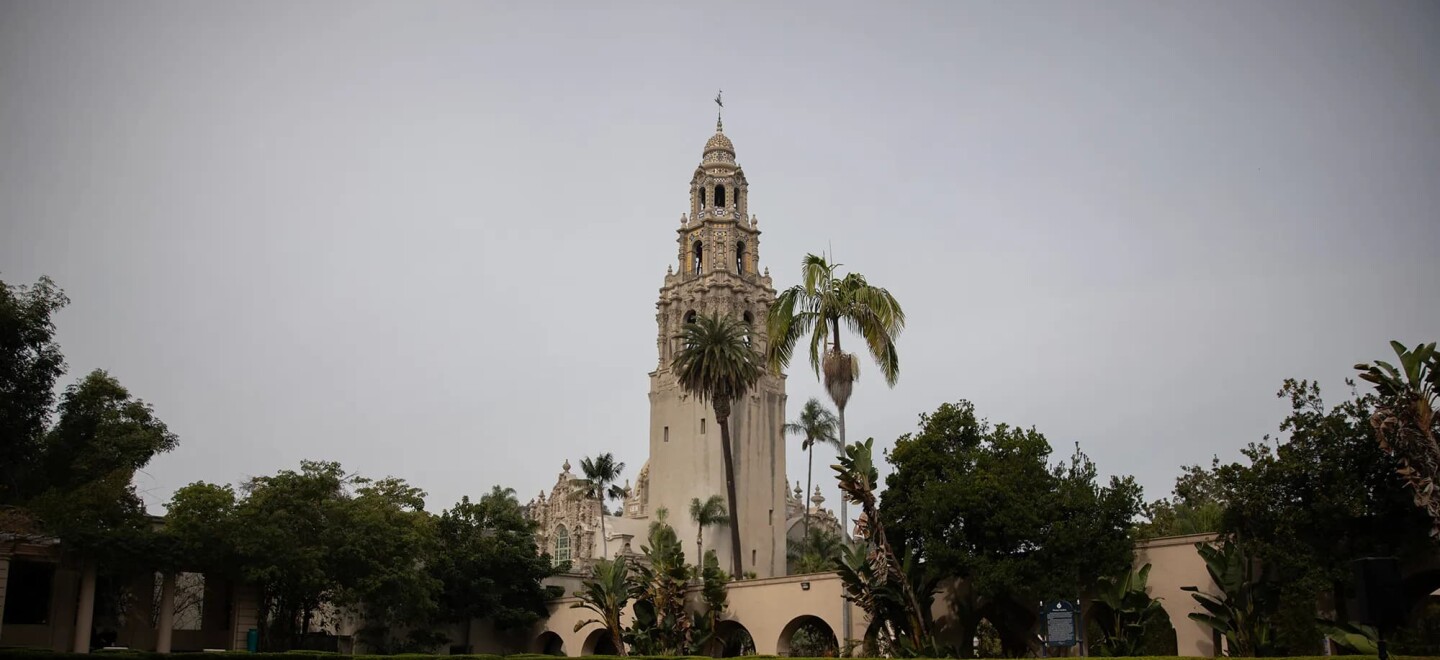
San Diego set aside 1,400 acres for Balboa Park in 1868, to create an urban space similar to New York’s Central Park, dedicated a decade earlier. In 1915, Balboa Park hosted the Panama-California Exposition, and its iconic Colonial Revival architecture took shape with sprawling plazas, Spanish arches, carved facades and Moorish tiles.
The park now hosts 17 art, science and history museums along with the San Diego Zoo. They range from the San Diego Natural History Museum with mastodon and megalodon skeletons and the San Diego Air & Space Museum featuring an Apollo command module and historic aircrafts, to the San Diego Museum of Art and the free Timken Museum of Art, showcasing European old masters.
Smaller venues such as the San Diego Model Railroad Museum and international cottages cater to specific hobbies or cultures, while performing arts groups, a bridge club and lawn bowling offer recreational activities.
It’s also a meeting place for thousands of San Diegans who walk, picnic or sightsee every day.
“I see people walking their dogs, pushing their babies and meeting up with friends for coffee,” Hanson York said.

The traditionally free parking has been a draw, Joyce Miller, a San Diego resident and volunteer with San Diego Police Department, said at the park Saturday.
“When we patrol here, everyone who talked to us said it’s the best place to go because the parking’s free,” Miller said. “It’s such a plus for us in San Diego and such a good tourist attraction.”
The park’s maintenance and operations are paid through the city of San Diego’s general fund, but Gloria wanted to create a direct funding stream. He originally proposed a plan that he estimated would bring in $11 million for the current fiscal year. The city council revised that upward to $15 million, then scaled back the timeline and fee structure, leading to a revenue estimate of $2.9 million this fiscal year.
'People are really mad'
Museum directors chafe at news that parking revenue won’t be added to the park’s budget - at least this year - but will backfill general fund expenditures, so the city can use that money for other purposes.
Parking meters cost $2.50 per hour and day rates range from $5 to $16. It’s less than commercial lots, which can cost upwards of $30 per day in San Diego. But for people who visit Balboa Park weekly or even daily, it’s excessive, critics complain. It adds insult to injury for people reeling from inflation, and for San Diego city residents it’s piled onto new trash fees and water rate hikes.
San Diego has regularly ranked among the most expensive housing markets in the country, and a recent analysis found that only 1.6% of San Diego homes are affordable for the typical household. Gas prices in California are about 50% higher than the rest of the country and San Diego prices as of Thursday were 20 cents higher still, at an average of $4.40 per gallon, according to AAA.
In San Diego city, voters narrowly approved a measure to charge homeowners for trash pickup, which was historically paid by the city. But the eventual cost - $43.60 - was at least 50% higher than earlier estimates of $23 to $29 per home. Meanwhile city residents can expect water rates to rise 14.7% next year and 14.5% in 2027.
In another source of contention, the council approved a tiered fee structure, with lower rates for San Diego city residents and full fees for everyone else, including people in other parts of San Diego County.
A group of mayors from other cities protested that Balboa Park is a regional resource.
“I’ve been to Balboa Park my entire life, and it’s a regional asset,” San Marcos Mayor Rebecca Jones said. “Parks should be free. The people that utilize parks the most are the people that really need them, people who live in multi-family housing.”

Visitors arriving at Balboa Park on Saturday fumed about the new fees.
“I despise it,” said Caden Mays, a kinesiology student at San Diego State University. “So many of the exhibits are free, it’s a shame to make parking cost.”
The chaotic roll-out of the parking fees only added to public animosity. Kidrick, of the Air & Space Museum, described the program as ill-conceived and “autocratic.”
“Somebody must have done an internship for six months with ACE parking,” he said.
San Diego city residents had trouble signing up for the local discount, and many visitors struggled with glitchy parking kiosks that gave confusing instructions, rejected credit cards or bounced users back to the start page as they tried to pay.
In retaliation, vandals defaced at least 10 pay stations by spraying foam sealant into card and coin slots, said Officer Terrell Totten, a spokesperson for San Diego Police Department. Those cost $400 each to repair.
In other incidents people smashed the pay station screens, spread green paint on them and smeared feces on one, he said.
“There has been a lot of controversy over paid parking at Balboa Park as of late, but that does not give individuals the right to destroy the meters,” he said in an email to CalMatters.
What’s next?
Frank said the city could get public buy-in on the fees, but only if it invests the money in park programs and access, such as public transit to the site.
“It seems highly reasonable to me that parking be charged, but there should be some accountability for the use of the money to make sure that it benefits the park and the public,” he said.

He acknowledges he’s in a minority. Neighbors have walked away from him when they hear that he agrees with charging for parking at Balboa Park.
“These people are really mad about it,” he said. “Really, really mad.”
To soften the blow for regular users, San Diego has offered yearly passes at $150 for city residents and $300 for other park visitors.
As of Monday, the city issued 2,405 passes, including 2,236 to city residents, said Rolland, the mayor’s spokesperson. Gloria also said he would review results of the parking fee program, and adjust as needed.
Peter Comiskey, Executive Director of the cultural partnership, urged Gloria to revise the parking program immediately, pointing to museum directors’ warnings that lackluster parking revenue and declining visitation create a downward spiral.
“That downward spiral could quickly become a death spiral, all over a few dollars in parking revenue,” Comiskey said. “As a region, as stewards of this historic cultural district, this cannot be allowed to happen.”
This article was originally published on CalMatters and was republished under the Creative Commons Attribution-NonCommercial-NoDerivatives license.


