
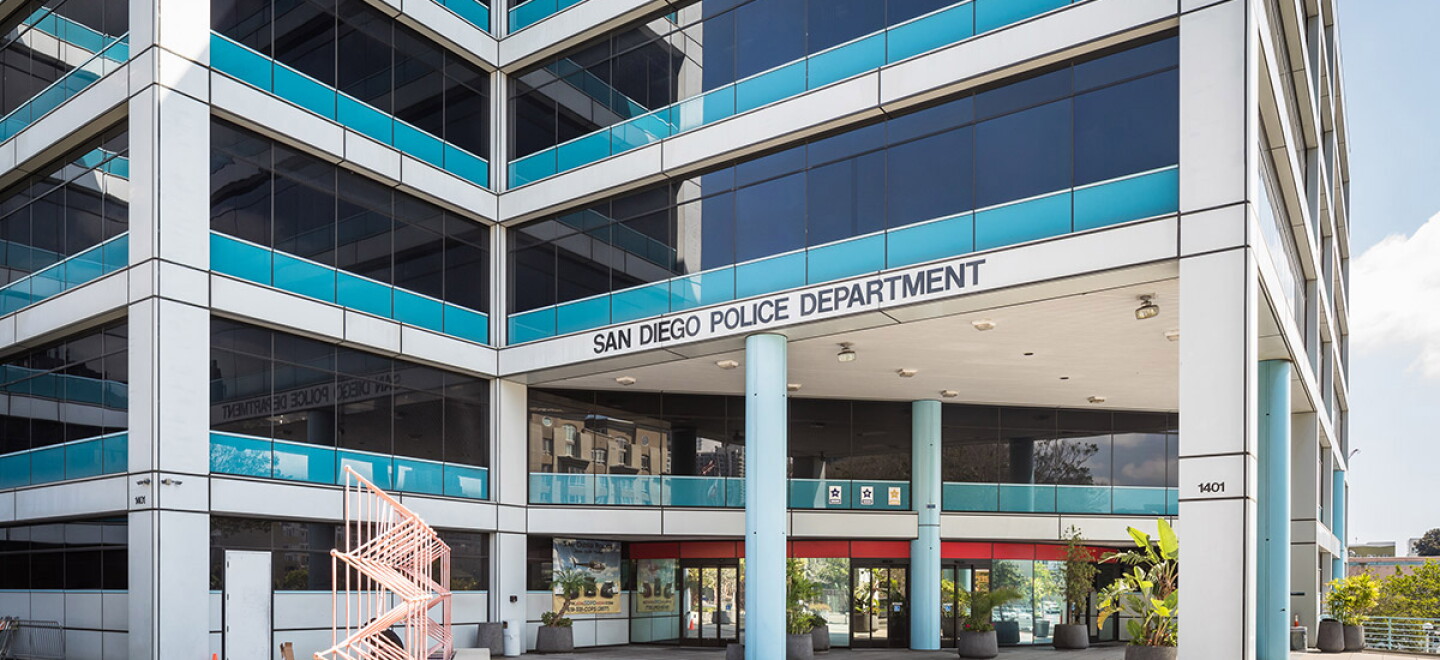

As the fight over whether to cancel San Diego’s contract with the controversial surveillance firm Flock heats up, records show that investigators with the San Diego Police Department used the technology to surveil officers.
Last year, Internal Affairs detectives used the license plate readers to surveil an officer they were investigating of misconduct. They also surveilled a victim of domestic violence with whom they suspected the officer had a sexual relationship.
It is not the only time SDPD has used the tech to surveil its own officers, a department spokesperson confirmed.
To watchdogs of the tech, those uses seem to violate the city’s policies about how Flock data can be used. They also think it further strengthens their case to rid the city of its sprawling network of automated license plate readers.
In the 2025 case, SDPD internal investigators began to suspect that one of their officers had engaged in misconduct. Colleagues reported they believed Officer Miguel Gonzalez had started a sexual relationship with a woman he’d met while responding to a domestic violence call.
“Officer Miguel Gonzalez began a romantic, sexual relationship with a domestic violence victim [redacted] went to her home while on duty, and had sexual intercourse with her on March 6, 2025. Prior to going to her house, Officer Gonzalez was dispatched to a call at a different location. Officer Gonzalez made the victim of that call wait 51 minutes before he arrived,” reads an internal investigation.
That investigation ultimately substantiated six allegations against Gonzalez relating to his conduct. They included that Gonzalez had taken the victim’s number from field interview notes, contacted her while on shift and had sex with her while a separate victim whose car was stolen waited for him to show up.
But as officers began investigating the allegations, they wanted to know if the domestic violence victim’s car and Gonzalez’s car were ever in the same spot. Luckily for them, they had an ideal tool: the city’s network of 500 Flock-enabled automated license plate readers. The cameras capture vehicle license plates, offering police a way to track the comings and goings of vehicles throughout San Diego.
In August 2025, the official investigating the allegations against Gonzalez turned to a fellow officer to pull up Flock data on the victim and Gonzalez’s personal cars. The search was conducted by Sergeant C. Evans, the then-supervisor of the department’s Real Time Operations Center, which specializes in the use of the city’s automated license plate readers. The search did not turn up evidence that the cars were near each other, possibly because the system only keeps footage for 30 days.
For Ted Womack Jr., the vice chair of San Diego’s Privacy Advisory Board, which oversees the city’s use of surveillance tech, the entire situation is troubling. To him, the department’s surveillance of the woman seems like a violation of San Diego’s use policy for Flock.
“That domestic violence victim was in no way in a circumstance or situation where they were some sort of suspect or subject of any kind of investigation where they would need to be surveilled,” Womack said. “This definitely sounds like a violation of the use policy. This isn’t the first time and I’m sure it won’t be the last that it’s not being used properly.”
On Thursday afternoon, Councilmember Raul Campillo also sounded off on the use. Campillo has long been a supporter of SDPD’s use of Flock cameras, but wrote that his support was not “unconditional.” This incident, he wrote, had pushed him to withdraw his support for the program.
“Learning that the Police Department used ALPRs inappropriately to surveil one of their own and a member of the public calls the entire program into question,” Campillo wrote. “I am demanding that the program be immediately suspended and an audit be conducted of its use within our Police Department to understand the extent which it has been misused.”
SDPD spokesperson Ashley Nicholes wrote in an email that both searching the victim’s license plate and Gonzalez’s were allowable by the department’s use policy and its procedures. The technology’s usage is governed by two separate documents – the department’s use policy and its procedures. The use policy allows the system to be accessed for “legitimate purposes,” whereas its procedures allow its use for “official investigations.”
“Those purposes are not limited to criminal matters,” Nicholes wrote. “The department’s position is that investigating specific allegations of officer misconduct also falls within those authorized uses.”
While the use policies do include those phrases, this use case isn’t specifically included as an example. Overall, the documents are pretty vague. They include a number of specific uses, like locating stolen vehicles or vehicles belonging to suspects, enhancing responses during public threats like shootings and safeguarding the lives of community members during missing persons cases.
But the documents also make clear that the department’s use of the technology is “not limited” solely to the listed cases. The documents, and other communication from SDPD, also don’t specifically state that the data was allowed to be used during internal investigations of officers.
And it wasn’t the only time the department had used its automated license plate network for internal investigations. In total, it’s used the program in internal investigations six times, according to Nicholes. Three of those searches returned no applicable information, two corroborated officers’ accounts of events and one substantiated misconduct. In that instance, an officer was disciplined.
“The Department is committed to thoroughly investigating allegations of officer misconduct, and that includes using available investigative tools such as ALPR when appropriate and consistent with policies,” she wrote.
Jared Wilson, the president of the San Diego Police Officers Association, the union that represents San Diego police, chose not to comment on the incident. But in a recent letter sent to city officials, the union lambasted the department’s use of Flock data in internal investigations, which it said was brought to their attention by members.
The union’s board wrote that it had not been informed that the technology would be used for internal investigations. Instead, board members believed it would only be used for “criminal investigations and public safety purposes.” This use had not been discussed in any meet-and-confer process the union had had with city officials, the board members wrote.
The letter demanded officials cease and desist using Flock for “non-criminal administrative investigations or other non-criminal administrative matters that could result in employee discipline,” and conduct a transparent audit of how it had already used the system. Board members also demanded that the city meet with them to discuss the system’s use for such purposes.
Nicholes rebutted some of the claims, writing that the union signed off on the technology’s usage in late 2023 – before the system had been activated. In any case, in an email sent to members following Campillo’s announcement, SDPOA’s board wrote that the city had agreed to its demands.
“We recognize that members will be understandably upset that this technology was used in this manner,” board members wrote. “The SDPOA supported Flock because of its value as a crime-fighting and public safety tool. We continue to support that purpose. However, using the system to monitor officers’ personal vehicles in non-criminal administrative investigations is an entirely different application, one that was never disclosed to us or negotiated with the association as required by law.”
The blow-up comes at a charged moment for Flock usage in San Diego. Over the past year, activists nationwide have mobilized a heavy opposition to the controversial surveillance technology. That opposition has been fueled by myriad examples of misuse in other cities, like cops using the technology to stalk romantic partners.
Some high-profile local cases have also inspired pushback. In one instance, an innocent San Diego man who was accused of having been involved in a drive-by shooting spent a month behind bars after being incorrectly identified as a suspect via Flock footage.
Fears that the data would be used to aid in immigration enforcement were also stoked by the revelation that SDPD had mistakenly allowed a slew of outside agencies, including Border Patrol and ICE, to conduct nearly 13,000 searches using its database.
The controversy has spurred some local politicians to change their stance on Flock. Last month, Councilmember Stephen Whitburn announced he was now opposed to the technology. Shortly afterward, a City Council committee advanced a plan to cancel San Diego’s contract with Flock and ban the use of automated license plate readers altogether.
But as it stood, the council only had five votes to cancel the contract, one short of the six required to override a veto, should Mayor Todd Gloria choose to use it. With Campillo’s defection, it appears they have their sixth vote.
Even the union that represents local police officers has begun to soften its pro-Flock stance. In an email sent to members after the committee vote, the board of the San Diego Police Officers Association wrote that it’s become increasingly difficult to defend use of the tech as the city struggles with budget constraints they feel have made it difficult to recruit and retain officers.
“Flock has done a poor job of defending its product locally and nationally from a public-relations perspective,” the email reads. “It has become apparent that continued use of Flock may no longer be politically sustainable in San Diego.”
Councilmember Sean Elo-Rivera has been on the frontlines of the fight against Flock. He said this latest potential misuse of data underscores the concerns many have had from the beginning.
“I think it is an excellent way of illustrating some of the risks that come with this technology being one of the tools that’s in the toolbox and the way in which the laws and rules that are meant to alleviate some of the concerns that people have are insufficient to prevent misuse,” Elo-Rivera said.
Beyond inadequate policies, Elo-Rivera also worries that, like with AI, the department’s access to these kinds of tools may lead to an overreliance on them.
“It’s a very powerful tool and can do a lot of stuff and if you aren’t really diligent with quality control and what kind of prompt you’re putting in, you can really screw things up. And if you just blindly trust it, you can find yourself getting lazy and using it in instances where you don’t really need to,” he said.
Flock, in fact, was not the tool used to actually bust the officer who was sleeping with a domestic violence survivor. While the department’s search of Flock data did not produce the results officers were looking for, a search of automatic vehicle location data did. That data compiles the location of officers’ vehicles at any given moment.
It showed Gonzalez’s police car was present at the victim’s house for 23 minutes the day he’d been accused of having sex with her while on duty.
During an interview with officers, Gonzalez admitted what he was doing there.
“Just in plain English, we had sex,” he told them.
Gonzalez is no longer with SDPD.


