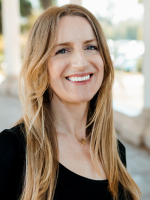
Kathryn Kanjo became director and CEO of the Museum of Contemporary Art San Diego — the first woman to hold the role — in 2016, just as the museum was entering a major transformation.
"Certainly the largest challenge, which in turn had the greatest reward, was the expansion," Kanjo said.
That expansion was a $105 million project that shuttered the La Jolla campus for five years. Kanjo said the period of closure was a roller coaster, spanning COVID-19.
"We were well into this thing when the pandemic hit, and we had to figure out how to move forward. At that time, I felt like if there had been — and of course there was — skepticism about the expansion, was it the right thing to do, and people in the community thinking, what are they doing to this site in La Jolla? If there was criticism or suspicion about it before, once we hit the pandemic, I felt the public's sentiment turn toward this kind of affirming, recognizing that this cultural institution was literally growing, and it was growing in a time that was so challenging and dark for our communities," Kanjo said.
While the since-closed downtown campus was still in operation during the early years of the pandemic, the museum's programming was limited. So when the La Jolla campus reopened, it felt monumental to Kanjo.
"To go from being so quiet, from not really having had a public presence for the years of construction, to then suddenly seeing the lines of people going down Prospect (Street) waiting to come in when we finally opened the building," Kanjo mused.

She also had a front-row seat to what she saw as an evolution in the San Diego art scene as a whole, one rooted in the universities.
"These are an incubator for new artists, and it's also a way to hold practicing artists by employing them," Kanjo said. "I've seen a shift in the faculty, particularly at UCSD, that you have folks like Amy Adler and Malik Gaines and Alexandro Segade, you know, really leading a very different kind of department than what I knew from decades prior. So I think that new, the energy that comes out of the campuses matters."
Kanjo also credits San Diego's artist-led spaces for reshaping the creative landscape here.
"I also have been just dazzled by the changes that have happened at Bread & Salt. Jim Brown is the architect, kind of mastermind behind it, Tom DeMello as the creative programmer. I mean, it aggregates, of course, many institutions, not just the one, but that's just been an amazing, I think, activation of a historical building — and creating kind of partnerships on their own terms," she said. "That's to me been really thrilling to see because I think it's homegrown. It's essentially artist-led, and it feels very San Diego and authentic."
Kanjo has been at the helm as MCASD discovered and advanced the career of emerging artists — and also as a community grieved the artists they lost. One example is the influential San Diego artist Robert Irwin, known for his "windows" installation, who died in 2023.

"Robert Irwin is this seminal, what we'd call, Light and Space artist who challenges what an artwork is — and sort of makes us realize it's about us tuning in and it's about perception," she said.
She said she remembers learning about Irwin as an art student, and then being able to work directly with him — both in San Diego and in other institutions she's worked at throughout her career.
Kanjo's work in San Diego stretches much further back than her decade of leadership as CEO.
"In fact, I had an early period of my career here in San Diego. I served as a curator in the early '90s, working under Hugh Davies," she said.
After that, she moved up in the art world as director of the UC Santa Barbara University Art Museum before returning to MCASD in 2010 as chief curator for Davies, and then deputy director of arts and programs.
Part of the lure in returning was the chance to work for an institution on the verge of transformation.
"(That) moment really in the organization's history really was on the brink of wanting to grow. The museum has existed since 1941, and it's had expansions over time. But at that moment, in the 2000s, we hadn't added gallery space since, I don't know, I think 1979. Yet the collection had grown. So you could see it was a moment where the museum was going to have some dramatic change," she said.

During Kanjo's leadership, the museum acquired a string of notable works of art, including pieces by Helen Frankenthaler, Mark Rothko, Yayoi Kusama, Maya Lin, Teresita Fernádez and more. And since reopening the La Jolla campus, major exhibitions like "Niki de Saint Phalle in the 1960s" and "For Dear Life: Art, Medicine, and Disability" attracted local and global attention.
Two exhibits she's particularly proud of happen to bookend her tenure at the museum: an exhibition of influential painter Jack Whitten in 2014, when she was deputy director, and the final special exhibit that recently closed, Yan Pei-Ming's monumental paintings, "A Burial in Shanghai."
"It was to the credit of this museum that we could attract an artist of that caliber, that we had the facility that could handle — that could literally exhibit a painting that's 16 feet by 25 feet," she said.
But she also remembered the meaningful interactions with the artist and his family as they installed the work.
"It felt very personal, you know, and we rolled and stretched the paintings — so it was physical as well," she said.
![Yan Pei-Ming, "Un enterrement à Shanghai (Montagne céleste, Ma mère, L’adieu) (A Burial in Shanghai ((Celestial Mountain, My Mother, The Farewell))" [detail] , 2019, will be on view at the Museum of Contemporary Art San Diego beginning April 17, 2025.](https://cdn.kpbs.org/dims4/default/c8c62fa/2147483647/strip/true/crop/1153x710+174+0/resize/1760x1084!/format/webp/quality/90/?url=http%3A%2F%2Fkpbs-brightspot.s3.us-west-2.amazonaws.com%2F8a%2F79%2Ffc21f0984eabbf5cd46c11cdeb40%2F2019-0000fnh-03598-tr315x668-03.jpg)
Another strong memory for Kanjo from the early part of her time at MCASD was artist Liza Lou's glass bead installation in the downtown space, which closed in 2024. The piece involved tiny glass beads threaded on wires installed on the ground, and the museum had volunteers work in the community alongside the artist.
"It felt intimate, like a quilting bee or something," she recalled. "We had folks sitting at tables on shifts building these pieces with Liza and having conversations — and then to see that process of work and time and intimacy translated into this rainbowlike carpet that was sort of unfurled on the floor of that downtown space was fantastic."
But for Kanjo, the idea of being a museum of — and for — a place and time hinged on the moment it reopened after construction.
"I had the great privilege of unfurling a collection that had been shaped over 50 years, not just by me, but by preceding directors and curators and donors. I was able to take these materials, and I think, make good sense of it — make sense of it that seemed true to this institution," Kanjo said.
The museum has begun a national search for a new CEO. Kanjo's next role is a return to academia as director of the UC Irvine Langson Orange County Museum of Art.