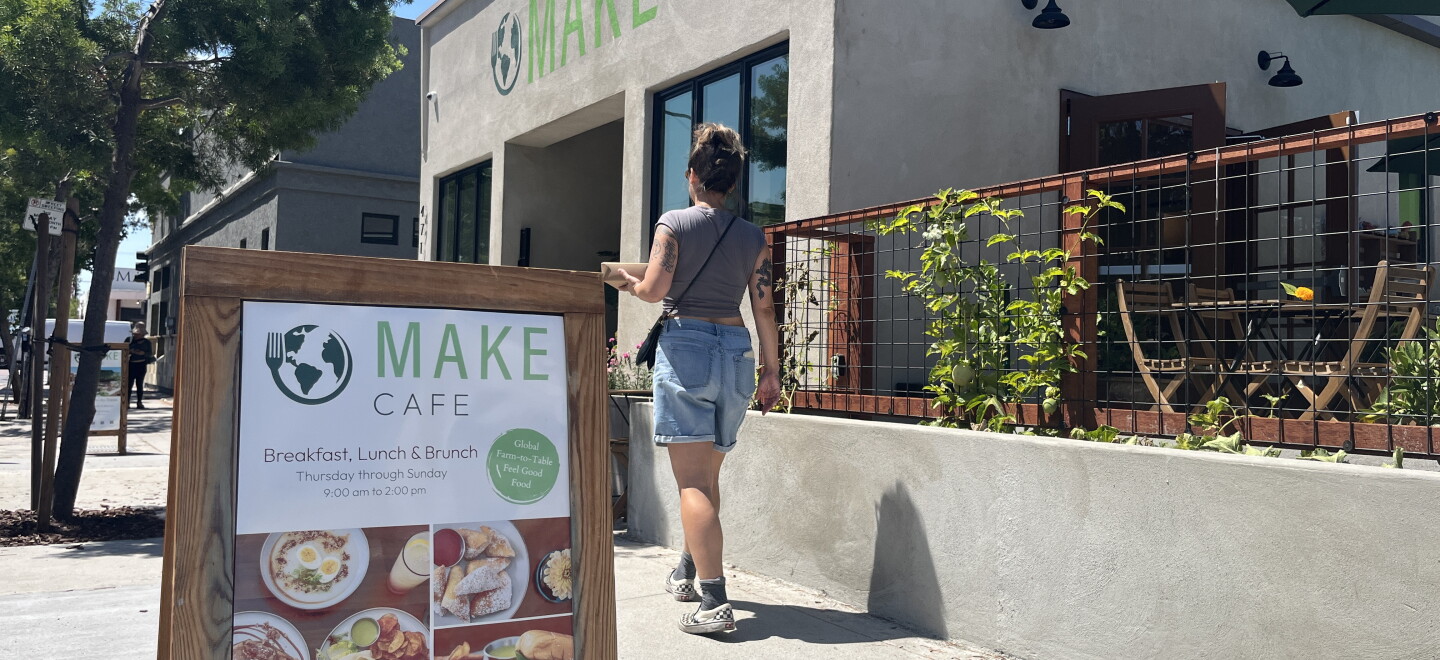
There are hundreds of cafes across San Diego, but a newly opened space in Normal Heights — Make Cafe — has a slightly different mission.
Groups of refugee and immigrant women rotate through the jobs that are needed to run a restaurant on-site. They learn job and life lessons in a new country through the farm-to-table business model.
“The cafe-restaurant solves the problem of ‘how do lower literacy, low income refugee and immigrant women get workforce development in San Diego,” said Make Projects executive director Anchi Mei. “It's so hard to attend an apprenticeship or training program, when you have kids or family responsibilities.”

She stood on a small slice of land under the trolley tracks near Snapdragon Stadium. There the earthy aroma of vegetables, herbs and other garden staples in the soil fills the air.
“Right now we've got the height of summer — eggplant, basil, tomatoes, cucumbers, and we're getting ready for fall,” Mei said.
This is the farm for Make Projects. It's where refugee and immigrant women begin the first month of a 12-week paid job readiness program with the organization.

They primarily work with students from San Diego Community College District’s College of Continuing Education.
“That has been the single greatest success is that we have that direct partnership with the (English Second Language) College. We're hoping to expand that, but for now we're more than busy with all the population of students there," Mei said.
Olha Fochshan is a program participant. She stood under the shade of a garden greenhouse at the farm on a hot summer day.
“Of course we are the farm so it's all about harvesting, planting, seeding, caring about the babies,” she said, talking about nearby sprouts.

She left her native Ukraine with her daughter about a year ago. Her husband is still there fighting as a soldier in Kyiv.
Here in San Diego, Fochshan said she’s found a Ukrainian community to bond with away from home.
She pointed out this program is teaching her the soft skills to thrive in the United States.
“When we start(ed) I would like to be like ‘okay I’m the best.’ I’m also more independent,” Fochshan said. “But when I started to work with other women I (saw) that okay we’re different, but what I can teach them and maybe what I can learn from them?”

Zahra Ahmed was once a participant, and now serves as a program assistant.
She came to San Diego from Sudan in 2020. She said the program helped her face fears that come with relocating to a new country.
“I know they have barriers to language. But if you have barriers to language too, that doesn't mean you're not going to achieve your goal,” Ahmed said.
Now she helps train other women who come from similar situations. She said they provide support in many ways, like case management.
“(If) she ha(s) any other problem in her life or issue, she can tell us and we're going to help her. It's not just about work,” Ahmed said.
Most of the food at the farm is sold in community supported agriculture, or CSA boxes.

But some of the food grown at the farm is used at the organization’s new permanent home just a few miles away in Normal Heights — Make Cafe. They officially opened in June.
“It’s world driven flavors, but also very comfortable. Salads, bowls, we have a congee on the menu,” said executive chef Ashley McBrady.
Congee, an Asian rice porridge, is an example of the cafe’s global approach to food that reflects their program’s diversity.

McBrady said the new location serves as both a public restaurant and hands-on training environment.
Make Projects previously operated a cafe at a temporary church site in North Park.
“We’re so fortunate to have such a beautiful space. The neighborhood has been really welcoming,” the chef said. “We’re on our group four in the cafe. And so seeing, meeting all these new people and having them train through — it's a fun and unique experience, absolutely.”
For now each group is made up of three participants. That means 36 participants go through the program in a year.

After spending four weeks at the farm, the women learn how to prepare and cook food in the kitchen for a month. Then they rotate to the front of the house as baristas and cashiers to finish out the program.
"Reading a recipe is the same functionality as any other job — it's about showing up, intentionality, communication and then just the drive," McBrady said.
66-year-old Maria Castillo was working in front of the house, making drinks in late August.
She was getting ready to graduate from the three-month program. Castillo said it offered a change of pace and greater financial flexibility for her future.

“I always worked as a babysitter and never worked in a program like this or with coworkers. Only by myself in people’s houses,” she said.
Castillo straddled two countries and two cultures living between Sonora, Mexico and San Diego County for decades.
Now firmly in San Diego, she hopes the skills she’s learning here might help her launch a new career. The program has given her the confidence to branch out on her own.
“I hope to have my own business — maybe a mobile truck or small dessert place, something. I see this in my future,” Castillo said.

The cafe is 25% self-funded and 75% funded through grants and donations, according to Mei. But she said they plan to become more self-reliant and increase their percentage of operating costs with time.
For now, it’s open Thursday through Sunday from 9 a.m. to 2 p.m, with Wednesdays designated as a training day for staff.
Make Cafe also hosts events in addition to catering, and plans to offer occasional evening service in the near future.