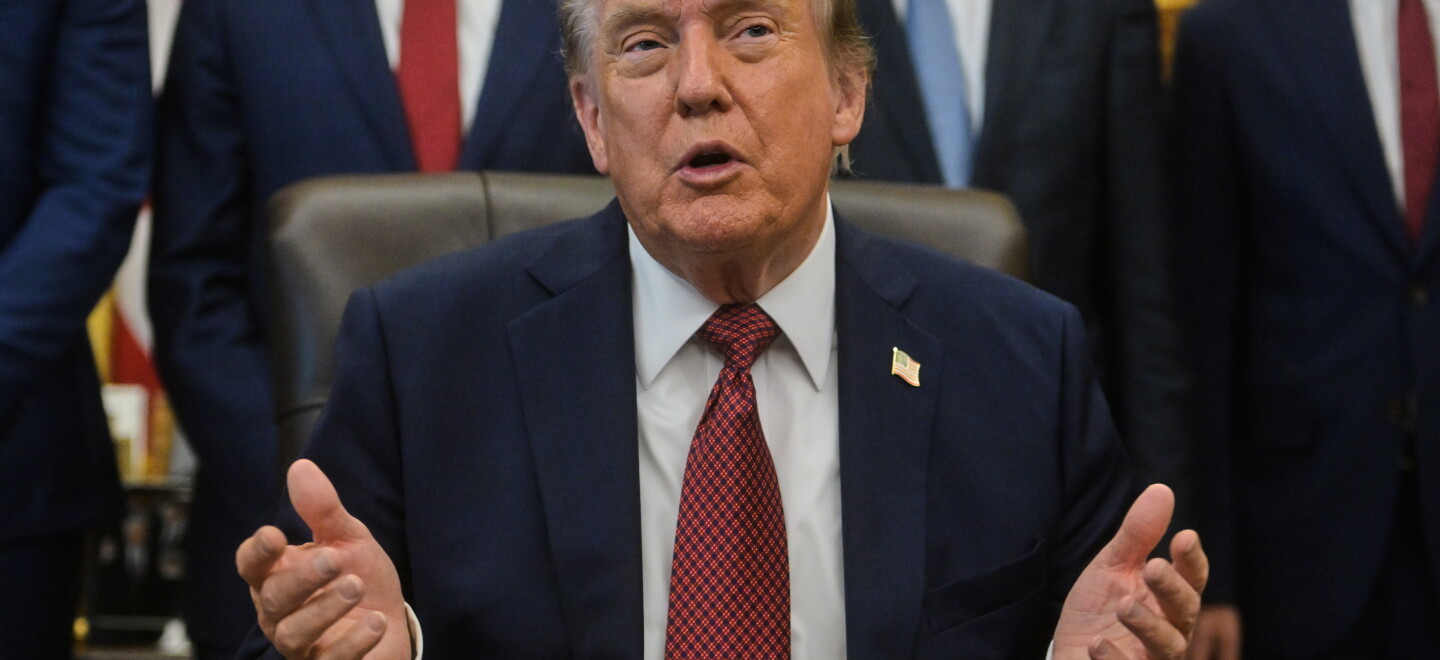
The first bill that President Donald Trump signed into law in his second term was a bi-partisan immigration bill. Called the Laken Riley Act, it was sold to the public as a way to protect Americans from dangerous criminals.
Now, more than 18 months after the law took effect, immigrants who’ve not been charged, let alone convicted of violent crimes are being held in immigration detention centers. And immigration judges are using the Laken Riley Act as justification for their detention.
The law was named after a Georgia college student who was murdered by an undocumented immigrant who had previously been arrested for theft. It requires mandatory detention for immigrants accused of certain crimes.
Have a tip? 📨
The Investigations Team at KPBS holds powerful people and institutions accountable. But we can’t do it alone — we depend on tips from the public to point us in the right direction. There are two ways to contact the I-Team.
For general tips, you can send an email to investigations@kpbs.org.
If you need more security, you can send anonymous tips or share documents via our secure Signal account at 619-594-8177.
To learn more about how we use Signal and other privacy protections, click here.
“The Department of Homeland Security will be required to detain all illegal aliens who have been arrested for theft, burglary, larceny, shoplifting, assaulting a police officer or any crime that results in death,” Trump declared when he signed the Laken Riley Act into law in January 2025.
Thirteen Democratic Senators and 46 Democrats in the House voted for the act, including San Diego Rep. Mike Levin.
Levin justified his vote by citing an increase in retail thefts in his North County district.
But civil rights organizations warned that the law would deny people their constitutional rights to due process protections because Laken Riley imposes mandatory detention before they have their day in court.
After his vote in 2025, Levin said in a statement he did not believe the law took away due process protections or targeted innocent immigrants.
“I fully understand concerns about protecting immigrant communities and ensuring constitutional rights,” Levin said. “However, the Riley Act does not take away due process or disproportionately target innocent immigrants. It also does not change legal rights for the accused or initiate deportations.
Now, more than a year-and-a-half since the bill was passed, immigration lawyers said that is exactly what’s happening.
“I thought it was absurd when I heard this was on the table and then I thought it was incredibly absurd when people voted for it,” said Carlos Barrios, a Los Angeles-based immigration lawyer.
Barrios represented a man who was arrested for receiving stolen property. A county judge dismissed his case in criminal court. But that didn’t matter in immigration court — where a judge pointed to Laken Riley as justification for keeping him locked up.
Even though Barrios eventually secured his client's release, the detention stint has had devastating consequences.
“This person was delayed and stuck in jail for a month-and-a-half,” Barrios said. “This person owns his own business, now he’s at risk of losing everything because he had to shut down the business. Bills had to be paid. They’re backed up on their mortgage payments and everything else. It creates a major impact.”
According to data from U.S. Immigration and Customs Enforcement, there are currently more than 65,000 people in immigration detention. More than 70% of them do not have criminal convictions.
Immigration lawyers told KPBS that the Laken Riley Act mostly applies to undocumented immigrants who entered the country legally but have since lost their status — like someone whose visa expired.
That’s because other Trump policies impose mandatory detention on immigrants who entered illegally.
The federal government does not publicly provide records that would document how many people are impacted by the law. But individual cases show its impact.
In San Diego, Noah Montague, who is accredited by the Department of Justice to represent people in immigration court, represented a man who was never even arrested for a crime.
“When he was picked up by ICE, the narrative that ICE wrote said that he basically resisted arrest and that resulted in an assault of a police officer,” Montague said.
No arrest, no charge, no conviction. Just the words of a federal officer. Yet, the judge invoked Laken Riley, according to court documents.
“The only context that this came up in is a report by an ICE officer that’s actually unsigned,” Montague added.
Barrios said immigration judges tend to put too much weight on accusations of police reports - which creates problems in the context of the Laken Riley Act.
In criminal court, defense lawyers get the opportunity to question the officer who wrote the report and a judge decides whether that report is credible evidence.
“You can’t convict someone just because some officer out there in God-knows-where wrote a report,” Barrios said. “But in immigration court, the judges tend to give police reports a tremendous amount of value.”
Montague described the Laken Riley Act as just one piece of Trump’s mass deportation machine. Others include courthouse arrests, travel bans, third-country deportations, and aggressive immigration enforcement raids.
All with the ultimate goal of making life so difficult for immigrants that they will self deport.
Levin’s office declined multiple interview requests by KPBS.
In a statement to KPBS, Levin said he cast his vote with the expectation that the law would be implemented consistent with the constitution and the rule of law. He also acknowledged that an arrest is not a finding of guilt and should not be allowed to become a shortcut around due process.
“I was clear when I first voted for the Laken Riley Act that it was not the bill I would have written,” he said. “Public safety issues in my district are real, and I believed then, as I believe now, that Congress has a responsibility to address them. But I cast that vote with the expectation that the law would be implemented consistent with the Constitution, the rule of law, and the due process protections every person in this country is entitled to.”
But the text of the law he voted for specifically requires DHS to detain immigrants after an arrest.
Since voting for that law, Levin has become an outspoken critic of Trump’s deportation agenda. He’s voted to withhold funding for ICE, demanded more transparency from detention centers, and advocated for families of deported constituents.
- Newsom signs bill revoking charity tax break for Imperial County ICE detention center
- After Trump ends protected status, San Diego’s Haitian community is struggling to adapt
- California lawmakers revoke charity tax breaks for Imperial County ICE detention center
- Last year they cut librarian jobs. Now the Grossmont Union High School Board is adding millions to the athletics budget