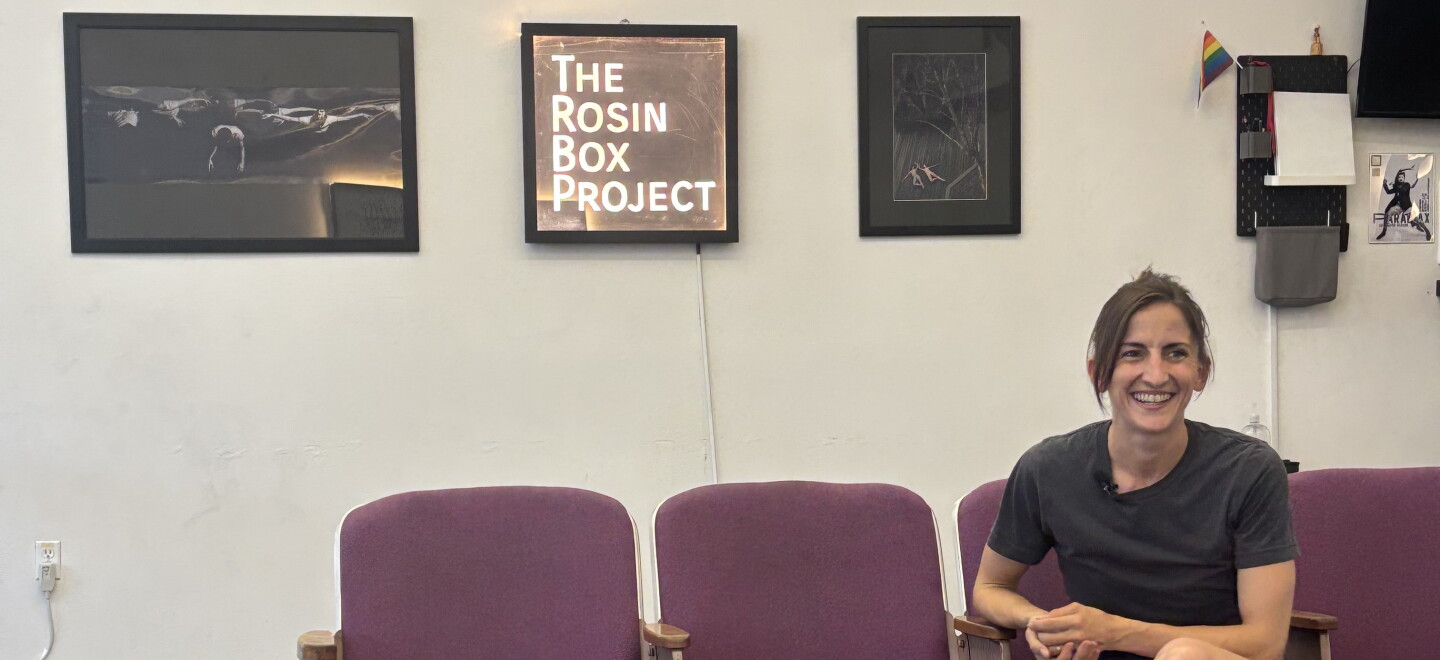
Most ballet audiences watch dancers from their seats, without interacting with them. The Rosin Box Project, a contemporary ballet company, challenges that tradition with its annual production, “Ghost Light Masquerade.”
Carly Topazio is the company’s founder and the choreographer behind the show.
“There's all these different vignettes that have to do with theater superstitions and a lot of mischief,” Topazio said. “A lot of playful encounters. It's spooky but not scary.”
One of those superstitions involves a ghost light. A ghost light is a single lamp left onstage when a theater is dark, allowing staff to move around safely. Some believe it keeps spirits away. Topazio put her own spin on it.
“In our version, the ghost light actually draws spirits and goes closer to the light,” Topazio said.

She recalled a possible supernatural encounter during rehearsals for the show’s first production in 2020.
Topazio said they were practicing at the Tenth Avenue Arts Center in San Diego’s East Village neighborhood; a venue some believe is haunted. One night, she and other dancers heard noises on the floors above them. A colleague went to investigate, initially thinking a janitor was there.
“Once we wrapped that week, he actually shared that he had never found anyone,” Topazio said. “He heard footsteps that just continued to go up the stairs, and there was no one there.”
Bethany Green is a founding member of The Rosin Box Project. “It can be a lot of fun to kind of test the waters with the personalities of our guests each night and, in fact, I think that brings a lot of people back for a second show because it's always different,” Green said.
Audience members are required to wear masks in one of two colors: one signals that they’re open to interacting with the dancers, while the other indicates they prefer to just watch.

Topazio said one vignette, “Chairs,” plays on the superstition that theaters should always have a seat saved for the theater ghost. “We normally invite an audience member to sit down, and there are three dancers in this particular piece,” Topazio said. “So they spook them away, and then by the end, there is a reserved sign and it says that you need to save this seat for us, essentially.”
Green said the masks make people feel less nervous when the dancers interact with them. “I also think that having a costume piece or a prop in common with the performers really lets the audience settle into their role as not audience, as not spectators,” Green said. “So we are all part of the performance; we're all part of the storytelling.”
Many ballet dancers practice something called pantomime, using gestures and facial expressions to convey a story. Green said dancers have to get creative when performing behind masks and moving between multiple vignettes. “So you have to be really careful about your intent and your gaze and where you are steering the guests, because the context is everything,” Green said.

And you don’t have to be a ballet fan to join in.
“A lot of our guests enjoy coming in full Halloween costumes, and I think it really is just a party,” Green said. “So if you're nervous that maybe ballet isn't for you, I think a costume party probably is.”
The Rosin Box Project’s “Ghost Light Masquerade” runs on select dates through Oct. 30 at The Nocturne Theatre.