
Pediatric heart transplants face a major obstacle — a shortage of child donors.
Surgeons often have to use adult hearts, which are much larger. To help ensure they fit within a child’s chest cavity, doctors at Rady Children’s Hospital are using emerging technology.
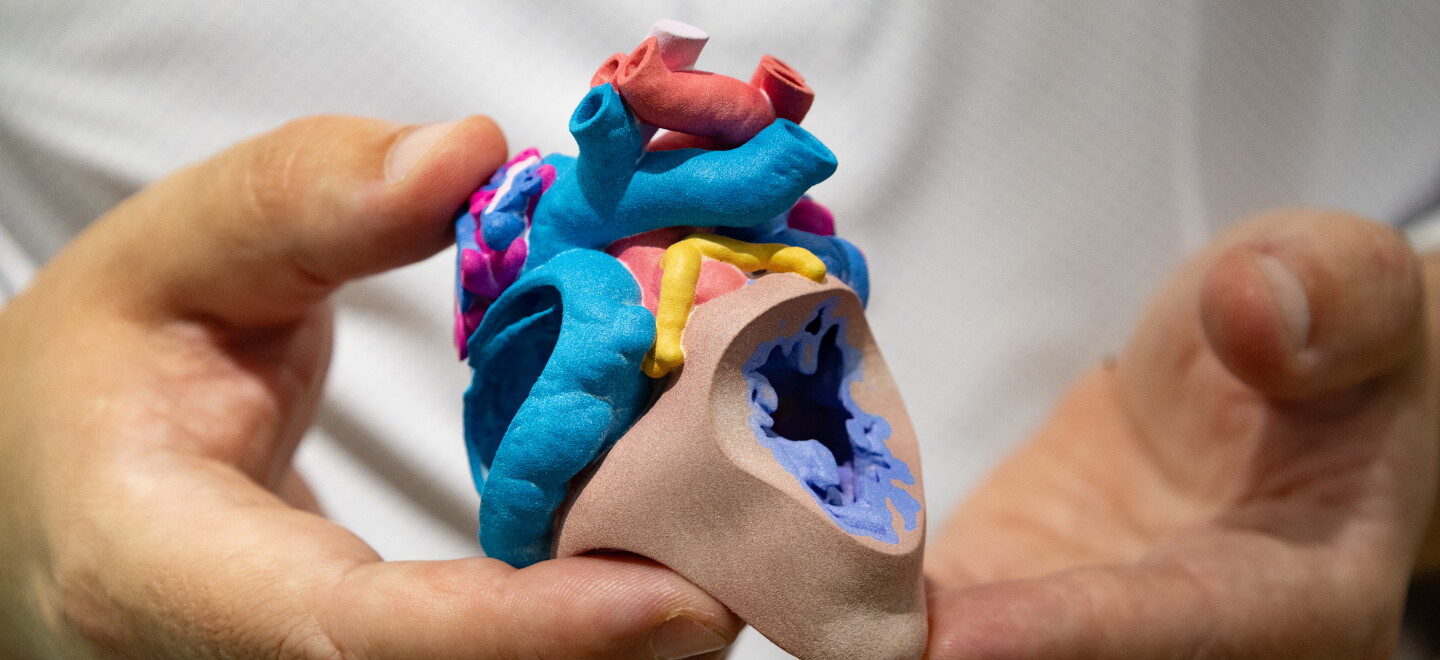
Engineers at the hospital's Webster Foundation 3D Innovation Lab use 3D computational modeling, custom software and 3D printing to create physical models and virtual simulations of both the child's heart and the transplant heart. Surgeons can test the fit and plan the procedure before surgery ever begins.
3D printing was first applied to healthcare in the 1980s. In 1999, the Wake Forest Institute created the first 3D-printed organ. Despite technological breakthroughs, 3D modeling in medicine is still uncommon.

Director and Research Scientist Justin Ryan joined Rady Children’s Hospital in 2018 to found the 3D Innovation Lab. The lab is the first of its kind in Southern California and has helped over 3,200 cases to date and 3D printed nearly 800 patient models, Ryan said.
From CT scan to 3D modeling
“We can make 3D models (computational and 3D print) from either CT or MRI. Most of ours are from CT as there is better spatial resolution from that modality,” Ryan said.
In computational models, a doctor can see all anatomical angles of the organ. Simulated surgeries can be done using virtual reality to test processes before the real thing. These mock surgeries allow doctors to navigate a difficult surgery virtually, before they make the first cut on their tiny patients.

Doctors can then bring the screens into the surgery to better view the 3D scan during a procedure, which is much more detailed than an X-ray.
3D models can also be printed to help doctors determine where to operate and can be cross-compared with "developmentally typical" organs. The doctors can easily cut into a model to perform a trial surgery on it to solve complex operations ahead of the procedure.
“We have shorter surgeries because surgeons are better informed, a better targeted procedure, so patients are under anesthesia for less time," Ryan said.
Yet, he said hospitals having 3D printing and modeling capabilities is still rare. This is partially because insurance companies typically don't pay for this service and hospitals have to find alternative funding streams.
Educational purposes
“We use the models primarily for surgical planning, but then there is the opportunity to reuse them afterward for education. We also use them for not just education for medical students, but education for families.” Ryan said.
Rady Children's surgeons can use a 3D model to show patients and family members what the surgery would do. Ryan shared that this has been a helpful tool on more than one occasion when there was a language barrier and a translator could not be located.
Sharing 3D models with patients also helps destigmatize surgery by making the procedure easier to understand and visualize. Ryan said families love them.
The lab works to solve a number of problems. Engineer Anna Hedberg’s recent work includes printing a large order of custom trays for fentanyl syringes, experimenting with materials in spinal models and printing throats.
“We've made throat simulators, like neck simulators to practice tracheotomies. We supplied 20 neck simulators to a med school conference,” she said.


The lab of five innovation engineers range in specialties from CAD engineering to video game technology, virtual reality and animation. They run five 3D printers. The printers range in cost from $2,000 to $4,000, plus one specialized printer that can print FDA-approved sterilized models, which costs around $100,000.
While 3D-printed prosthetics are a developing field, at Rady Children's 3D Innovation Lab, it's not a current focus.
“A lot of our materials that we print either aren't biocompatible and or aren't sterilizable. We generally print reference models right now,” Hedberg said.
Ryan said the San Diego lab is one of the most prolific centers of 3D printing in medicine in the United States.


