Long before thousands gathered for San Diego Pride each summer, local activists were building the movement from the ground up.
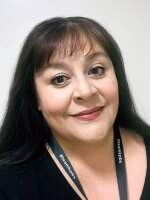
T.J. Tallie, a board member of the Lambda Archives of San Diego sat down with KPBS anchor Debbie Cruz to talk about the history of San Diego Pride.
This interview has been edited for brevity and clarity.
When people think of San Diego Pride today, they picture a large celebration with a parade and floats. Can you tell us what those very first Pride events actually looked like?
Tallie: We think of a slick corporate Pride or one that feels all-encompassing, but San Diego Pride's journey is a lot more complicated than that. First, it grew out of grassroots movements in the late 1960s and early ‘70s.
We see a chapter of the Gay Liberation Front starting here at San Diego State University in 1970. The first unofficial Pride took place in 1974, and one reason why it's understood as the unofficial Pride is that it's nonpermitted. There's a movement where people decide to march from newly emergent Hillcrest to Balboa Park, but they can't march in the street since they don't have permits.
So, there are people marching on the sidewalks, and the summer of 1975 is when we have the first official, permitted city-allowing parade. The origins are a little bit rough and tumble. They are also directly out of community growth.
Like a lot of places in the country in the late '60s and early ‘70s, there's a sense of a shared momentum of wanting to make space in the body politic in the public — that's really about this guerrilla movement that then becomes slowly but surely established by 1975.
How did organizers actually pull Pride together before it became Pride officially?
Tallie: It was community to community. There were meetings in homes — just like what became the center itself, which originally began life on B Street as the Center for Social Services. But before that, it was a drop-in with a phone number so that people who were queer-identified could not feel alone. One of the ways to think about this is a DIY local community space in the early '70s.
It's word of mouth, and it comes from a lot of simultaneous liberation and organizing movements. People in feminist movements, or racial civil rights movements, or economic equity movements, are seeing this as a shared struggle and as a comparable movement to really claim this space.
They'll be organizing parties, or they'll meet at people's homes clandestinely, and then begin what they call sit-ins — or actually, what they called gay-ins. They would have gay-ins in public spaces, and you'd have a few of these throughout the early 1970s — being gay in public!
You'd have gay-ins in Balboa Park, and the 1974 Pride really grows out of that. It's just a big gay-in, and that becomes a moment of saying, “We are here, and we belong here.”
What were some of the things early organizers were advocating for?
Tallie: One of them was an end to outright police harassment. Some of the things that came out of this in the 1970s were police stings or raids. Then, most notoriously, in the early 1970s, there was a raid in Mission Valley at a restroom where men had been engaging in cruising. This was, of course, illegal.
Not only were the men arrested, but their names were published in the paper along with their addresses. This was a huge, not only violation of privacy, but also one that left them targeted. There was not only a protest against this punitive and very specific discriminatory policing, but also for spaces to gather. Also, against discrimination in housing.
At this period, it could affect your ability to find a decent place to live if people knew that you were not heterosexual. So, the freedom to gather, the freedom to be yourself and not have that affect your employment, the freedom from being heavily policed, and access to housing. These were all fundamental rights that people were searching for.
In 1990, it was decided that Pride would be moved from June to July. Can you talk about why this was such a transformative year for San Diego Pride?
Tallie: As a historian, one of my favorite things to think about is these junction points. Pride 1990 is an essential year for us to understand how Pride went from this scrappy organization to parts of what it is today. There are so many nexuses that I want to think about.
First, 1990 is the last year that San Diego Pride was held in June. It's June 9 and 10. The biggest reason that we talk about why it changed is that there was a torrential downpour that year. So, we're still safely within the San Diego rain belt in May and June, and the June gloom turned furious that year. There was intense rain all throughout that Friday and Saturday that let out only an hour before the parade began. We had about 13,000 attendees that year, which is a good number given how rained out it nearly was.
But the organizers saw, and they looked around, and they said: "There are multiple reasons why we perhaps should push this back.” One being, we will be safely out of the rain possibility, and the bedraggled rain nature of the 1990 Pride really sort of stood as to why they moved to July.
Another reason being also, comparably, there was a proliferation of Pride events, almost jokingly, a victim of their own success. Cities throughout the state were having Prides: San Francisco Bay Area, Los Angeles, Long Beach, and other places — and they were all in June. That meant a lot of competition in the same space. In 1990, Long Beach moves to May, and San Diego really saw this as a moment. “Why don't we move to July? It'll be drier, and it'll also give us a space to really make it our own.” That's one reason why July has been our month.
But one thing I love about 1990 as a snapshot is that it is a fundamentally interesting way to understand Pride's transformation. Just the board for Pride, first off in that year after Christine Kehoe had, at her urging, added two members of color to the organizing group, which had never been there before. It was also the first year in which San Diego's Grand Marshals for Pride were two queer Black people, Cynthia Lawrence-Wallace and Fundi.
Cynthia Lawrence-Wallace was a long-time Black lesbian activist and advocate and a member of the San Diego Gay Women's Chorus. She was one of the Blood Sisters working to raise blood for people struggling with HIV/AIDS.
Fundi was a writer and a poet and a philosopher who was one of the main organizers of a group called LAGADU, which is Lesbians and Gays of African Descent United, which was a really important Black LGBT organization in the early '90s. I find 1990 to be this fascinating year in which we see a parade struggling with what its identity is. We're 15 years into being established; how do we fit ourselves into a larger narrative? But also, how do we respond to a community arguing that we should have greater inclusion of different voices within San Diego? And so we see LAGADU, we see GLASS, which was Gay, Lesbian, Asian, and Pacific Islander Social Space organization led by James Mitsuo Cua, and there were the Natives of the Four Directions. We have a lot of groups of color really advocating and saying, “We also share pride.”
What I love about 1990 is that it’s a moment in which the organizers of Pride tried to begin to respond to that. You see the community push in thinking about a new direction for Pride.
Can you tell me more about the impact that people of color have had on the local movement?
Tallie: One of the things that I love is that Pride, in many ways, has been critiqued for being commercial or for being universalizing. But one of the things in San Diego, historically, is that people of color have continuously and consistently argued that they are part of the fabric of Pride. They are part of this experience. Their queerness is also part of their lived reality.
Especially in the early 1990s, we had organizers organizing on a variety of topics, from HIV/AIDS to battling racial policing to housing. But they say these are all queer issues because we are all multiple people with multiple lives. So, groups like LAGADU or GLASS, as well as plenty of Latinx groups, all made these specific claims about “How do we belong?”
In 1991, Marti Mackey, a Black lesbian activist, writer and campaigner, was designated Pride's Woman of the Year. She gave this amazing speech where she was a little halting and a little confused that she was given the award. And she said, "But I appreciate that you see that I fight and I want to keep fighting for you and for this broader community.”
What I also see is that Pride has not always felt like a space for communities of color. Historically, what we've also seen is the emergence of complementary Pride. So, in the late '90s and early 2000s, there was Ebony Pride, which was a separate Black queer organization that wanted to say, "We don't feel necessarily immediately seen by Pride. We're not trying to leave Pride, but we want to emphasize that we have something special to offer.”
And so, in the late '90s and I think 2000 to like 2005, is when this organization was really prominent. We have today San Diego Black Pride as well, which sees itself as an addition and a response to Pride. Also, centering the voices of Black San Diegans and their queer lives. We see this also with Latinx Prides that have happened, too.
What should community members and businesses keep in mind as we celebrate Pride?
Tallie: One of the things that I think is extraordinarily important about Pride is that it grows out of community. Pride, I think, at this moment, 50 years after San Diego Pride first started, feels like such an institutional and established thing. But it only exists because community members advocated, pushed and challenged.
I think that Pride needs to be something that we not only find joy in and celebrate, but we need to be attuned to the fact that it is a community-based movement. Therefore, it should always be open to critique, response and recalibration — just like in that 1990 moment where we take a look in the rain and the wind and say, “Maybe we can do things differently.”
Two, Pride is a living organizational movement that needs constant input and response to the world around us. I think in this current political moment, Pride is extraordinarily important to remind us that we are all connected in community and that we have something real to offer each other.
T.J., thank you so much for joining me, and enjoy San Diego Pride!
Tallie: I know I will, thank you so much!
KPBS Podcasts Live: The Art of Protest
- Add to Google Calendar
- Add to Outlook Calendar
Download ICS file