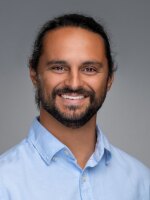
On Aug. 24, Tambra Sanders-Kirk got a call from a random 619 number. She ignored it, thinking it was spam.
But when the caller left a voicemail, Sanders-Kirk instantly recognized the voice of Hagop Chirinian, her boyfriend of 18 years. He was in trouble.
“He said, ‘I got picked up by (Immigration and Customs Enforcement) ICE, I need to talk to you, answer the phone when I call,’” she said. “So, I called the number back to see if it was really the ICE number. And it was. I waited and waited by the phone all night. He didn’t call back until the next day.”
Sanders-Kirk spent that night worried and confused. Wondering how an early-morning surf trip near Oceanside could end in ICE detention.
The next morning, she got some answers.
Chirinian and his friends got to the beach early that morning, before the sun was up. They set up a tent near the shore and waited for their friends to arrive.
But it turned out that they’d unwittingly wandered about 100 yards into Camp Pendleton.
“The military police pulled up in their Jeep with their lights on and told us we are on a military base,” Chirinian recalled. “They issued us trespassing tickets.”
Military police also asked everyone whether they were United States citizens. When Chirinian told them he was not a citizen, they called ICE.
When ICE agents arrived, Chirinian tried to explain to them that he was already enrolled in a supervision program with ICE. He has spent the last two decades going to regular check-ins with ICE agents. They know exactly where he lives and works.
The ICE agents at Camp Pendleton didn’t seem to care, Chirinian said in an interview with KPBS earlier this month.
“He goes, ‘I know you’ve been reporting for 20 years, I know you reported three weeks ago, I’m still going to take you in,’” Chirinian said.
Four months later, he’s still being held at the Otay Mesa Detention Center.
Record number of immigrants detained
There are currently more than 68,000 people in ICE detention centers nationwide, which is an all-time record according to federal data. Most of them, like Chirinian, spent the Christmas holiday separated from their friends and family.
KPBS spoke with Sanders-Kirk from her home in San Bernardino and to Chirinian from inside the Otay Mesa Detention Center.
They both expressed frustration at the fact the Chirinian has not been scheduled for a court appearance or been offered a bond hearing.
“ICE did not talk to me for the first two months,” Chirinian said. “Nobody came and said a word to me.”
That lack of information left him feeling totally powerless, Sanders-Kirk said.
“He started getting really depressed at that point,” she said. “He has no court hearing, he’s just sitting there doing nothing. There’s no resolution in the future.”
ICE did not immediately respond to a request for comment.
The family has spent hundreds of dollars on Chirinian’s detention — funding everything from food to phone calls, Sanders-Kirk said.
“He had $500 when he first got there,” she said. “That’s all gone obviously. For the phone calls, it’s between $10 and $20 a week.”
The role of private companies was another source of frustration for the couple.
“To me, it’s all about money,” Chirinian said. “They make money for each of us being here every day. It seems like they just keep people here as long as they can just to make money.”
According to a 2024 ICE budget overview, it costs taxpayers approximately $217 per day to keep someone detained in the San Diego “area of operations,” which includes San Diego and Imperial counties.
Chirinian has spent more than 120 days in detention, costing taxpayers roughly $26,040 to keep him separated from family and friends.
A substantial amount of that money goes to CoreCivic, the Tennessee-based private prison company that owns the Otay Mesa Detention Center.
“It’s ridiculous,” Sanders-Kirk said. “They’re holding him for whatever reason and it’s costing everybody — every taxpayer money to hold him there.”
Detained for the holidays
Chirinian came to the U.S. from Lebanon more than 50 years ago. He was a legal permanent resident until 2005, when he lost his status because of a felony drug conviction.
Chirinian said ICE tried to deport him in 2005. But the Lebanese government could not produce a passport, birth certificate or other travel documents, he said. Records reviewed by KPBS showed he was placed in a supervision program that allowed him to stay and work in the U.S.
Chirinian said he has checked in with ICE agents every year for the last 20 years. He has a work permit, pays taxes and hasn’t gotten in any more trouble with the law, according to Sanders-Kirk.
“He’s done everything they’ve asked,” she said. “And there’s thousands of people that are doing everything asked of them.”
Chirinian is among the 26% of people in ICE custody who have criminal convictions. Nearly half don’t have any criminal history, according to federal data.
The family has been unable to find an immigration lawyer willing to represent Chirinian pro bono.
Relatives have written letters of support, asking an immigration judge to release Chirinian from the privately-owned detention center.
In one letter, Sanders-Kirk’s daughter described Chirinian as “family.”
“For many years, he has helped care for my sisters, one of whom is disabled,” she wrote. “He drove her to school and back, waited with her through doctor’s appointments, cheered from the sidelines at her marching band performances, and showed up for her in every small but meaningful way that makes a child feel safe and supported.”
Given that ICE could not deport him to Lebanon 20 years ago, his family fears that he will either be held indefinitely or be deported to a third country, which the Trump administration is now doing with immigrants as part of its efforts to meet the president’s mass deportation goals.
Sanders-Kirk wasn't able to see Chirinian on Christmas, which was last Thursday. That’s because the Otay Mesa Detention Center only allows visitations on Sundays. And only for one hour.