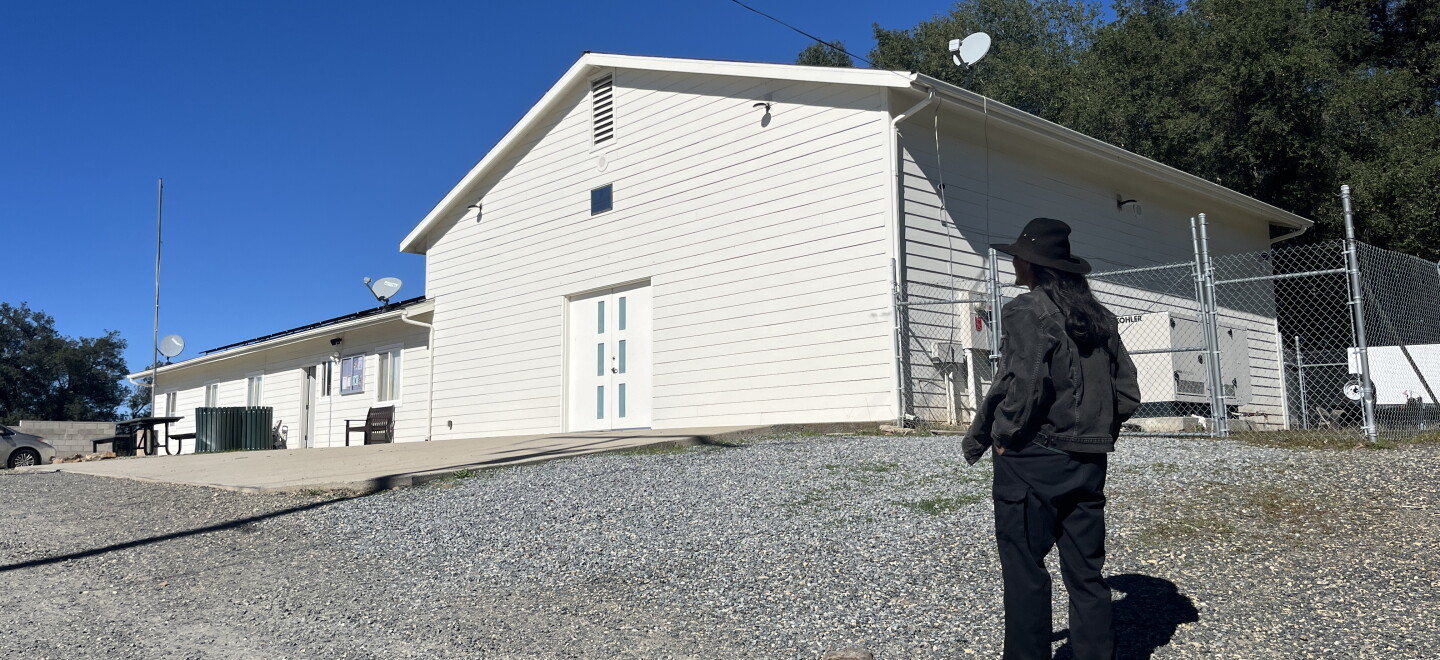
Well beyond the sprawl of San Diego County suburbia, rocky canyons carve through rolling green hills with oaks trees.
There, tucked around pockets of private land and national forest is the Mesa Grande Reservation, home to the Mesa Grande Band of Diegueño Mission Indians.
“So you head to Julian, but turn left,” said tribal Chairman Curtis LaChusa. “About five miles outside of Julian, you go towards Lake Henshaw and you'll see the signs for Mesa Grande.”

LaChusa spoke to KPBS in front of photos of their tribal members from the past 150 years, inside the reservation’s Tekamuk administration building.
He said the band recently completed its first public clean energy installation there: solar and battery systems now fully power three of the tribe’s primary administration buildings.
Each of them is spread out across the reservation. The other two sites are called the Hallyeyaaw and Golden Eagle administration buildings.
“It was a long time coming to get this specific type of energy — to be clean — and to bring us closer to that net zero,” LaChusa said.

LaChusa said grid electricity only reached the reservation around the mid-20th century, and a few homes still lack grid connections.
While many of the 60 or so homes on the reservation do have their own forms of solar power, the main administrative buildings never did until the recent installations.
LaChusa said the community experiences outages several times per year, sometimes for days at a time. Backup generators were often not reliable.
He said the new solar energy system has changed how resilient the reservation is in times of crisis.
“If power goes out now, we won't notice. It'll keep going just as it is. Everything is running. We have all the communications. All the computers are working. All the services are up, all the people are here,” LaChusa said. “And we use propane for cooking. So we are able to provide kitchen services, food, a place to be able to charge your phone to make contact with your family.”

The tribe partnered with the Solar Electric Light Fund. It received about $200,000 in private donations by the William, Jeff and Jennifer Gross Family Foundation and other funders to make the project possible.
Bob Freling, the organization’s executive director, said they employed four tribal members for the solar and battery system installations.
“The systems we installed were designed to help reduce electricity costs and carbon emissions. We're displacing about 18 metric tons of carbon emissions per year. The tribe is saving close to $17,000 a year on electricity bills,” Freling said.
Both Freling and LaChusa said they are interested in converting the reservation’s water pump to solar power as well in the future.

The new solar and battery storage project is the first of several changes in a new era for the Mesa Grande Reservation.
“There was no opportunity on the reservation at all. So in order to survive, that generation told the kids at the time, if you can get out … then do that,” LaChusa said.
He said the tribe is undertaking a long-term effort to change that narrative of generations past.

Now they are planning to build dozens, or even hundreds of new housing units and infrastructure that would allow more members to return back home.
As new homes are built and members start to move back in the coming years, LaChusa hopes the diaspora of their tribe “become reconnected with the earth again and with their relatives and with their beliefs.”
The Mesa Grande Indian Housing Authority received over $12 million in funding through California’s Tribal Homekey program in late 2025 to build the first 12 units, designed for those at risk of homelessness.
The reservation is currently home to about 130 of the tribe’s 800 enrolled citizens.