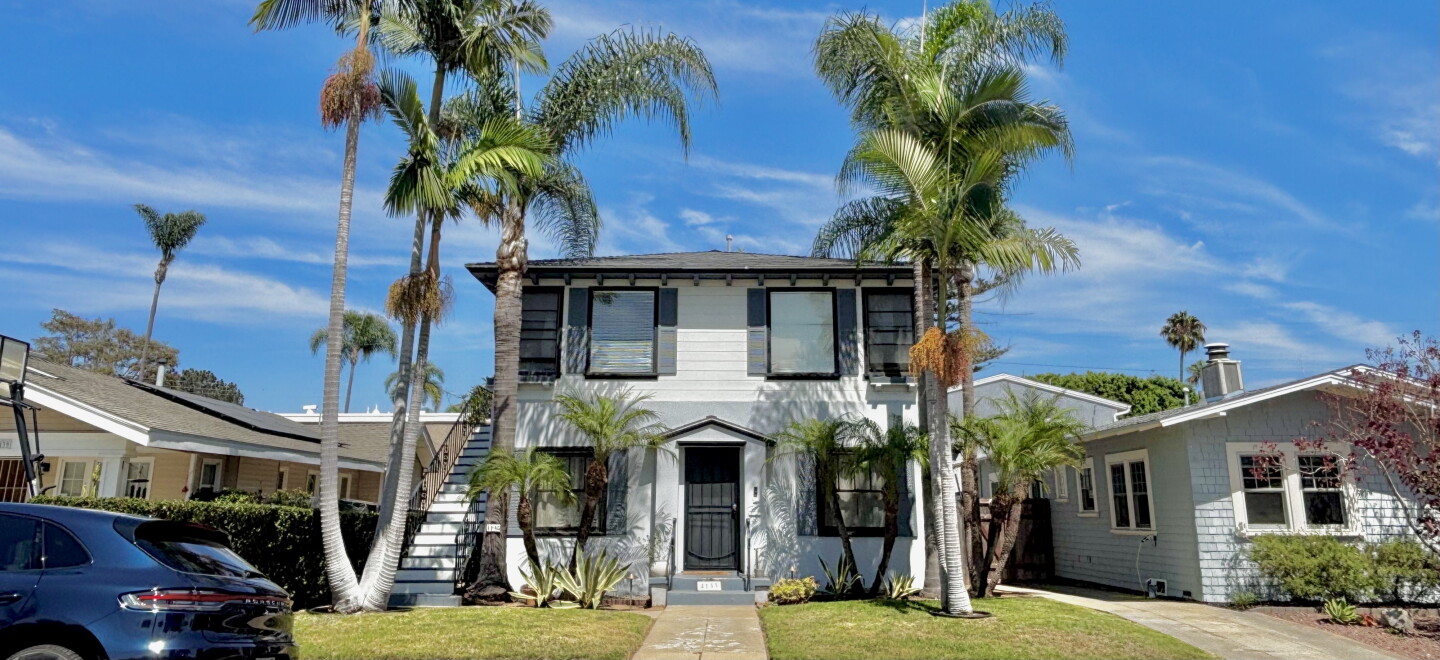
At first glance, San Diego's Mission Hills neighborhood looks like a suburb in the middle of the city. But look closer and you'll see a lot more than just single-family homes.
Scattered amongst the quiet streets and houses with big yards are a number of duplexes, granny flats and small apartment buildings. Most were built a century ago, when the neighborhood was served by the city's electric streetcar network.
"They really add up to providing a lot of housing in a small space, which makes it a much better neighborhood than something that's sprawled out all over the place," said Mike Stepner, a resident of Mission Hills and retiree who worked in the San Diego City Planning Department for 27 years.
Until recently, much of the neighborhood's small-scale multifamily housing would have been illegal to build. That's because in the 1960s, 70s and 80s, San Diego downzoned huge swaths of its urban core, effectively banning apartments in some of the city's most walkable neighborhoods.
Downzoning is a city planning term that describes when a government changes a neighborhood's land use regulations to allow for less housing. The practice took off in San Diego after 1967 — the year the city adopted its first general plan.

Leaders at the time said the general plan would combat urban sprawl and encourage more compact development. In reality, the plan kicked off decades of downzoning that dramatically reduced the city's ability to grow.
Neighborhoods that were downzoned include Mission Hills, Middletown, Hillcrest, North Park, Midway, Clairemont, College Area, La Jolla and Pacific Beach.
San Diego City Planning Director Heidi VonBlum said the era of downzoning was a fateful mistake that pushed growth further into the suburbs, lengthening commute times and blocking the construction of lower-cost housing options.
"When you have lower density, the price of housing is inherently higher," VonBlum said. "The higher the density, the more affordable the housing can be. And so if it were not but for the downzoning, we'd probably be in a very different situation than we are today in terms of housing affordability."
San Diego's first zoning ordinance was adopted in 1923. Stepner said early zoning was fairly simple and permissive. He recalls a colleague carrying around a roughly 30-page booklet that contained all the regulations for the city's four distinct zones.

Today, the city has dozens of zones spanning hundreds of pages in the Land Development Code. Stepner said the city began to use zoning to try and solve every minute neighborhood issue. He often found the regulations excessive — sometimes even absurd.
"I remember a discussion about whether a yogurt shop is the same as an ice cream shop," Stepner said. "What the hell difference is it? It makes no difference!"
While downzoning was sometimes used to protect San Diego's canyons and preserve open space, news coverage at the time suggests it was more often motivated by a desire among incumbent homeowners to preserve "community character."
That phrase can be used as a dog whistle, said Richard Rothstein, a historian and author of the book The Color of Law: A Forgotten History of How Our Government Segregated America. As courts and lawmakers began to outlaw explicitly racist housing discrimination, zoning emerged as a more subtle tool to segregate neighborhoods by race and class.

"Preserving community character is a code word for keeping out non-white people," Rothstein said. "You can't prove it just by the phrase 'community character,' but frequently when you go into the … city council meetings where this is being debated, people do make racially explicit comments that explain what 'community character' means."
VonBlum said as the city works to reverse decades of downzoning and allow higher density housing near jobs and public transit, it is also working to include populations that were historically excluded from planning processes.

"We may hear from decades ago the community wanted no change, no additional housing, they wanted large lot sizes," VonBlum said. "We may not have heard from the workers that were working in the community, that were commuting in for an hour and really would love the opportunity to live on a smaller lot size, in a smaller house."
While San Diego has been reversing some of the downzoning from the last century, it has not made significant changes to the city's single-family neighborhoods. But that could change later this year, as Mayor Todd Gloria prepares an initiative to allow more townhomes and smaller lot sizes throughout the city.
When announcing the "Neighborhood Homes For All of Us" initiative last December, Gloria said its goal was to create a wider range of housing options for people of all income levels.
"We must create more opportunities for residents who are stuck between the rising cost of single-family homes and the limited options in today's market," Gloria said. "'Neighborhood Homes For All of Us' gives us a chance to do just that."