It was a tough case. A man had been forced to flee his native Russia because he had provided humanitarian aid to Ukraine, which made him an enemy of the state.
But due to the Trump administration's crackdown on asylum-seekers at the border, the man had landed in the Otay Mesa Detention Center.
He needed help. And he got it — from a group of law school students at the University of San Diego (USD).
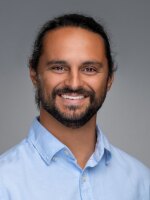
“The fact that I was able to help get him out and get him released on bond is just really, really wonderful,” said Amber Rahim, a third-year law student at USD School of Law and an intern at the school’s Immigration Clinic.
During her two years interning at the clinic, Rahim has, in addition to this case, helped clients become U.S. citizens, apply for a green cards, secure visas and even fight deportations.
She’s part of a growing number of students who view immigration law as a way to fight back against the Trump administration’s mass deportation campaign. And the clinic helps them get hands-on experience before passing the bar exam.
For Rahim, the work is personal. Her parents are immigrants.
“Growing up, I just watched their journey of coming here,” she said. “I went to my dad’s citizenship ceremony.”
Have a tip? 📨
The Investigations Team at KPBS holds powerful people and institutions accountable. But we can’t do it alone — we depend on tips from the public to point us in the right direction. There are two ways to contact the I-Team.
For general tips, you can send an email to investigations@kpbs.org.
If you need more security, you can send anonymous tips or share documents via our secure Signal account at 619-594-8177.
To learn more about how we use Signal and other privacy protections, click here.
The clinic is run by Tammy Lin, a San Diego-based immigration lawyer with decades of experience.
“I was brought in specifically because students wanted to do asylum cases. They wanted to be in court. They wanted to go to detention,” Lin said.
When Lin was in law school in the early 2000s, immigration law wasn’t a popular specialty. The stereotype was that immigration lawyers were more administrators than litigators, spending most of their time filling out paperwork.
But that’s changed during the second Trump term. Law school students are seeing viral videos of federal immigration agents arresting people based on their appearance or forcing their way into homes without a warrant.
Records from U.S. Immigration and Customs Enforcement (ICE) show approximately 70% of the people detained at the detention center in Otay Mesa do not have a criminal record.
As a result, more law school students now view immigration law as a way to make a difference in their communities.
“They’re looking at immigration practitioners as really much the front line of protection of constitutional rights,” she said.
And the Trump administration’s enforcement surge over the past year has further exacerbated an ongoing shortage of immigration lawyers.
The number of people held in immigration custody across the country has nearly doubled since Trump took — from about 40,000 people detained during the Biden administration to about 70,000 today.
Federal data also show more than half of people with pending cases in immigration court do not have legal representation.
“I think the market for them right now is very bright in that there’s just so much need and there’s just not enough attorneys,” Lin said.
Last year, the clinic opened 60 new cases. And interns dedicated thousands of hours to help San Diego’s immigrant families, according to USD.
Difficult work
Lin acknowledges that practicing immigration law can be emotionally draining and heavy caseloads lead to burnout. The USD clinic offers students a chance to find out if immigration law is really for them.
Lin also cites examples of students who decide against full-time immigration work but still plan on to taking pro bono immigration cases on the side.
Logan Quessenberry went into law school thinking he’d be a public defense attorney, but now sees immigration law as his calling.
“I felt this semester, more so than ever, the resolve to continue helping people in the community,” he said. “That’s what we’re here to do. We help people.”
Quessenberry, who grew up in San Diego, says he sees the impact of Trump’s campaign every time he visits the Otay Mesa Detention Center.
“We have such a vibrant community from all over the world that I just had no clue about until I went to the clinic,” he said.
Francesca Nevil, who graduated from USD last year, now works at the clinic as a staff attorney.
It primarily serves low-income San Diegans. But anyone is welcome to call in for a screening. Nevil has worked with a lot of different people who have one thing in common — fear.
“I think our community is really afraid right now,” she said.
Nevil said one of the central challenges to practicing immigration law right now is how quickly it changes. The administration, for example, has threatened to terminate legal humanitarian parole programs like “temporary protected status.”
Then there are court rulings, like the one from a federal judge in Minnesota, who ruled that ICE agents likely engaged in unconstitutional practices, including racial profiling.
Immigration laws rarely offer undocumented immigrants a simple solution to adjusting their status and sometimes, there are no options. Still, Nevil said, it helps to arm people with knowledge.
“I do think that the power of education and sharing resources is really impactful and that gives folk the opportunity to make the decisions that are right for their families,” she said.
- Newsom signs bill revoking charity tax break for Imperial County ICE detention center
- After Trump ends protected status, San Diego’s Haitian community is struggling to adapt
- California lawmakers revoke charity tax breaks for Imperial County ICE detention center
- Immigrants are losing due process rights because of Laken Riley Act, lawyers say