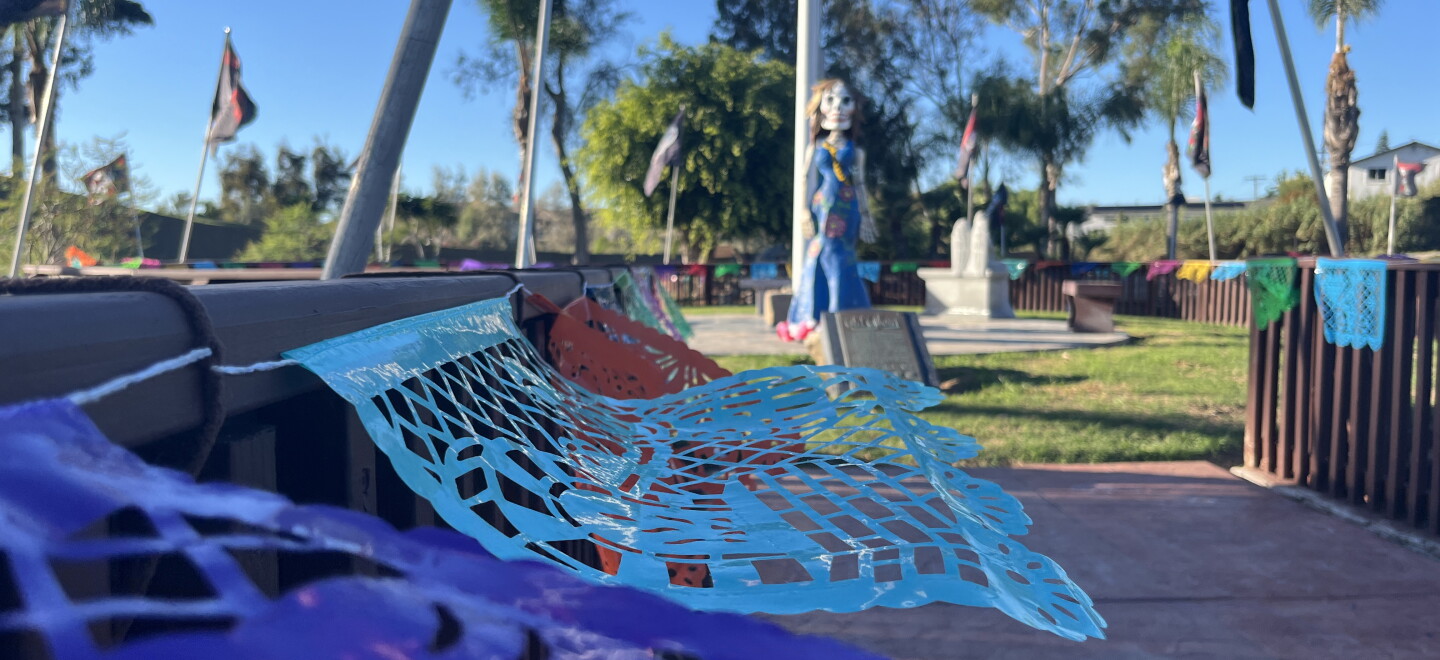
Colorful marigolds and decorative cut-paper banners called "papel picado," skulls and skeletons and the early stages of altars dot La Vista Memorial Park’s rolling grassy hills and gravesites.
The scent of those marigold flowers, called cempasúchil, is what many people believe helps the spirits of the dead find their way back home.
In the coming days, many of those spirits are expected to return to this cemetery in San Diego’s Lincoln Acres neighborhood for the celebration of Día de los Muertos.
It's part of an annual tradition that began at the site nearly 20 years ago.

“It started with my dad’s passing. And he's laid to rest in Tecate, Baja California. But when I came and integrated here at La Vista I thought ‘woah, I don't have his headstone here, but what I can do is have an altar for him,’” said Luisa McCarthy.
She’s co-owner of La Vista Memorial Park and Mortuary.
McCarthy is originally from Mexico City, one of the major urban areas known for its celebrations of Día de los Muertos. It’s a holiday with ancient Mesoamerican and Aztec roots.
She said Día de los Muertos takes place Nov. 1 and Nov. 2, with many families beginning preparations days or even weeks earlier. She encouraged people of all backgrounds to take part.

“These are the three stages of life — your youth, when you grow old and death. So that way it's not scary,” McCarthy said, gesturing to her family altar. “It's a tradition of love where we remember our loved ones with their personal mementos, we play their music, we serve them the food they liked.”
McCarthy said long before Disney and Pixar helped popularize the holiday with its iconic “Coco” film in 2017, she offered a more traditional Mexican celebration of the holiday — north of the border.
At La Vista cemetery, families have been planning their altars and will soon gather in the cemetery during the day and at night during the first two days of November.

At night it's believed the border between the physical and spirit worlds cross over, and the souls of the dead return to eat, drink, and enjoy music with loved ones.
“The cemetery lights up by its own personal light that the families bring, which is really what it's all about,” McCarthy said. “It's about decorating your resting place, building your own personal altar in your resting place and bringing food, like potluck style, and sharing it with your neighbor. This is where you'll get to know the neighbors in the afterlife, not just right now.”
Angela Riggs is a mother of a family who takes part in the custom. They celebrate her son Leo, who died when he was just 26 days old.
“In 2013 we lost our son unexpectedly to Sudden Infant Death Syndrome. As you can imagine, it was devastating and tragic, completely unexpected,” Riggs said at the cemetery.

She said when Leo passed away there was nothing physical for her to do anymore. Since his death her family has built an altar at La Vista, year after year, as a means of keeping an ongoing physical connection.
Despite being half Mexican, she didn't grow up practicing the tradition.
“Being able to build an altar — to put it together, to make the seven levels that represent the ascension, to put the salt that represents the taste of what their spirits would flavor their food with, and water to quench his thirst, and the candles, and the marigolds, and the beautiful smell of copal — it was such a therapeutic way for me to continue to do something as his mother,” Riggs said.

Racquel Galicia is the matriarch of another family that takes part in the celebration at the cemetery.
“For us, the meaning of the Day of the Dead is an offering of love,” she said in Spanish.
She was born in the greater central Mexico region and raised in Tijuana during her youth. She said the festivities at La Vista aren't quite like those south of the border, but they're about as close as it gets in the U.S.
Galicia always brings food to share. That includes pan de muerto, or bread of the dead.
The sweet bread is packed with spices and symbolism — many renditions including dough that’s shaped like a cross representing human bones.
To them it's not just a custom tied to faith, it’s a way they make a living.
“My husband and my grandson are here in this cemetery,” she said in Spanish. “My husband was one of those people who — like all immigrants — arrived here with no money or anything else. However, he had the intention of starting a business, and 30 years ago, he launched Sammy’s Mexican bakery.”

Another participant is Thomas Gallardo. He lost his father last year.
Just a few months after his passing, he and his family built an altar for the first time at the cemetery.
They went big and won an altar competition during last year’s event at La Vista. He said it’s helped the grieving process.
“It’s a beautiful thing to be able to move past things — to be able to come here without spending the whole time crying, you know,” he said in Spanish. “You just let go, and that’s that. Their time here has passed; they’re in another place now — a much, much better one.”

McCarthy said their celebration has changed in size and scope over time, but the essence of what they offer hasn’t strayed.
She will be there Nov. 1 overseeing the celebration and competitions dressed from head to toe as an elegant skeleton — a Catrina. It’s a costume reminding us that in death we are all equal in the end.
“We don't want it to become another Cinco de Mayo,” she said. “It's a tradition, a sacred tradition of Día de los Muertos to remember your loved ones. You drink, but you bring them the drink. And you can share the drink with your families, whoever is around that headstone.”

McCarthy said anyone can build an altar at La Vista as long as participants sign up ahead of time. The public is welcome to come visit and explore.
The official cash-prize altar and Catrina contests take place during the afternoon on Nov. 1 — the day designated for the souls of children. Nov. 2 is when the souls of adults are honored.
She expects a couple thousand people to be there on the Nov. 1 celebrations that last into the night. That includes the park’s families, the greater community and the souls of loved ones, who can stay until midnight in the cemetery reunited together — if only for a brief moment in time.