On a recent afternoon, hordes of curious visitors traversed the La Jolla Tide Pools.
Laura Simonato meanders around the shallow algae-filled basins in her rainboots. While most people visiting the tide pools on this day may be unsure what types of creatures they'll encounter, Simonato came here with a purpose.
She’s searching for sea slugs.

Luckily, her friends already spotted a few.
“A Sea Hare… a Hunchback, all over there, and then a Price is right there,” Simonato’s friend tells her as she arrives on the scene.

The crew pointed their flashlights into the water, illuminating what appeared to be a glob of goo. But as one of the tidepoolers dunked an underwater camera into the entanglement of seaweed, a tiny animal fills the screen.
They often spend hours crouching in odd positions and kneeling on foam pads in hopes of snapping a photo of the colorful creatures also known as nudibranchs.
It started out as a niche interest for Simonato. But now, much of her life revolves around the hobby.
“Tidepooling is very addicting,” she said. “ Once you start and you want to see everything that everyone else sees, you want to see things that people have never seen before.”
She belongs to a group known as the “nudi-nerds.” They are dedicated to finding as many sea slugs as possible. But their quest extends far beyond spying cool critters. Tidepoolers who share their photos online can help shape science.
“We want to help scientists in whatever way we can, whether people are working on it now or we'll work on it in the future,” said Simonato, who is a cell therapy scientist. “We want to help show whether certain species are disappearing or appearing from certain areas.”
San Diego is a hotspot for nudibranchs. There are more than 3,000 known species. But Simonato and her friends aren’t hunching over wet rocks for the average garden slug. Nudibranchs look more like aliens.
“They have a bunch of cool little quirks. They're super colorful. They can have a bunch of appendages,” Simonato said.
The slugs are incredibly diverse. Some are pink and shaggy, others are yellow with bunny ear-like sensors called rhinophores. And some even have polka dots.
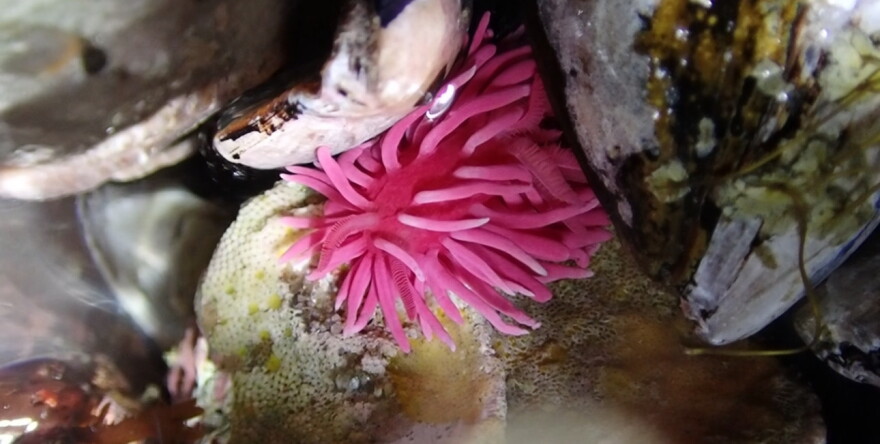


“Every color you can think of, I can probably find you a slug,” Simonato said.
Nudibranchs live in tide pools, on manmade structures like docks, and out in the open water. They feed on specific prey, ranging from algae and invertebrates called bryozoan, to coral and jellyfish-like creatures called hydroids.
Nudibranchs rely on many different types of marine organisms to fuel their specialized diets. Their presence signals a healthy and thriving ecosystem. California is exceptionally diverse.
“We have over 140 of them, ranging from tiny little millimeter long slugs to hand sized ones or even bigger ones,” said Simonato.
Four years ago, she began peering into tide pools. Some of the slugs she would look for were no bigger than a fingernail. But her underwater camera’s high quality lens magnified the creatures. The gear allowed her to capture nudibranchs’ flare in startling detail.
“I feel like a lot of people can relate to them because they can see their eyes on a lot of the species, and their mouths, so they look like they have little mustaches,” she said.
Simonato has gone to great lengths to snap new photos. She's traveled to other countries including Wales and Mexico to find new nudibranchs. Her trips are centered around visiting tide pools and snorkeling for slugs. She and her friends often scour new territories for eight hours a day only stopping to eat, hydrate, and reapply sunscreen.
“We’ll do that for days on end until we are basically exhausted or we run out of (time off),” she said.
She has even woken up at 3 a.m. to search for nudibranchs.
“A lot of people will do earlier or will just not go to bed at all,” she said. “That has happened. I need my sleep, but some of my friends don’t. ”
In recent years, social media has thrust the animals into the limelight. Tidepoolers’ high quality photos have spawned a group of sea slug influencers.
Simonato gained a following after she created a poster that helps track personal finds.

“It's a way to collect nudibranchs without taking any real nudibranchs home,” she said. It’s a black and white poster that comes with colorful stickers and for each species you see, you can add a little sticker and the poster gets more colorful. “
She calls it the Tidaldex. Her Southern California version has 143 different species that sea slug sleuths can identify.
When she launched the poster in 2023, Simonato only sold a handful to friends. But as the hobby boomed, so did her sales.
“I've sold over 230 of them now,” she said.
Nudibranchs are more than colorful curiosities. Their rainbow of hues often contain toxins — a warning sign to predators not to eat them.
Those chemicals have the potential to be turned into medicines, said Terry Gosliner, senior curator of invertebrate zoology at the California Academy of Sciences.
“Nudibranchs are just one of the examples of organisms that really have huge potential to benefit our society,” he said.
Gosliner discovered nearly half of the known species of sea slugs. He’s one of a handful of researchers who specialize in nudibranchs.
Nudi-nerds who share their finds on a biodiversity tracking platform called iNaturalist have already added to scientific understanding of the species, he said.
“Many of the species that weren't previously discovered have been found by ordinary people with a discerning eye. And they brought them to the attention of scientists,” he said.
Tidepoolers’ photos create a database that is invaluable to scientists like Gosliner. It not only helps him discover new species, but also identify how El Niño is changing ecosystems in real time.
“We are seeing those warm water shifts of distributions (of nudibranchs), and it’s because ordinary people are documenting those things and providing the evidence,” he said.

Simonato has already seen different species appear on local docks. Recently, she plopped down onto her stomach and hung her head over the side of a dock in Mission Bay. After combing through a spaghetti-like bryozoan, she found a teeny camouflaged slug called a Gland Dorid.
“It is one of the species that may be coming from Mexico during warmer water periods,” she said.
This type of sea slug searching is called dock fouling. The foulers usually search for creatures on man made structures such as piers, pilings, docks, buoys or boats. People who encounter it for the first time may find it a little unusual.
“People are confused all the time,” Simonato said. “People are always asking us if we lost something, if we dropped our phones. But usually we just take a couple minutes to explain that we're looking at animals.”
As evening low tides return to California’s coast more tidepoolers are slinking to the shoreline to find the animals.
Last month, Simonato repeatedly sprawled out on public docks across California. She participated in Doctober. It’s an annual iNaturalist event created by a sea slug enthusiast in Seattle.
“There's a little bit of a competitive aspect, which just helps you get out there and do the best you can,” Simonato said.
The event encourages participants to log as many species as possible on docks. But getting the shot can require creativity

“Sometimes we ask our friends to hold our ankles just to make sure we don't dive in,” she said.
This year, participants logged more than 3,000 nudibranchs worldwide. The surge of community scientists may help researchers understand these types of under-researched ecosystems.
“We can get a pretty thorough look at what the ecosystems are around human activity,” she said. “And we can also see over the years how that changes if human activity increases, if that has an impact on the docks.”
Next week’s king tides will also bring extreme low tides that will likely draw droves of novice tidepoolers.
The big crowds worry Simonato.
“It exposes a lot more of the intertidal surface area and also the subtidal area, which is very fragile,” she said. “And so if there's too many people visiting at one moment, it creates a big impact.”
She encourages visitors to be good stewards of the tide pools. Touching or moving sea creatures can cause potentially fatal harm. Simonato’s advice is to leave the nudibranchs alone.
“Think about the animals' well-being and also just slow down,” she said. “Be really patient. You'll see so many more behaviors if you don't intervene and don't interact.”
More information about tidepooling etiquette can be found on Birch aquariums’ website.