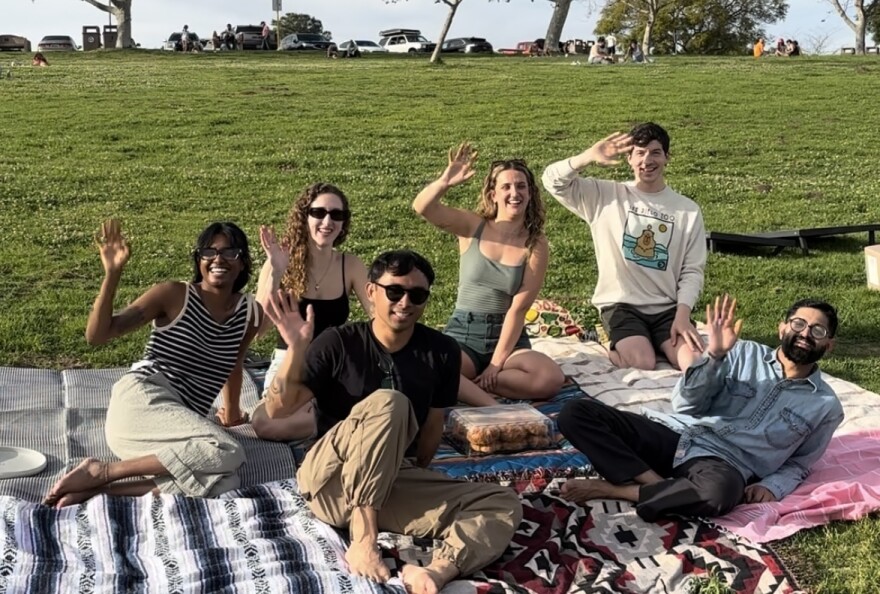
S1: It's time for KPBS Midday Edition. On today's show , we're talking all about friendship , how to make friends , where to make friends , and how to keep friendships strong. I'm Andrew Bowen in for Jade Hindman with conversations that keep you informed , inspired , and make you think. Our producers visit a park to talk to San Diegans about their thoughts on friendship. We'll also hear from mental health professionals on the challenges of making and keeping friends in San Diego. Then the importance of third spaces , places outside work or home where people can meet and build community. That's ahead on KPBS Midday Edition. First the news. There's nothing like a good friend. They are the people who make you laugh. They have your back and they take care of you when times get tough. But when's the last time you sat down and really took stock of your friendships ? And what about new friends ? Making friends as an adult can be challenging. So on today's show , we're trying something a little different. We're taking a deep dive into friendship. We'll talk about how to find friends , make friends , keep friends , and everything in between. And joining me now are the show's producers , Ashley Rush and Juliana Domingo , who also happen to be friends with each other. So welcome to you both , Ashley and Giuliana.
S2: Hey , Andrew. Good to be here. Yeah. Hey , Andrew. It's good to be here , too.
S1:
S2: But personally , I also just finished Broad City. So I think the theme of friendship and , you know , the strength of platonic love was really top of mind for me. So I think Julianna and I just started talking about the show and things kind of snowballed from there.
S3: Yeah , and I feel like friendship is just a really universal topic. You kind of go up to anybody and ask about , you know , their friends or what they think about friendship , and they'll always have something to say. And I think that's been our experience with this particular show. And I think , you know , in San Diego , people have varying experiences of friendship or with making friends or keeping friends. So that's also something that we wanted to explore.
S1: So tell me about your friendship. You work together.
S2:
S4: Yeah , I think we're definitely ready. Okay , good. I'm like , are we ? No , no , we're.
S2: We're friends too. And that's something we wanted to explore too , is like , how do you go from the coworker category to , okay , we're not friends outside of work. We do XYZ. We get , you know , drinks , we got a coffee. Um , but Julianne and I , you know , we're texting outside of work hours , so I think we've made that that transition ? Yeah.
S3: And I feel like Ashley and I were definitely in a very similar stage of life , which , you know , really helps. Um , I remember , I think the first time we actually got to sit down and have a conversation. You had just come to San Diego , and then we had a coffee , and we just chatted for hours and hours and hours. And I think that's when we knew that , you know , we clicked as not just coworkers , but also as friends and that this could be , you know , something that could last , I guess. Or.
S4: Or.
S3: You know.
S4: Um , but. Yeah. Oh , yeah.
S2: And the part about us being in a similar , um , age group or similar stage of life , we're both in our mid 20s and I think , you know , you're outside of college , so there's not kind of built in social structures to meet people , but you're pre , you know , maybe building a family or all of these other things where there's other ways to make friends or , you know , adult friends through your children or something , you know. So it's kind of this , like awkward stage in the middle. Yeah.
S1: Yeah. So you decided to take the show outside of the KPBS studios. You went to Kate Sessions Park in Pacific Beach. Tell me why you decided to do that for the show.
S3: So one thing that we really wanted to explore , or one thing that we are exploring in the show , is this idea of third spaces. So we wanted to go out to a third space where people just sort of gather and connect or even make new friends. And so Kate Sessions Park was a big one for us. We , you know , it's one of the most popular parks in San Diego. And so we just wanted to go out on a Friday afternoon , Friday evening and see , you know , what people were up to. And we ended up encountering a lot of different groups of friends who were just doing whatever. Some were holding birthday parties , others were just there to have picnics and and spend time together. Others were , you know , even playing sports. So a lot of , you know , just a big variety of activities. But it's definitely a place where , you know , people just come to spend quality time together. And so I feel like , um , that was really important. And , you know , as , as we were looking to , to speak to people and find people who could talk about their friendship.
S2: You know , it was definitely a fun social experiment walking up to people with a big microphone and asking them about their friendship. But I think for a few of them you could tell , like what a special opportunity it was to to talk about their friend with them sitting right next to them. So we compiled some of those interviews together in a little package for you. So take a listen.
S5: We're here at Case Sessions Park.
S3: Interviewing just.
S5: Groups of friends across San Diego.
S6:
S4: Yeah , we met rock climbing.
S6: Yeah , we met rock climbing. Yes.
S4: Yes.
S7: Actually , we're like the survivors for a friend group.
S4: Yeah , yeah , we were four.
S7: But we're all the only to the two of us. Yeah.
S8: I joined the flag football league , and this is my captain. And , yeah , we kind of just hit it off.
S9: We met at a bar because my boyfriend was with her , and I was checking him out , and I thought he was straight because he was with her.
S4: And then let me tell the story.
S10: Let me tell the story. Okay.
S3: So could you just , like , walk me through , like the moment that you guys like Matt and realize , you know , you could become like potential friends.
S4: I feel like the second time we climbed , you also brought , like , peaches to the gym.
S6: Yeah , yeah , I had some peaches that grow in my. They're the place I rent. They have a peach tree. So I was just like , I was like , I'm gonna bring a bunch of peaches. So.
S4: And I was like , okay , I think I like this guy. He could be my friend. He brings peaches randomly. Yeah.
S6: Yeah.
S4: Do you feel like it's. Um.
S3: Um. Easy.
S4: Easy.
S3:
S11: It does depend on which neighborhood you live in. So I know a lot of my coworkers live in Ocean Beach , and it's rather easy to make friends there. But if I live in Mira mesa , which I do , uh , it's a whole different story because the only other place you can meet someone is like H Mart.
S4: It's hard now to just , like , walk up to someone and become their friend because it seems like like everybody has their people , whatever. And everyone's also not to be annoying , but like just looking at their phones these days , so it's harder to like People are as approachable.
S6: I think it depends on like the life stage. Like , I think 20s and single , like it's hopefully pretty easy in San Diego , but like , I'm well , I'm 30 , 32 , so I feel like it's getting harder the older I get to like meet new people.
S4: I just did the things that I love doing and then made friends through that. So I've made friends through surfing and then like mutual friends of each other as we all introduce each other. Meeting.
S11: Meeting.
S6: New people.
S9: I find it pretty difficult to find.
S12: Like like minded people in San Diego , although everybody's like always out and about and having a great time. But finding people who have the same kind of values.
S2: When it comes to making friends and keeping friends.
S13: I think a lot of people cancel a lot. So a friend that that shows up and I can have a good time. Those are the good ones.
S8: Yeah , that's a good answer. I'm gonna second that. And also , uh , just like someone you can be yourself around. You know , I think that's a really big one. And then I actually met someone recently that said they only stay in relationships that nurture them , too.
S3:
S7: We just tell the other. Yeah , I.
S14: Think we're both very direct and with our emotions in all of our relationships , we kind of are that person. And I saw her like , um , eldest daughter kind of figure like myself and like a bigger sister that I don't have.
S2: Anyone else have anything else you want to say ? Any less advice ? Parting words.
S4: Um , everyone should be friends with us. And should I give them all our address to just find us , or is that not good for everyone ? Okay , we'll just walk around Ocean Beach and then find us and then be our friends.
S9: And love her like my sister.
S10: I feel like the best friends I have are are no longer friends. They truly are family. And I think that's a beautiful thing because it's like a chosen village.
S9: Chosen village ? That's good.
S1:
S3: Um , actually , I think it can come across in the audio as well. Just people really lit up when we asked them about , you know , their friendships. And so , um , I guess a big takeaway for me. Um , you heard that last bit about The Chosen Village. I think , um , Ashley can also speak more to this , but really , friendships are about the people in your life who you choose to be with and who you choose to to really make an effort to , to form a connection with and also just continue to build a community around. Um , and I think that was a really big takeaway. Yeah.
S2: Yeah. And we were just really impressed by how thoughtful the responses were. We also asked everyone that we spoke to for some questions for some of our guests that we'll be speaking with later this hour. Um , and like what Juliana said about the Chosen village. We really wanted to end with that piece because it really speaks to the importance and the resonance of friends in someone's life. You know , I think about my friends and I just think about how far they've taken me and what they do for me on a day to day basis. So this show is kind of a tribute to all of our friends , I would say as well.
S1: I've been speaking with Giuliana Domingo and Ashley Rush , who are Midday Edition producers and friends. Well , thank you so much , Ashley and Juliana.
S3: Thanks , Andrew. Thanks , Andrew.
S1: Well , we're going to turn now to two experts on the subject of friendship. Mitzi Ruelas is a licensed marriage and family therapist here in San Diego , and Dan Singly is a psychologist and director of the center for Men's Excellence in San Diego. Mitzi and Dan , welcome to you both. Hi.
S15: Hi. Thank you for having me. Yeah.
S16: Yeah. Thanks for having us on.
S1: Mitzi , I'll start with you.
S15: Um , oftentimes clients say that maybe they hang out with somebody here and there , but they have like a hard time building , like a foundation for the relationship. Um. Oh , sorry.
S1: No , please go ahead.
S15: Oh , I was going to say the other thing that I , I notice is navigating a friend and long term friendship as changes and transitions happen , is another thing that clients will bring up.
S1:
S16: And in fact , at the practice we see people of all genders , um , male identified and then the people that love them. And so , uh , really kind of top tier , I see two clusters of issues. One is the men and the boys themselves really devaluing the importance of friendships , and that gets much worse as you go. Like I do reproductive mental health. And so the due to D&D transition friendships , one of the first things that'll go the other kind of cluster of of what I see that I think is pretty important is , um , non male loved ones that that feel like , well , he's just kind of like he's just there. He doesn't really have he doesn't really need friends. He doesn't. And a real confusion about what connection and intimacy and friendship really mean to men in today's society.
S1: And I think what you're talking about is loneliness. It's a growing public health crisis. I think we're talking about a lot as a culture. It's gotten worse during the pandemic. Studies show that 1 in 3 Americans experience loneliness at least weekly.
S16: So the surgeon general under President Biden put out a very important report on loneliness in the United States today. Unfortunately , given the bandwagon that I'm always on , they didn't really break things out by gender , which , of course , I would have liked to see because because of what I just said about about men. But one of the findings in that was that , in aggregate , the weathering effect of unwanted loneliness and isolation over time , it has the same impact on mortality and morbidity. Like how much , how sick you get , how quickly you die as smoking a pack of cigarettes a day. Like , let that settle in being lonely. Which doesn't mean you're not around people , means you're not connecting. You're not investing. You're not getting that that serve and return of of attunement and empathy and connection and attachment and so forth. You die sooner and you struggle more. So naturally. On the flip side , the question you actually asked me was , what's good about it ? And what's good about it is having friendships where one can mirror back and forth. And when I say friendships , families , great , partners are great , awesome. And the way that I choose to do this work with men is to say you need for other relationships. They don't have to be besties , but four legs on a table for support people. And when they do that , they have they have a context for a serve and return for the mirroring of hey , here's how I experience you. It it can be sort of the counter to the the negative stuff. I say to myself about myself every day when I have cultivated relationships with people that I care about and who are meaningful to me , what they reflect back to me , what they mirror me. And with men , it's often it's not verbal. And they're not saying , I think you're really cool and smart and responsible and let's go play and be friends in the sandbox. Like that's the subtext of what it means when you say , let's go get a coffee. But not having that means we don't get to see ourselves in other people's eyes , which is so important.
S1: Well , let's take a listen to some questions that we receive from folks out in Cate Sessions Park. One thing that has come up is maintaining friendships through different stages of life. Here's a question we got from Katie.
S4: I guess a good question could be how they've seen friendships mold and changed through different seasons of life. I think when you go through different seasons , friendships can look a lot different or change , but then there's also friendships that change and stay sustained. So I guess just like curious how they see that happening in our world and what what works to keep friendships sustained and where maybe it breaks down.
S1: Mitzi , why don't you take this one ? Sure.
S15: Yeah. You know , this is something that comes up a lot , and it's particularly challenging when the adjustments are happening. Or like , the decisions are happening at a different rate or a different pace. I think what I've noticed sustains relationships is having flexibility and understanding for the transitions , and that naturally is going to take a little bit of an adjustment period for the friendship and to to trust the friendship and to check in with each other as you're going through these things and to also not take it personally if somebody's really busy , but to in some sort of way , the checking in with your capacity and maintaining the friendship with the capacity that you do have.
S1: We got a similar question about growing with friends through life stages and relationships. Here's a question from Brenda Delgadillo.
S14: I would like to ask her what's the best way to grow along your friendships ? And this would include also like their lifelong partners , because that's something that we've been struggling with lately , like accepting our friends and in their relationships and having to deal with the reality that this is going to be long lasting in the future.
S1:
S16: So I'm going to do a little tricky nerdy thing here for a second. There's an air of psychology called interpersonal psychotherapy that focuses on relationships in the back and forth. That fits nicely. We're going to look at relationships , and within that , an exercise I like to do with people that relates to , I think the thoughtful point that , that , that , that she just made is that they're not stagnant , right ? They shift. They shift over the life course. So we could look at this a number of different ways. But one of them is just to say , I like to tell people , um , neither biology nor momentum are really solid bases for mutually satisfying relationships , which means just because you're related to them or just because they , you know , you've known them since the third grade , and that doesn't mean that it's really the best fit of relationship. Sort of back up. What what Mitzi just said , um , at the same time , when you look at the life course , particularly for men , we become more and more isolated. And there are different , you know , milestones. And what I will say is it only gets harder. It does not get easier as it gets funny like in the intro. Um , I think it was Ashley that was interviewing one of the guys and said , yeah , I'm kind of in this. We're in this middle period between. And I was wondering , well , what's the other book at ? Because when you get older , it's no easier. It only gets harder , in particular when you socialize men to have lots of fairly superficial relationships , but not really to prioritize depth of connection and emotional intimacy. Then , quite frankly , when you do start talking about those , you're stepping outside the man box and you're going to get shamed. That's why I loved when they were talking , when when Ashley and Jonah were talking like , wait , are we friends ? Yeah. I'm friendly. Just the beauty , like the simplicity and the directness and frankly , the awkwardness of that exchange between the two of them , I think , goes a long way. Like , imagine their two men having that conversation. Like , the awkwardness factor gets ramped up that much more.
S15: And I could , if I could add , I would agree to that , that it does get difficult as you get older and more responsibilities. And so what changes ? Is that before you used to hang out with your friends , when you were bored , when you had nothing to do , and that really rarely happens and doesn't really happen in , you know , adulthood , especially after college and all of these things. And so while it's not romantic and while it's not very , you know , cool to schedule in friends , you have to make time for it. Like , if you wait for the moment where I'm free , then you're going to keep pushing that friend day in that experience. Um , in terms of like when there's relationships and there's adjustment to that , I would invite people to involve their friends. Right ? To if you're going to like a farmer's market with your partner and it's not like a date date , ask your friend if they'd like to join. You know , like that's okay too. So getting them involved. Yeah.
S1: Yeah. Well , we heard a question about group dynamics and friend groups.
S11: Here's Matthias when it comes to friendships , I feel like there's different types of friendships , right ? There's people who you talk to regularly. There's people who you don't talk to for months , and it's okay. There's people who close host more. There's people who are , uh , never host , but they're always down to join. How does one navigate finding your role in that ? Dan.
S1: Mitzi.
S16: Well , one way that I try not to be , like , overly robotic or mechanized about something as organic as friendships , but I'm really big on teaching people concrete ways to assess fit in their relationships and to my way of thinking fit. And you can you can apply this to any relationship familial , romantic , you know , platonic friendship and fit boils down to kind of a two by two matrix , and fit is it's a function of needs. Who do ? Who do I need to be in our relationship ? Who do I need you to be in our relationship. And then the flip. Who do you need you to be in our relationship ? And who do you need me to be ? And one of the examples given was in the intro. Was there there responsive. Like they're consistent. They'll show up. So I need you to show up. Maybe part of what I need to be for fit in our relationship is I need to be the convener , or I need you to be the convener. And so then I will these are just examples. But other times it's I need to be able to be goofy or loving or , you know , sometimes I lead or you lead. But to me , most of that boils down to fit. And that's a very messy , kind of ill defined concept that I think people would do a lot better in relationships , that they did stop and take a look at.
S1:
S15: I would agree that you're possibly all of them , right ? Depending on the space , depending on the group , depending on like the friendship. And to even have a conversation with your friend of like maybe they're needing something different or you're needing something different depending on where you are in life. But I would invite you to be to allow yourself to be more fluid and trust that you know the dynamic and the system will find its balance.
S1: We've got a pretty blunt question here , but I think it captures the challenge of making friends in today's world. Let's hear it.
S4:
S15: And so oftentimes where some of my clients are like , you know , how do I start making friends ? I would , depending on your comfort level , I would say , just like practice complimenting people , you know , or asking them , hey , where did you get that ? Or , you know , do you see them walking out of a controversial , hey , I've been looking at that coffee shop. What are your thoughts about it ? And then if it sparks further conversation , cool. And if it doesn't , at least like you complimented somebody , somebody had a nice day , you know , to start there as opposed to like , hey , want to be friends. I mean , maybe you could do that. Some people would probably be down , but start with a compliment.
S1:
S16: I was actually just thinking how stoked I would be , like , I'm in and out and some dude rolls up and is like , oh my God , I love your t shirt. You want to be friends ? I think that would be too cool. I mean , the the spontaneity piece of it. I think Mitzi nailed it. Like , I don't know , it's really about sort of looking at the contacts now with men in particular , like we're socialized to connect with each other , not about each other , but about that third thing that we're talking about , be it whatever's in the situation like , you know , I'm dropping my kid off and you're dropping your kid off like , hey , you know , those are cool kicks that your kid got or , you know , whatever. The thing is , a lot of the work that I do is not so much about sort of cold calling new friends. It's about taking kind of an environmental scan of who are the people already in your life ? Who's that colleague , who's that person you know from ? You know , from school or or church or whatever the thing is ? And then how do you take it to the next level ? And with those guys , usually what you find is they have been starving. They are starved for more connection , but they don't know how to go about it. And so oftentimes I'll just ask we'll do like a little concentric circles. Where is this person okay. Your friend what's his name ? Joaquin. Okay. And then you look at okay with Joaquin. What's the frequency you're in any kind of contact with him. Well , I'll see him like , every two months. Okay. Every two months. What happens ? Will we text ? What do you text ? Oh , he text me dog videos. Cool. And then that's the content of it. Is it only dog videos or is it politics or what's going on with Joaquin's family ? No , it's pretty much dog videos. And then we look at one of those factors the frequency of communication , the medium of communication , and then the content of it. And I'll ask my guy , change one thing , not spill out your emotional baggage necessarily. Pick one thing. How about you go from two months to one month that you text him ? Or how about you text him a doggo video and then let him know ? You know , I'm actually kind of having some work. Work life stress is like the lowest hanging fruit for dudes to like , unburden themselves because you're not violating any bro dude moments. Like you're supposed to have one , a family. You know , it's like it's the easiest way to begin the vulnerability thing , and you see what the other person does.
S1: Yeah , well , I'm afraid we're out of time. That's been a great conversation. Great advice here. I've been speaking with Mitzi Ruelas , a licensed marriage and family therapist here in San Diego , and Dan Singla , a psychologist and director of the center for Men's Excellence in San Diego. Mitzi and Dan , thank you for your insight.
S15: Thank you so much. That was so fun. Yeah.
S16: Yeah. Thanks.
S1: Coming up , where ? To meet friends outside home or work ? Look for Third spaces KPBS Midday Edition is back after the break. Welcome back to KPBS midday Edition. I'm Andrew Bowen in for Jade Hindman. So far this hour we've been talking about making friends in San Diego. And from what we've heard , it can be pretty tough. Well , you might have heard of third spaces , places to connect with others outside of home or work. Here to talk more about San Diego's third spaces. Is Lauren Mapp. She's the co-founder of Daylight San Diego , a local community oriented nonprofit newsroom. Lauren , welcome to the show.
S17: Thank you so much for having me.
S1:
S17: It's the concept that your first place is your home , or you know , the place where you live and sleep. Your second space is school or work , and a third space is anything outside of those two places where you might be connecting with people , meeting people , having conversations. And , you know , historically , people had one place. They lived on a farm , they worked on the farm. Any friends that they met maybe was at the second space , like a church or something like that. But as the industrial age happened , we started working outside of the home more and needing to find other ways to connect with folks.
S1:
S17:
S1: So you started a series at Daylight San Diego all about San Diego's third spaces. Tell us more about this series and why you wanted to start it.
S17: The idea for the series is kind of stunned with some reporting that I was doing last year. I had covered a program at , uh , San Marcos on college , um , where they , the native students there had this place on campus where they were able to connect with one another , learn about different cultural aspects like drumming classes and traditional dance classes. And it was really just like their kind of place away from the classroom on campus , where they could connect with other native students and professors. So that kind of was one part of the idea. Second , part of the idea , as I started reporting on the Block Club , which is a new place in the Black Arts and Culture district , and as I was going there both for reporting and then just to casually be there for their craft or noon type activities , or are they call them solar Craft Saturdays. I was just seeing how open of a space it was and how people were connecting with one another. And so the as I was writing that story , I had the idea to make this a whole series of covering third spaces and what they mean to the people that go there.
S1:
S17: I know like one of my favorite coffee shops closed in the last year or so because , you know , the story was that their rent had gotten increased and so they had to close their doors. Um , and so if a place has a model where they're not necessarily there to make money , then it's harder to be able to rent in a city like San Diego , where everything is so expensive. Um , there's also the availability of your time.
S1: It's also just , do you have time to go there ? Exactly.
S17: Yeah.
S1: Yeah. And you mentioned in your story about third spaces , a couple other issues that make it difficult to keep these spaces alive. One of them was car centric development. Can you tell me more about that ? Why would a car centric development model or system make it hard for people to meet in third spaces ? Yeah.
S17: So with car centric development , that means you're spending a lot more time in your car. So if you live in Poway but you work in downtown San Diego as an example , you might be spending like a whole hour in your car versus if we had really good public transit , you'd be on , you'd be on the bus , or you'd be on a trolley or subway or something , and you'd be just naturally interacting with other people because we kind of have this urban sprawl. There's just fewer places where there's concentrations of spaces where you can walk from your house to a cafe , or walk from your house to a library or something like that. Yeah.
S1: Yeah. And I think about how even like , you know , there are a lot of driveways and curb cuts , you know , in a sidewalk that can sort of disrupt the flow of pedestrians and create conflict points between cars. And that can sort of discourage walking. And people want to be where people are and walking where other people are walking. I mean , this the whole idea of mixing , of seeing other people and chance encounters. Right. Yeah.
S17: Yeah. And I think about this on Oklahoma Boulevard in particular , you know , like you have this kind of corridor along 30th where there's a lot of businesses , but they're kind of like all spread out. But then if you go east , yeah , east from 30th , you get to this point where it's no longer friendly to be a pedestrian. And there's also not businesses that you can pop in and out of. You know , I think you hit an electric station. You get onto this really dangerous bridge that's hard to walk on. And then there's a grocery store that's been closed down in a bank. Like there's not like a lot of places that you want to like , walk to and pop in and maybe meet people.
S1: And places along the along the way , along the journey that are just interesting to look at , you know ? Yeah.
S17: I mean , compare and compare that to like kind of the heart of North Park where like there's bookshop after bookshop and coffee shops and restaurants and bars , like there's just like a lot of , a lot of different things to do in a very short walking distance.
S1: So what's your own experience with third spaces ? Yeah.
S18:
S17: So when I was a college student here in San Diego living in Normal Heights , I used to go to LA starts on Adams Avenue on a nearly daily basis. Um , in part because I didn't really have a quiet place to , to study or work from home , and in part because I disliked the kind of hustle and bustle of being in the coffee shop late at night. Um , la stats was open 24 over seven at that time , and I would sit at this big communal table. And that's how I met one of my very dear friends , Paige. I think I talk about her a little bit and the kind of like intro to the series , and , you know , we would just sit there and , like , both be doing our homework. We wouldn't have met if it wasn't for both working in this one coffee shop , because she went to a totally different school for me , had a totally different major , had different career paths and whatnot. And we met two older writers , one of whom was , uh , had written scripts for Star Trek because they also used to sit at this big communal table. And we ended up we just really kind of struck up this friendship with them. I ended up in like a scene in one of his movies , like one of his like , short films , and we would play this game called Dungeon Quest and like , it would just be like our kind of 3 a.m. break of , like , we've been doing homework for hours.
S1: Can you talk about third spaces as a place where you know there is a mix of people , there's a diversity , and you're not just meeting people who are all into the same thing.
S18: Yeah , absolutely. I mean.
S17: Like with the example that I had with the States , like , you know , the two friends that we met were much older than we were. They were probably about 40 years older than us. Um , you know , people that I wouldn't have necessarily met in my day to day life , they weren't college students or things like that. Um , another place where I've , like , met folks as an adult has been swing dancing classes. And of course , you're all being brought in for that one thing , but everybody has interests outside of that. I've met engineers. I've met at , you know , one of my kind of friends from the swing dance scene is a man who I believe just turned 100 and is actually from the city that I grew up in. But there's no way that he and I would have met if it wasn't for being in that third space of the firehouse.
S1: You know , we've talked about third spaces on our show before , and it always generates a lot of conversation and feedback.
S17: And so I think people are really craving other places where they can build connections.
S1: And how do you encourage people to find their own third space ? Yeah.
S17: So at Daylight San Diego , we launched a series called Weekend Energy about. I'm not exactly sure how long ago , but sometime last year we walked. We launched Weekend Energy , and this is a roundup where we go through and we find events happening all throughout San Diego County of , you know , different art gallery openings and different , you know , kind of curated conversations and things. So we have a weekly calendar that comes out to highlight those events. We also are launching our own series this month called the Daylight Culture Club. And so this is going to be an occasional arts and culture series. Kind of think of book club , but you don't have to do homework first and not necessarily around authors and books. And so we're having our first event in that series at the end of the month. It's called Making Home , and it's all about how the immigrant community finds a place of home through their art and remembers where they came from.
S1: Well , third space is such an important part of our society. Thank you so much for sharing. I've been speaking with Lauren Mapp. She's a co-founder and reporter with Daylight San Diego , and we'll link to her third spaces series on our website at KPBS. Lauren , thanks for joining us.
S17: Thanks for having me.
S1: Still ahead , a San Diego journalist finds community through improv. KPBS Midday Edition returns after the break. Welcome back to KPBS Midday Edition. I'm Andrew Bowen in for Jade Hindman. This past hour , we've been talking all about friendship , the psychological psychology behind it , and how we make friends. Well , one way people are connecting is through comedy. My next guest is a journalist by day and an improviser by night. Maura Fox joins me now. She's a reporter with the San Diego Union Tribune and the founder of Let Me Have It , an all femme improv team. Maura , welcome to the show.
S2: Thanks for having. Me.
S3: Me.
S1: So you've done your fair share of reporting on how to make friends in San Diego. Talk to me about this story you did in 2022 and why you wanted to report on it. Yeah.
S19: Yeah. So we were reporting this story , reported this story as part of a series that the Union Tribune did about New Year's resolutions , kind of how to maximize your your new year. And I was coming from a place personally of thinking , I want to make friends , make community in in the new year. And I don't think I was alone in that experience. I think a lot of folks in the new year are , um , seeking ways to , to put themselves out there. Be brave. And so that was the part of this that was the main , um , you know , reason for writing this story. And it was really interesting for me. You know , like I said , it was it was personal as well as it was wanting to , you know , give San Diego readers a way to make friends. I was also seeking this out myself. I had recently moved back to San Diego and was finding , you know , wanting to Wanting to make connections with with folks.
S1:
S19: And I knew that something was brewing. I knew that I was on the route to to making friends through that , and I thought that that would be kind of a good way to to get into the story of showing readers , hey , not only am I this like external reporter who is who's got all the friends in the world and is , you know , doesn't need this. But I was also like , I'm doing this , you know , as much as , as much as the readers are wanting it.
S1: So for the uninitiated , tell us about improv , how it works and how you practice it. Sure.
S19: Sure. Well , first , improv is a lot of fun. You can do it in , in , um , through various various means. You can do it just because it is fun. You want to get on stage and have a laugh and entertain people , which is a big part of the reason why I do it. But it also was a really great way to build confidence. You are putting yourself out there to make a mistake to to to say something goofy and there's something really , really special about that. And it can just build , you know , strong public speaking skills. And again , that bravery that I think is there's not a lot of avenues for us to just like put ourselves out there as adults especially , and play kind of in a very childlike way that feels , feels lacking for a lot of us. Yeah.
S1: Yeah. And , you know , journalism can take a lot out of us , I think. Imagine. I imagine improv feels very freeing. There's really no limits to what you can act out on stage. What sets it apart from your day job so much ? Every.
S19: Every part of it. As you know , our jobs are very exacting. We have to get things right that are our. Our goal is to strive for , for correctness , for the truth. And that is so important. It is also stressful and taxing. And so when I do improv , I'm not worried about saying the right thing. I'm not worried about a fact checker , you know , calling me out for something. It's just fun. And and I think that is freeing. You know , we if I , if I didn't have it , I think I'd be very like structured living in this like really rigid box. But but improv gives you this chance to just , um. Yeah , just relax and and have fun in a way that is , is just so unique from , from our , from our day jobs.
S1: And how have how has improv been a good avenue for you to make friends ? Yes.
S19: Well , it works , I promise. Um , so , yeah , I mean , I think , like I was mentioning earlier that you're , you're doing something that is so vulnerable and , and I think when you're doing that with a group , it has like a very powerful effect , um , because you're putting yourself out there to. To make a mistake. And you have a group of people around you that is there cheering you on. They're actually like clapping for you or hooting and hollering. Um , and , and in that you just learn a lot about people. Once you kind of open that door to vulnerability , to making a fool of yourself in front of somebody. You're sort of like , nothing's off , off the table now. Like , now we can be best friends. And I think that if anything , like my friendships through improv have been very fast. They're very deep , but they also like they just happen really quickly because you find like in a month or even less , you are so bound to a person because , you know , you stood on the stage with them and did a weird scene , um , about wacky characters. And that's awesome.
S1: I imagine bombing might also bring you closer together to people.
S19: You have no. Idea.
S1: Idea. Oh yeah.
S19: I mean , you do bomb because that's life.
S1: That's life. And you. So you founded this all femme improv team. Tell me about it and how it has created a community for you. Yeah.
S19: Yeah. So I'm a co-director on this team. It's called Let Me Have It at Mockingbird Improv. Um , and it's very special because I think that friendships , anyway , in improv are deep and awesome. But then when you take it to this , like , all femme sisterhood element , it's it's even richer. Um , something about , you know , improv and comedy that may or may not be , you know , fully known is that it can be a very male dominated activity. And so many women will tell you that when you're on a on in a scene with somebody on stage with a man , you'll often be designated as the woman , the the mother or the the sister. And it's it's kind of limiting in a way that if you wanted to play the rugged truck driver , man , you you might not be able to to do that. So all to say that when you are performing with women , you are you're just granted more opportunities to to be sillier. And that in , in a very deep way feels feels limitless. Um , and and then again , those friendships with women , I think are just very important to have.
S1:
S20:
S19: Um , I mean , I think that. No. I mean , I think that of course it's it's nerve wracking and and know that you don't have to become a performer. I mean , that's something that I ended up wanting to do , but to to do a workshop , to do a class series just to , um , to to build that confidence and , and kind of put yourself in a situation that might feel uncomfortable , but but very worth it. Just know that you don't have to ultimately like , try to audition for SNL or anything. It can just be a , um , just a really good way to meet like minded individuals.
S1: Any parting words for folks who are in search of friends here in San Diego , or who want to do more to maintain the friendships that they have already ? Gosh.
S19: Well , I am no expert , certainly , but I think like if it if it feels a little uncomfortable , like that's okay. Like you're on the right track. And I think knowing that , especially when I was starting an improv like it was me and everyone else who was trying to make friends , we were all in that same boat. And so knowing that you aren't alone , we're all seeking connection. This is a very , um , relatable experience. Yeah.
S1: Yeah. Yes it is. Well , I've been speaking with Maura Fox. She's an improviser and reporter , and you can see her team let me have it perform at Mockingbird Improv at Liberty Station. Maura , thanks for joining us.
S19: Thank you so much.
S1: And that's our show for today. If you missed anything , you can download KPBS Midday Edition on all podcast apps. Don't forget to watch Evening Edition tonight at five for in-depth reporting on San Diego issues. You can also share your feedback or segment ideas by emailing us at midday at or call us. The number is (619) 452-0228. I'm Andrew Bowen in for Jade Hindman. Join us again tomorrow. Thanks for listening and have a great day.