






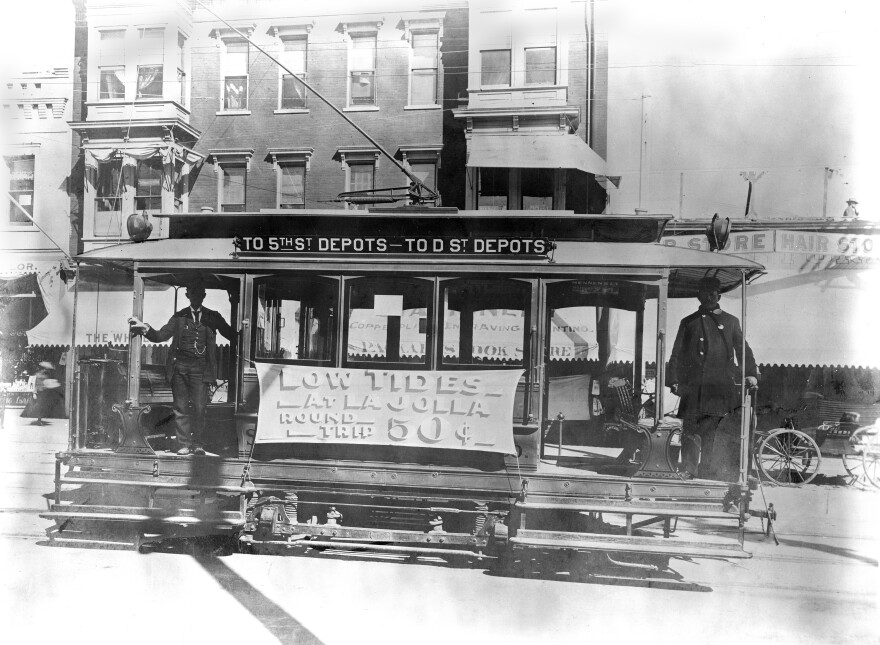


Long before San Diego became defined by freeways, parking shortages and long commutes, electric streetcars connected the region's urban core to beaches, business districts and growing neighborhoods more than 100 years ago.
In this episode, KPBS metro reporter Andrew Bowen talks with The Finest about how the streetcar system helped shape neighborhoods that remain some of the city's most walkable and desirable today. The conversation traces the rise and fall of the rail network, how San Diego became shaped around cars and the lasting impact those decisions still have on the way people move through the city.
We also look at why conversations around public transit are shifting again and meet the people trying to bring the streetcar system back to life.

Guests:
- Andrew Bowen, KPBS metro reporter and Freeway Exit host
- Ethan Elkind, Climate Program director at the Center for Law, Energy and the Environment at UC Berkeley
- Michael Donovan, co-founder of Vibrant Uptown
- Monica De La Cruz, car-free San Diegan
Sources:
- The enduring legacy of San Diego's streetcars (Andrew Bowen, KPBS, 2026)
- Amid San Diego's high transportation costs, some manage to find relief (Andrew Bowen, KPBS, 2026)
- ASU study finds Americans' attitudes toward car-free living are changing (Delores Tropriano, ASU News, 2026)
Episode 40: Streetcars Transcript
Julia Dixon Evans: Imagine for a second: It's 1916, 110 years ago, you're standing in San Diego's North Park neighborhood along University Avenue. You want to run a few errands: stop by the butcher, get a haircut, do some shopping. Or maybe you wanna dip your toes in the Pacific at Ocean Beach 10 miles away or La Jolla Cove 15 miles north. How will you get there? You don't have a car — most people didn't. You could walk or possibly call a horse-drawn carriage. But the easy answer to your problem might seem a little futuristic for the time, and it's something San Diego no longer has today.
Andrew Bowen: The electric streetcar. That was the dominant form of urban transportation for close to a half-century.
Evans: This is Andrew Bowen, KPBS metro reporter and host of the Freeway Exit podcast. It's an excellent series that dives into the history of cars and transportation in San Diego. Recently, Andrew reported on San Diego's historic streetcar system.
Bowen: I mean, people really liked these things. They were electric and so there wasn't an engine or a motor running that creates noise. I mean, they were quieter than most, you know, gas-powered automobiles that we have today. The acceleration was also really fast. You know, these streetcars were able to move pretty quickly. It was a pretty smooth ride 'cause they're running on rail and you don't have to worry about potholes. The fares were also very affordable.
Evans: Some streetcars were enclosed like a train car with glass windows. Others were open air with wooden benches. One historic photo — check it out on our website — shows one with a banner reading, "Low tides at La Jolla. Round trip 50 cents." Another photo is of a double-decker streetcar, both levels packed with men in three-piece suits posing for the camera. What these photos have in common is people in an Old West town enjoying a technology and convenience that despite all our modern advancements, we let slip away.
Bowen: The streetcar offered a way to get to a job downtown or to shopping, really anything entertainment. They mostly started in downtown and then branched out from there. So they went as far as City Heights through the South Bay. Mission Beach, La Jolla and Coronado had streetcars. So it was a really, really extensive network of streetcars. And there were packaged deals where you could pay for your fare on the streetcar, and it would include, like, a little lunch at Mission Beach and like a towel or…
Evans: With a towel to the beach.
Bowen: Yeah, you know, when I've talked to people about this history who are not familiar with it, it's just it's mind-boggling to them to imagine a San Diego where you could take a train to the beach. Like, we all wish that, I think, that were an option for us.
Evans: Andrew tells us about the surprising way the streetcar system came to be and the huge influence it had on how the region still looks today. He'll also share the story of its downfall and how a car-centric state of mind changed our culture and communities in unexpected ways. And he'll introduce us to people who in 2026 are trying to bring the electric streetcar system back to life.
Bowen: A lot of new arrivals and a lot of people who have lived here for a really long time really want better public transit. And they look back on this history when they first learn of it, of the streetcars in San Diego, and think, You know, why did we get rid of this?
Evans: From KPBS Public Media, this is The Finest, a podcast about the people, art and movements redefining culture in San Diego. I'm Julia Dixon Evans.
[Theme Music]
Evans: OK, I wanna talk about streetcars.
Bowen: Yeah, me too.
Evans: Great. Can you talk about how, what you learned about how the system was implemented in the first place?
Bowen: The San Diego Electric Streetcar Company was founded in 1891 by a guy named John D. Spreckels. He was kind of a founding father of San Diego. His family got rich from the sugar industry. When we think of public transit today, we think of government agencies. The metropolitan transit system is governed by a board of directors made up of elected officials from cities in San Diego County. The early streetcar companies were not government agencies at all. These were for-profit companies.
They were tied to real estate development.
So for this story on the streetcars, I interviewed a man named Ethan Elkind. He is the director of the climate program at the Center for Law, Energy and the Environment at UC Berkeley. And he knows a lot about the history of streetcars across the country. I mean, this wasn't something unique to San Diego. It's really every big city had a streetcar network around this time.
Ethan Elkind: Yeah. Well, they really started out as a way to develop the real estate of cities. So before cars were really a big thing and real estate developers wanted to sell land, and a good way to boost the value of land was to build their own private streetcar systems, and then they could sell the lots, and then people would just commute into where their jobs were — usually in the city centers — by riding these privately funded streetcars.
Bowen: The neighborhoods that were built around the streetcar, I mean, they were, were literally built around the streetcar. They would not have existed if the streetcar had not been there, because nobody would've been able to get to downtown where the jobs and the shopping were just by walking.
Evans: Right.
Bowen: The streetcars didn't just shape, like, the density and the, you know, the type of housing and development that happened in these urban core neighborhoods. It also influenced the actual layout of those neighborhoods and the distances that people had to walk in order to access public transit.
Elkind: So it makes a lot of sense that those would be the neighborhoods that would be more walkable, you know, often more charming, more desirable, more character 'cause they were built kind of pre-automobile, and those are often the neighborhoods that now are some of the most expensive and desirable to be in 'cause people are hungering for that.
Bowen: So I think that's a big part of the influence of the streetcar is that, you know, we have these old neighborhoods that are walkable, and maybe people don't know why. They don't know how the streetcar influenced that urban design, and yet it's such a big part of it.
Evans: I wanna talk a little bit more about the public versus privately owned element of it. Like, how did the streetcar system make money? How was it profitable?
Bowen: So one thing that Ethan Elkind told me was that these streetcar companies didn't actually have to be profitable.
Elkind: I think they were loss leaders in many cases because they boosted the value of the real estate holdings. So you could justify the expense as a way to make money on the real estate. And actually, it's similar, for example, to how Tesla started. You know, they lost money building charging infrastructure for their electric vehicle customers, but they knew that that was a value add to sell the vehicle.
Bowen: And, you know, that's the model that some public transit agencies around the world still use today. Hong Kong, their public transit system is a big real estate owner and they make a lot of money on the real estate that they, you know, lease to private businesses. You know, if you can get it to work, it can be really, really, profitable. And that profit, you know, if it's a public transit agency, a government-run public transit agency, the profit is not going to a shareholder. It's being reinvested in the operations of the public transit system.
Evans: You make it sound so simple.
What ultimately then was the downfall of the system?
Bowen: That's something that Ethan talked to me about.
Elkind: What happened was is that, you know, once the real estate was sold off, there was no longer an economic incentive for these companies to continue operating the transit systems. In most cases, they sort of went to the local governments and said, All right. We're losing money on this system and, you know, will you step in and rescue the system and now subsidize it and pay for it?
Bowen: And in some places, the government said yes, and in other places, like San Diego, the government said no.
Elkind: And sometimes there were voter initiatives that happened in Los Angeles. The voters did not wanna step in and rescue these systems, especially because in the interim years, cars had been developed and were taking off, and the streetcars really lost favor.
Bowen: There's this sort of mythology among the, like, streetcar heads who, like, really are into this history, about a vast conspiracy among automobile manufacturers, tire makers, oil companies to kill the streetcar. And a lot of it is based on this prosecution and this conviction of some companies that actually were colluding to kill a streetcar company.
The consensus that I see from most historians is that while there may have been those types of conspiracies happening, the streetcar probably wouldn't have survived even if those, you know, robber barons were not conspiring to kill the streetcar. The issue fundamentally was the change in technology and the advancement of the automobile. As the automobile became more of a part of the fabric of American life, I think that was really what killed the streetcar. It's interesting, the last ride on the streetcar in San Diego was in 1949. One year before that was the opening of the first freeway in San Diego. You know, it's not a coincidence.
And I also wanna be clear that, you know, while it's true that there was a consumer preference for cars at that time, there was also a lot of government intervention to promote the automobile. Particularly in the 1950s with the Interstate Highway Act, the government spent huge amounts of money on infrastructure for cars. We were building freeways all over the place, through neighborhoods, buying up really, really valuable land, spending huge amounts of money on the labor, on the construction, the concrete. And so, you know, some people sort of sneer at public transit, thinking, Well, if it can't operate without government subsidy, then why do we need it? Cars cannot operate without government subsidy. I would really love for us to sort of dispel this myth: cars are not subsidized by the government, because they, I think, are in fact subsidized much more than public transit. It's not like the government is giving you a check to buy a car, although sometimes it is.
Evans: Sometimes. Yeah.
Bowen: It's spending money on all of the things that are required in order for you to be able to drive somewhere.
Evans: Like the transformation from a streetcar system to car culture, it feels like so much more than just, like, paving over a couple miles of track or digging it up completely. You cover this so much in Freeway Exit, like, this idea that the car would bring us this, like, new life and solve all of our problems. And then, like, come to find out, things don't necessarily turn out that way. Can you talk about, like, some of the ways that the car did not meet our expectations?
Bowen: After World War II, there was just unbridled optimism in America. Urban planners were not stopping to think about, what if this doesn't work out? Or what are we missing here? But it was a project that was fundamentally unsustainable.
In the neighborhoods that developed after the streetcar died out, you have places where generally you get in your car and you drive to your destination, you get out of your car, and everything that is in between point A and point B is just kind of like dead space.
You know, people wanted a house with a white picket fence and a front yard, and the places where there was enough land to build that were pretty far from the urban core of these cities where the streetcar networks actually existed. Ultimately, we ran out of space to build those types of suburban neighborhoods, and we ran out of space to accommodate the number of cars that were required to move people in and out of those suburban neighborhoods.
And so now I think we're reaching this point of, you know, people are less interested in sitting in traffic and driving really long distances on commutes. I once was talking to my dad about my podcast and about, you know the change in cities and city policy and development and everything. And he said, I can't ever imagine any time in my life when my dream was not a single-family home. But, you know, like particularly for people of my generation, I kind of feel like the idea of the suburbs and that being what you aspire to is falling out of favor, and people are really interested in being in dense, urban, walkable neighborhoods where they live close to their friends, and they can hang out and, and meet up spontaneously and walk to a bar or restaurant or cafe. I couldn't do that when I was a kid.
Evans: Right. Couldn't walk to a bar.
Bowen: No.
Evans: Coming up, the people trying to restore this electric streetcar magic in San Diego. Stay with us.
[Music]
Evans: We're back talking streetcars with Andrew Bowen, KPBS metro reporter. For some people, the streetcar isn't just history, it's a blueprint for San Diego's future. We have buses, but the reality of the system today leaves a lot to be desired compared to the streetcar system from a century ago.
Bowen: Buses are fine and good, but don't have the same level of experience. I mean, buses run on the streets, and they can hit potholes. A rail runs on, you know, steel tracks in the ground, and it's much, a much smoother ride. Rail is less…
Evans: Less subject to traffic.
Bowen: Yes. Yeah. I mean, the rail will have generally its own dedicated right of way so it doesn't have to wait behind cars. It's tempting to, like, look back on this time and just, like, get mad at those people, you know? Like, Why didn't you build a better city for us? And I mean, as much as I do feel kind of angry that San Diego lost this really, really good public transit network and now all we have is cars, basically, there are a lot of elements of the streetcar that have set us up for a success in the future.
The fact that these urban neighborhoods, like North Park, Hillcrest, Bankers Hill, are built in this very efficient grid layout and could accommodate a new streetcar if we were to build one again, all of those are thanks to the history, the early development of San Diego as a streetcar city. And ultimately, you know, we have to look into the future and think, Well, what is the way that we can build a better life for ourselves and our children? And I think that there is a lot of hope and an opportunity around, you know, building on the success of the streetcar in San Diego 70 to 100 years ago.
Evans: You talk to this guy, he's an advocate locally, Michael Donovan, about thinking about the future for transportation by looking back. Can you talk about some of the ideas there for recapturing the system, rebuilding?
Bowen: Michael co-founded a group called Vibrant Uptown. They have this campaign to bring the streetcar back to San Diego.
Michael Donovan: So you can tell the difference when you look between this part of the city, which was built around streetcars, and some of the suburbs that are newer that were built around cars. You have very wide roads, limited residential. You can't walk anywhere. This was a very pedestrianized area and it was designed that way. The idea now is to try and get back to that.
Bowen: And, and they see, you know, this future version of the streetcar as different from the trolley that we have. You know, the trolley generally takes people really long distances, but they imagine the next version of the streetcar in urban San Diego as something for shorter distances and something that people could use to not just get to jobs, but also get to shopping or nightlife even, or, you know, visiting friends in other neighborhoods.
Donovan: If I wanted to get down to North Park to go to a restaurant and I could hop the streetcar, I would. There's no point trying to look for parking at that point. I would just go down to the streetcar, hop on, maybe hop off partway and buy something at a small store and then go on the rest of the way. It's a very different kind of commute.
Bowen: The amount of growth that we're seeing in the urban core of San Diego is really astounding, and it's happening fairly quickly. And if every one of those people who's moving into these new apartment buildings comes bringing an automobile, the neighborhood's gonna fall apart pretty quickly.
Evans: Right.
Bowen: The streets are the size that they're going to be forever probably.
Donovan: We don't have room for all the cars that are gonna be here as we continue to build out these neighborhoods, so we need an option. It's not to replace cars, but it is to give us an option where you can fit 100 people in the space of a streetcar, as opposed to the amount of traffic it would take for 100 people in cars.
Bowen: SANDAG, the county's transportation planning agency, under its previous executive director developed an idea or a concept around a streetcar in San Diego that would basically circulate around Balboa Park. It would, along perhaps some of the same routes that the previous streetcars used to go. And so it would connect these neighborhoods that are growing very fast and that are already pretty well-suited for public transit because of the density and because of the walkability of the neighborhoods and the streets. And they originally had hoped to build this streetcar by 2035. And in the more recent update to the regional transportation plan, it got pushed back to 2050. And so what Michael and the folks with Vibrant Uptown are trying to do is figure out a way to move up that timeline and bring back the streetcar sooner so that the people who are, you know, reviving the urban core of San Diego by moving into these new apartment buildings don't have to wait so long for that kind of future, where they don't need to drive everywhere and they can just hop on a streetcar to take them around the neighborhood.
Donovan: There are several things that we're looking at. The first is to get the neighborhoods on board. We're past that hurdle. The second is to get the planning done. We've got a few good leads right now as to where we can come up with the half a million dollars to get that started. Once that happens, then we'll hold town halls throughout the neighborhoods to work with SANDAG to make sure that we're doing it in a way that people will use it at the end of the day.
Bowen: One thing that I think the people, the imagineers of the mid-20th century got right is they were thinking long-term. They were looking into a future where their children, their grandchildren would be thriving. And I think today we tend to be pretty shortsighted with our planning decisions. And you know, while this streetcar might take a generation to build, if we don't start planning and talking about it now, like, when is it gonna happen?
Donovan: Just because we change something doesn't mean it was the right decision at the time. As these neighborhoods are growing, and they're growing at a crazy rate, we're gonna get 50,000 new people in this neighborhood. We're not gonna get 50,000 cars in this neighborhood. So maybe it's time to rethink and learn from what we did in the past and revive the streetcars that we once had through neighborhoods that were originally designed for them.
Bowen: There's some interesting research recently on people's attitudes towards car-free living and how open they are to that type of lifestyle. They could imagine it for themselves someday. And there is an unmet demand right now. There are people who want that life for themselves and maybe they want that for their children. They just don't see the pathway to get there. And they don't see, they don't see the options in front of them.
Evans: What's, like, a baby step recommendation that you would have to, like, I don't know, to somebody who's wanting to make some changes or maybe, like, start changing the way you think about transit?
Bowen: I think people who are curious about public transit but maybe a little intimidated may not know just how easy it is to pay your fare and, you know, like, make it fun. Go with a friend, decide to ride the bus, you know, one place and back, if that's something that you're curious about. I mean, when you ride public transit often enough, like, there are really beautiful experiences that you get to witness.
I just did a story recently about the cost of transportation in San Diego and how San Diego has one of the highest transportation cost burdens in the country. So more of our income is going towards transportation than other cities. And…
Evans: Like on an individual level?Bowen: Right, on a household level.
Evans: Yeah.
Bowen: And that's largely because of the necessity of owning a car, the necessity of the distances that we have to drive, you know, we have to drive longer distances than other places.
And so I interviewed this woman, Monica De La Cruz. She's been car-free for, I think, close to 10 years now. And she said, you know, while she enjoys the experience of, like, not needing to find parking or, you know, just being able to hop on the bus and go, some of the greatest and most rewarding experiences on public transit are just being around other people who ride public transit.
Monica De La Cruz: I love how often, you know, there'll be a parent with a young child and I get to see, like, a baby, and there'll be other passengers on the bus that try to make them laugh, and it's just really nice to see. And it's just, like, a spontaneous thing that you don't really expect in your commute as you're going to do errands and going to the grocery store.
But it just feels way more like you're part of a community, and these little interactions all make it feel worth living here and that I am a part of San Diego so much more so than when I was alone stuck in a car.
Bowen: You know, these are the connections, the human connections that I think we crave so much right now in our society that is very, like, disconnected and divided by devices and politics and everything. And being in a space where everybody's in the same boat or literally not boat, but, like, everybody's in the same bus. We're all trying to get to the same place or generally the same direction. And, you know, sharing that space is, it's a beautiful thing.
Evans: Special thanks to Andrew Bowen, Ethan Elkind, Michael Donovan and Monica De La Cruz. You can find photos and route maps from the San Diego Electric Streetcar Line on our website.
And thank you so much for listening. If this episode resonated with you, please subscribe, leave a rating or comment. It makes a real difference and helps stories like these reach more people.
The Finest is a production of KPBS Public Media in San Diego. I'm your host, Julia Dixon Evans. Our producer is Anthony Wallace, who also composed the score. Ben Redlawsk is our engineer, and Chrissy Nguyen is our editor. This episode was written and researched by Anthony and me.
This transcript has been edited for clarity and conciseness.
From KPBS Public Media, The Finest is a podcast about the people, art and movements redefining culture in San Diego. Listen to it wherever you get your podcasts or click the play button at the top of this page and subscribe to the show on Apple Podcasts, Spotify, Amazon Music, Pocket Casts, Pandora, YouTube or wherever you get your podcasts.
Have feedback or a story idea? We'd love to hear from you. Email us at thefinest@kpbs.org and let us know what you think.