








San Diego's Cameron Mofid set out on an audacious quest: to break the record for being the youngest person to visit every country in the world. His journey took him to 195 nations, from peaceful capitals to conflict zones few dare to enter. Along the way, he faced moments of danger and discovery, including assuming a fake identity in Yemen to navigating a terrorist threat in Somalia and making a buzzer-beater, last-minute entry into North Korea.
But for Cameron, the record was only part of the story. His travels became a powerful lesson in privilege, perspective and humanity — and inspired him to give back. He launched Humanity Effect, a nonprofit that has built multiple schools in Nigeria.
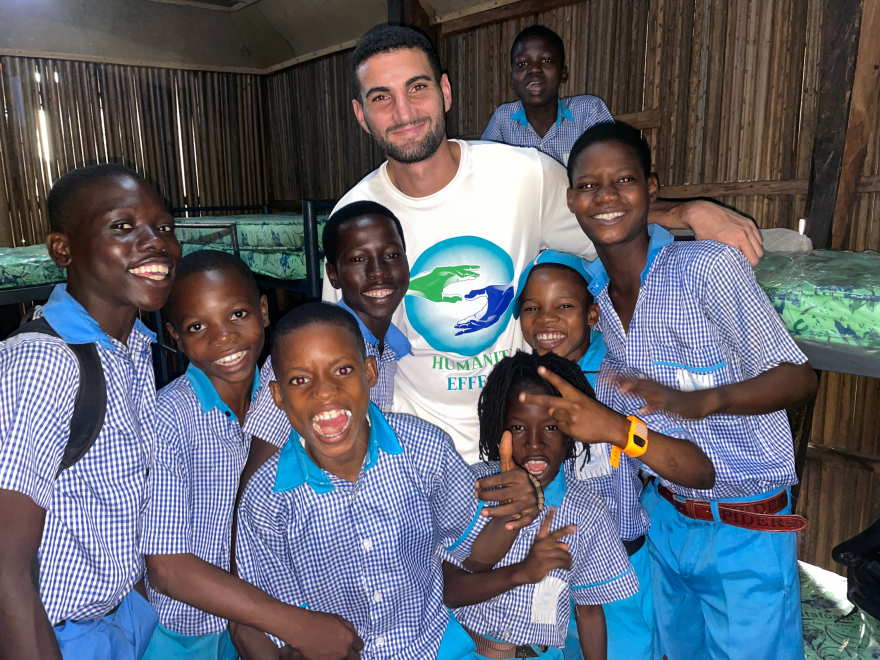


In this episode, Cameron reflects on the risks he took and the barriers he overcame. He shares the truths he discovered about the world, explores what it means to connect across borders and why these lessons matter for all of us.
Guest:
- Cameron Mofid, youngest person to travel to all 195 countries in the world, founder of Humanity Effect
Sources:
- Everyone Who Has Ever Been to Space (Clara Moskowitz and Zane Wolf, Scientific American, 2025)
- Ultimate Report on People Who Visited Every Country in the World (NomadMania, 2025)
- Three Spanish tourists killed in central Afghanistan gun attack 17 (Thomas Mackintosh, BBC News, 2024)
- Counter Terrorism Guide: Terrorist Groups, Al-Shabaab (Office of the Director of National Intelligence)
- Attitudes on an Interconnected World, International travel (Richard Wike, Janell Fetterolf, Moira Fagan and Sneha Gubbala, Pew Research Center, 2023)
- When in Rome ... Learn Why the Romans Do What They Do: How Multicultural Learning Experiences Facilitate Creativity (William W. Maddux, Hajo Adam and Adam D. Galinsky, Sage Journals, 2010)
- The Mental Benefits of Vacationing Somewhere New (Todd B. Kashdan, Harvard Business Review, 2018)
- A Meta-Analytic Test of Intergroup Contact Theory (Thomas F. Pettigrew and Linda R. Tropp, Journal of Personality and Social Psychology, 2005)
- "Maybe we did not learn that much academically, but we learn more from experience" – Erasmus mobility and its potential for transformative learning (Cosmin I. Nada and Justyna Legutko, International Journal of Intercultural Relations, 2022)
- Pack Your Bags and Travel: It's Good for You (Elizabeth A. Segal, Ph.D., Psychology Today 2022)
Episode 21: World Traveler Transcript
Julia Dixon Evans: There are more people than have been to space than to every country on Earth. And there's only one person, San Diego's Cameron Mofid, who has done that by the age of 25 years and one month. Parts of his saga are about as harrowing as launching out of the atmosphere in a rocket, like assuming a fake identity in Yemen.
Cameron Mofid: There was a group of tours about a year ago who didn't take those precautions and unfortunately three of them were killed 'cause they were tracked. Someone was following them. We wanted to attract as little attention as possible, so we dressed up in local clothing head to toe in the headscarf, and we each had fake names. So mine was Memet. We said we're a group of Turks.
Evans: And that was just one of 195 countries. There were many more adventures.
Mofid: Djibouti, um, just a little hostile. I was actually arrested there on espionage charges, and they took me to jail for half a day.
Evans: There were run-ins with authoritarian regimes, a terrorist threat in Somalia and a buzzer-beater, last-minute entry into North Korea to break the record. His adventures were exhilarating and eyeopening, but travel is a privilege. Cameron impressively paid his way around the world by starting a successful business, but he was born with huge advantages: a stable home, an American passport — all things he learned to appreciate while traveling.
Someone's ability to leave their country depends on where they're born. For example, more than 99% of people in Sweden and the Netherlands have traveled abroad compared with just 3% of people in India. This is closely linked to income. Residents of wealthier countries travel more. Yet even among rich nations, Americans are significantly less likely to travel abroad. Research shows travel gives people more empathy and makes them feel more connected to the rest of the world. Maybe we could use a little more of it.
Mofid: We have this version of the world in our mind which is very cynical, and that's the farthest thing from the truth — in almost every country in the world, I was met with extraordinary human kindness.
Evans: We'll take you inside Cameron's record-breaking mission to visit every country on earth with all its twists and dramatic moments. His chance, philanthropic partnership with Kyrie Irving, his beef with the Guinness Book of World Records and a host of herculean efforts to enter countries Americans cannot easily access. But his travels were more than a thrill. They were an education that, for Cameron, defied what we normally see on our phones and TVs.
Mofid: I think you just kind of learn about the goodness of humanity. And I know that sounds trite and I know that sounds cliche, but that's just the truth.
Evans: From KPBS Public Media, this is The Finest. A podcast about the people, art and movements redefining culture in San Diego. I'm Julia Dixon Evans.
[Theme Music]
Evans: Earlier this year, Cameron defeated the final boss of international travel. Today he's back home in San Diego, and he made a relatively short and easy trip by car to our KPBS studio to tell us all about it.
Mofid: My name is Cameron Mofid and in April this year, I became the youngest person to ever visit every country in the world after visiting North Korea and running in the Pyongyang Marathon.
Evans: When would you say your travel bug started?
Mofid: My teacher allowed me in the reading time that we had to choose the geography book. So while other kids were reading “Harry Potter” or fiction novels, I was studying the maps and learning about the different people. I had always loved history as a little kid. You know, history is always told by the winning side, right? So I wanted to learn about that other side and hear the other narrative that wasn't maybe pushed when I was learning this sort of thing about history and politics.
Evans: But the actual traveling started with tennis. His own promising career ended early due to injury, but he stayed around the sport and it brought him to some interesting places.
Mofid: For my gap year before starting college, I wrote for a tennis magazine called “Florida Tennis,” and I traveled to maybe 15 tournaments around the world writing for the magazine. And so flying somewhere where you know not a single person, not how your next day is gonna look like — that sort of lack of structure is like a drug. It's an adrenaline rush in a way. And as drugs do, right? The more you take, the higher your tolerance becomes. And so for me to get that same sort of adrenaline rush as I did five years ago, the sort of level of difficulty of the trip, the more remote the place, that you still get that adrenaline hit.
Evans: Ironically, it was when global travel completely shut down that he started to get really ambitious.
Mofid: So let's go back to COVID time. This is March 2020 and at this point I had been to maybe 40 countries just from traveling through tennis, doing weekend trips from the extra money I was making. And so I'm in my apartment, taking some online classes.
Evans: During this period while stuck at home, Cameron was also struggling with his mental health.
Mofid: My OCD at the time is really spiraling out of control because that's a disorder, for those listening who don't know, where an individual's obsessive thoughts can drive these compulsions. And I was not in the best mental state. And I was also on my computer randomly looking one day: How many people had ever been to every country? I found that more people had been to space than had been to every country in the world, which I thought was a really crazy statistic. So about 700 people have been to space. About 400 have been to every country in the world. So it just kind of hit me like, OK, I have 150 or so countries left to get to this real certified record of the youngest person who had probably done it. I had about five years and I told myself that would be a crazy cool thing to do and I wanted to go for it. And that's what I spent the last few years doing.
Evans: What Cameron means by real record points to a bit of a controversy in the world travel community.
Mofid: The Guinness Record, I didn't really see as legitimate. There was a woman who had done it, but she didn't go to North Korea because she went to the demilitarized zone from the South Korean side, and I think there were some airport transfers that she did as well.
Evans: I have to say, I'm with Cameron on this one. Do you count airport layovers when listing how many states or countries you've been to? I don't, but sound off in the comments if you disagree.
Cameron and many others use NomadMania to track and verify their travels, and that site does not count airport layovers — you have to literally touch the ground. Users measure their count against the United Nations list of 193 member states, but Cameron's goal was 195. Adding Palestine and the Vatican City, which the UN doesn't include.
The world's list of countries has probably fluctuated since you might've learned it in school. The newest to appear is South Sudan, added in 2011.
One hundred and ninety-five countries is a lot, but once Cameron realized that the record was within reach, he now had a goal. Still, as we mentioned earlier, traveling is expensive. He also didn't delay college to do it. So working around classes at the University of Miami, he made a plan.
Mofid: So I started my own event marketing company. So that was my way of saving up for the three years before I set out to really finish the mission. And we were doing events. So we'd say, OK, we're gonna sell 200 tickets for this party before 2020. It was just, you show up to the club, you pay a cover fee and that's it. There was no ticketing. Right. That was only for concerts and live music events, but we were doing that now for college kids and building a sense of urgency with tiered pricing. And we kinda blew up. We had 100 promoters, so I was working from like 10 p.m. to 4 a.m. five or six nights a week.
And I think that's one of the things about OCD is I try to see it as a superpower sometimes. I was like doing the event marketing company. I was finishing up school, and trying to figure out how to visit every country in the world. So it was always go. I've always been super organized.
And then when early 2023 came, I had just finished my MBA, so I wound up doing this like 4-year undergrad MBA program. I had saved up enough, maybe just over $100,000, to be able to finish the last 90 or so countries on my mission because I had traveled a bit during that three years. During the breaks, I went to Iraq randomly one week during my MBA, which my professors didn't like too much.
Evans: Cameron had the money and he clearly had the drive. Once he graduated, he had three years until he aged out of the record and almost 100 countries to go in order to break it. To finish the list, he had to take some risks. After all, not all 195 countries are in peaceful moments in their history. For example, Somalia.
Mofid: I wanna go to Mogadishu because that's the capital. The day I arrived, there were two rounds of motor attacks that hit the presidential palace and the international airport shut down. So my flight was canceled and I was effectively stranded in the most dangerous city in the world.
I was like, I need to get out of here. And Al-Shabaab had made a statement that they were going to attack the airport. Everyone's like, don't go. U.S. government put out a statement saying the U.S. personnel movement is suspended, avoid the airport. And I wound up being able to get to the airport. There was only domestic flights and there was a flight to the north of Somalia. And I remember that 15-hour span of when I was trying to figure out how to get out. That was pretty scary.
Evans: Then there's something even amateur world travelers can relate to: eating something risky and suffering the consequences.
Mofid: I was like deathly ill. I was in the southern part of Mali. I'd eaten some street food and then I flew that same night to Algeria. I was in the Algerian Sahara — not the place you want to get sick. And after I landed, I started feeling dizzy and confused. When I tried to stand up, I collapsed and I went through the night having delusions and I was kind of in a state of paralysis. And the next day was enough where I could make it to a hospital and I got an IV. I remember the head of police came for that city because if a foreigner dies in Central Algeria, especially in America, and it's not a good thing. And I just remember thinking to myself like, why am I here? That was like the closest I got to a breaking point.
Evans: And then there's what's probably the single biggest hurdle to going everywhere in the world: getting into countries that might not approve of your passport. To enter such places, you have to put yourself at the mercy of an unpredictable government, some with a history of detaining American tourists.
To get a visa for Venezuela, which has no functioning embassy in the U.S., Cameron had to fly to Barbados twice, submit a doctor's evaluation and still got interrogated when he finally arrived in Venezuela.
In the case of Afghanistan, Cameron went about two years after the Taliban took control of the country and after he got his visa — which involved meeting a guy at a shopping mall in Dubai — he decided to enter Afghanistan through Pakistan.
Mofid: Yeah, I found a driver to take me at 4 a.m. I put on the local clothing. I had my beard grown out for a few months at the time. I'm ethnically Middle Eastern, so I looked the part and we didn't get stopped at any of the checkpoints. Thankfully, I get to the border Torkham border crossing, which I'm pretty sure is now closed for tourists. It's known as the most chaotic border crossing in the world because there's such an influx of Afghans going to and from Pakistan. There was people grabbing onto the fence, kind of like yelling. And actually the Pakistani immigration officers were whipping people at the border. So once you cross that border and you see this massive Taliban flag — this white flag, which is the Taliban flag — and that's a surreal thing to be like, you know, oh my god I'm actually here. The Afghan immigration officer was a member of the Taliban, and I was like, oh my god, what is he going to say to me? How is this going to go? He sees my passport, I'm American, and he looks at me and he says, hello brother, how are you? I said, I'm good, excited to be here. And he said, can I get you anything? Would you like some tea or water? And I said, no, I'm OK. And he said, OK, well we welcome you to our country. And that was it.
And not any sort of endorsement at all for the Taliban, but I interacted with quite a few of these guys over the trip. And you have the guys that are like, women should not be in school because we're protecting them. And then you have the guys that say, absolutely, I want my kids to be educated. So that was fascinating to say, OK, that these people have their own opinions. There's not just one set Taliban playbook.
The world is very nuanced and the issues that we face are very complicated. And to recognize that complexity has been such a metaphor for my trips. This is more complicated than I had initially thought in Afghanistan. It's like this happened in the Congo. This happened in Yemen. This happened in Iraq. This happened in Chad. This happened in Sudan, in Niger, in Mali, in Venezuela, over and over again. And so I tell people the biggest takeaway from my travels is that despite the rhetoric that we see from politicians and media that try to pull us, to divide us and make the world seem very black and white. Almost all of the issues that the world faces fall into this massive gray area of nuance and uncovering that truth is extraordinarily difficult.
Evans: After the break, in the midst of his race around the world, Cameron is stopped in his tracks, shocked by poverty that surpasses anything he'd seen before, so he decides to do something about it. Then he faces his biggest test yet: getting into a country no Westerner has entered in half a decade. Stay with us.
[Music]
Evans: Afghanistan was adrenaline-packed and revelatory for Cameron. His time in Yemen and Somalia felt like something out of an action movie, but in the middle of it all came an unexpected country that would change his life more profoundly than any of the others.
Mofid: I find myself in Nigeria. It's my 115th country, and I visit the slum of Makoko. So you have 200,000 people living in a lagoon in the water, and they build their homes on stilts and instead of streets, they have canoes that are going over this very polluted water. So I've seen some of the worst poverty that exists in the world, but that, for me, was shocking. And so I visited the school, which was totally underfunded. You had the roof that was kind of collapsing. Many of the students didn't have shoes and books and backpacks. The teachers hadn't been paid in a few months. So I organized a GoFundMe to support the school. Initially, it was just going to be a few thousand dollars I had hoped from friends, but just as I had finished this initial GoFundMe round — which raised around $5,000, which I was happy with — I woke up one morning to a $45,000 donation from Kyrie Irving, famous NBA player who I guess had seen the fundraiser because it was trending on GoFundMe because of the amount of people that had donated to it. I said, OK, I want to start an organization called Humanity Effect, right? Where our collective humanity will propel change.
So that was two and a half years ago. We started off by refurbishing the first school, getting water tanks that easy access to water, paying all the teachers, getting a school boat, electricity. So we have 750 children under our care now. We pay all of our teacher salaries. We have 20 full-time teachers. We refurbished an orphanage. So before there was just an empty building where kids were sleeping on the floor. We actually today just had our first medical mission and our new medical center that we opened. We have eight doctors from states. My goal is to eradicate the educational crisis in Makoko.
Evans: Cameron never heard personally from Kyrie Irving, but this is something Kyrie does fairly regularly, randomly giving 20, 40, 60K to completely unsuspecting fundraisers. He apparently surfs GoFundMe in his free time and drops huge donations on causes that catch his eye. In terms of rich person hobbies, I gotta say that one is pretty cool.
Cameron has taken full advantage of that chance donation. He used it to turn Humanity Effect into a full-fledged nonprofit with donors, fundraising events and an impressive and growing list of achievements in his 115th country.
Mofid: We have hundreds of donors who have supported us. We have people that go visit every week. We've had volunteers come for months on end. I took our first group of donors in January on our first annual Humanity Effect group trip. So I think that has been by far the most rewarding and memorable experience, for me, the most purposeful thing in terms of visiting every country.
Evans: So Nigeria was more than just a notch on his travel log, but there were still countries left to visit and Cameron breezed through almost all of them. By the start of 2025, he had visited every country in the world, but one. And the clock was ticking on the record. He was just six months away from being too old to be the youngest person to do it.
Mofid: So North Korea was the perfect kind of climactic ending to this story. I'd been to 194 countries. Actually on my personal Instagram account in December, I posted this sort of thank you everyone for following along message 'cause and I said with North Korea closed and really no way in sight for me to get there. It's been five years. This is where this journey is coming to an end for now. There was no Westerners that had been to North Korea in more than five years at this point, and there wasn't anything I could do.
A month later, a friend of mine from the travel community, a Danish woman, she lets me know that she is going to try to get a visa as a table tennis investor through the Swedish Embassy with some Swedish friends because Sweden has always had kind of an oddly positive relationship with North Korea. And so we submit these resumes to this North Korean embassy in Stockholm, and they approve it. So I'm thinking, this is great. I'm gonna go to North Korea. We get the flights for early February. We're going as a part of a delegation of sports investors, and then a monkeypox outbreak hits the country and they cancel our visas.
And then a few weeks after that, they announced that the Rason Special Economic Zone is going to open up for tourists. And so of course I set up for the trip and then three days before the flight, it gets canceled. They allowed the first group in. There was a group of influencers and they had spoken not particularly fondly of the country, which the Ministry of Tourism I think didn't take too well. And so they shut it down and they say that's the end of that.
And so at this point I'm demoralized and then surely enough, a week later, they announced the 2025 Pyongyang Marathon is going to take place. And that was really the last chance for me if I wanted to break this record of 25 years and three months — what the previous record was. So we gave our passports to the tour organizers who took them to the North Korean Embassy to get an athlete visa. Normally, I had nap on planes, but I was so nervous and excited for that moment. My eyes were just wide open, looking out the window. We land, I sprinted off the plane. I was the first person off.I sprinted to the immigration man and he is asking me some questions, kind of looking at me and I'm like, oh, no, no, no, no, no. And then he stamps the passport.
Evans: How much of the country were you able to see?
Mofid: Yeah, and I get criticized by some of my friends when I speak to them about North Korea. And I wanna make it very clear that in no way do I support or endorse the policies of the North Korean government, but I can really speak for all of the people on that tour when we were shocked at how nice the city of Pyongyang was, right? Super clean. They have excellent public transportation. We were there for five days just in the capitol. We ran the marathon through the city unattended. We could go on morning runs.
There were some oddities for sure, like all of the apartments had a picture of Kim Jong Un hanging in the exact same spot. And the souvenir shops, they have these postcards with missiles going to America. And then they had this kind of eerie classical music on the streets playing at night in certain parts. So it did feel a little dystopian in a sense.
And again, not to make light of or to undermine the fact that the people there don't have freedom of speech and freedom of movement, but I think for us it was also a humanizing trip. Because you see like running in the streets during the marathon, people were high-fiving us and there were also people that were just going to work and walking around and riding their bikes and seeing kids play Frisbee with their parents. That's what you can find anywhere in the world. And so humanizing in that way that people are kind of just people no matter the place and find joy in a lot of the same things. And a smile goes a long way.
My thoughts were moving too quickly for what was actually happening and I didn't really register any of it, but yeah, it didn't really hit me actually that entire time I was there. The moment that it really hit me that this happened was when I crossed back and then once I passed the immigration in L.A., I just remember I started crying a little bit. It was just like, I can't believe it's over.
Archival clip: Cameron Mofid has actually visited every single country in the world.
Archival clip: He has set a world record for being the youngest person to visit each country in the world.
Mofid: Even now it's hard to kind of that feeling of like, you'd put seven years into something and I was in school, my MBA, writing for this tennis magazine, had this event marketing company — my whole life was trying to visit every country in the world. Even while I was doing those other things. Even while I was in school during class, all the time when I should have been listening to what the teachers would say I was trying to plan these trips. And all these late nights at 10 p.m. scanning these tickets for these kids to go to these nightclubs and trying to save up to be able to do this.
Just all of that in that moment, it was just like, I can't believe it's over. And like, what's next? You've just completed one of the most challenging goals possible in the world, something that only 400 people have ever done.
Evans: Have you considered going to space?
Mofid: Uh, yeah. That would be cool. There's actually a guy, his name's Jim Kitchen. He's the first person to visit every country in the world and go to space.
Evans: Oh, it's been done.
Mofid: And just to add to that, he went to like the lowest part of the earth in a submarine, like the deepest part of the earth that you can go with, like in the water. He did that.
Evans: Beyond the accolades or the record, we wondered, does Cameron see the world differently now that he's stepped foot in every country on it? He's hung out with some of the world's most notorious villains, narrowly avoided a terrorist attack, been detained multiple times on suspicion of espionage. He's seen the world's worst conflicts up close, but what he really notices is the people who are enduring them — surviving.
Mofid: People say that they're scared for the future of the world and like I'm not because I know that there's so much more goodness in this world than there is bad. The world has gone through horrible things, horrible events, and look where we are today. There's so many positives to focus on, and I think if you see the world from a lens of like everyone's bad, humans are inherently bad, then you're gonna think the world is doomed. And especially with all this news, right? This bad news of these wars and this kind of divisive political situation that we're in in our country and abroad. You're gonna have no hope, you'll have completely lost your hope in humanity.
I'm not saying that your listeners have to go to Afghanistan or Iraq or Somalia to find human kindness and restore their faith in humanity, but just have a little bit more of an open mind and to recognize that the world is a lot safer and in a much better position than I think it's made out to be.
Evans: How has traveling changed your perspective about the United States?
Mofid: I think a lot of the qualms that I have with the U.S. have to be foreign policy related. The fact that no country in the history of the world has orchestrated more coups than the U.S. government, it's exhausting to learn about that in practice. When you travel to these countries that, for example, Eritrea, I remember learning that the U.S. backed Ethiopia in the War for Independence because if Eritrea were to gain independence, then the U.S. would lose access potentially to the Red Sea, to those ports. So it's like Costa Rica and Honduras, or it's the Philippines, or it's Vietnam, or it's North Africa, or it's the Middle East. And that is kind of an exhausting thing to have to see over and over again. The U.S. had their hands in this, and the U.S. had their hands in that. But at the same time, when I hear that, people say like, OK, I don't wanna be American anymore. I'm disgusted of my American passport. It's like people die, people would do anything to come to America all over the world. Even in countries that we say like, oh, they hate America. They hate Americans. Like in parts of Africa or in the Middle East, those people would do anything. I've seen people hang American flags in their cars, seriously, because they say one day, like every day I'm working towards this and like one day I'm gonna get to America to make my dreams come true. And the reality is 99% of them will never be able to make it here. This truly is the land of opportunity and all over the world people want to have the privileges and freedoms that we’re offered in this country.
Evans: There is a certain perspective on America and the world that is harder to grasp from home. If you're lucky enough to leave your comfort zone, you can experience incredible food, art, music and architecture that seems otherworldly, but you can maybe also expand your idea of what humanity is capable of. What was once just an abstract piece of news on a screen becomes real and human.
Cameron is winding down his relentless travel era, enjoying his new title as the youngest person to visit every single country. He's back working in tennis media and putting a lot of time into his nonprofit, but traveling didn't just make him appreciate the U.S. as a whole more. It also made him love the place where it all started.
What do you think of San Diego now after all of this travel?
Mofid: Oh, I think it's the best place ever. I love San Diego. Of course it's an expensive city, but that aside, it's just wonderful. Weather for me is huge. That's great. We have a lot of things to do. It's not too congested. For example, Manhattan scares me. At the end of the day, there's no place like home. I'm not gonna say it's the greatest city of the world because I think that would come from a place of bias, but top 5. I'll really give it top 5 in terms of greatest cities. I think Sydney is the number one greatest city in the world. I always tell people, Sydney and San Diego are quite similar. For the listeners out there, you don't need to spend seven years visiting every country in the world to find out that San Diego is at the top of the list.
[Music]
Evans: A special thanks to Cameron Mofid for his help with this episode.
Next week on The Finest, we're experimenting with a new live music series and we're bringing you highlights of the first concert from the patio of the KPBS studio. And we'll introduce you to Slacker, the energetic punk band that kicked things off.
I'm your host, Julia Dixon Evans. Our producer, lead writer and composer is Anthony Wallace. Our engineer is Ben Redlawsk and our editor is Chrissy Nguyen.
This transcript has been edited for clarity and conciseness.
- Americans who have traveled internationally stand out in their views and knowledge of foreign affairs (Richard Wike and Janell Fetterolf, Pew Research Center, 2023)
- Remembering My Friend, Jim (Cameron Mofid, Florida Tennis, 2024)
- ‘It was a form of healing’: How traveling to every country helped this American cope with a mental health disorder (Tamara Hardingham-Gill, CNN, 2025)
- What is a Visit. Minimal Requirements according to NomadMania Rules (NomadMania, 2023)
- NomadMania Travel Lists
- What Is the Newest Country in the World? (Amy McKenna, Encyclopedia Britannica, 2011)
- Venezuelan embassy run by opposition in US closes after Guaido ouster (Jennifer Hansler, CNN, 2023)
- The Taliban in Afghanistan (Lindsay Maizland, Council on Foreign Relations, 2025)
- North Korea halts foreign tourism weeks after reopening to Western visitors (Peter Guo, NBC News, 2025)
- Makoko: 'Venice of Lagos' (Olamide Udoma, Smart Cities Dive)
- Chime Community Spotlight: Kyrie Irving recognized for civic contributions (Tamara Jolee, NBA, 2023)
- North Korea holds first Pyongyang International Marathon since borders were sealed during COVID pandemic (Anhelina Shamlii, CBS News, 2025)
- UNC prof and world (and space) traveler explores the deepest point on Earth (Sydney Franklin, WRAL, 2022)
- 10 Times America Helped Overthrow a Foreign Government (Becky Little, History.com, 2025)
- Hostile Acts U.S. Policy in Costa Rica in the 1980s (Martha Honey, 1994)
From KPBS Public Media, The Finest is a podcast about the people, art and movements redefining culture in San Diego. Listen to it wherever you get your podcasts or click the play button at the top of this page and subscribe to the show on Apple Podcasts, Spotify, Amazon Music, Pocket Casts, Pandora, YouTube or wherever you get your podcasts.
Have feedback or a story idea? We'd love to hear from you. Email us at thefinest@kpbs.org and let us know what you think.