Stream the series now with the PBS app
At the front lines of climate change, animals have a surprising story to tell in the PBS environmental docu-series, EVOLUTION EARTH. Narrated by evolutionary biologist Dr. Shane Campbell-Staton (HUMAN FOOTPRINT on PBS), the series embarks on a global expedition to reveal animals keeping pace with a planet changing at super speed.
1 of 9
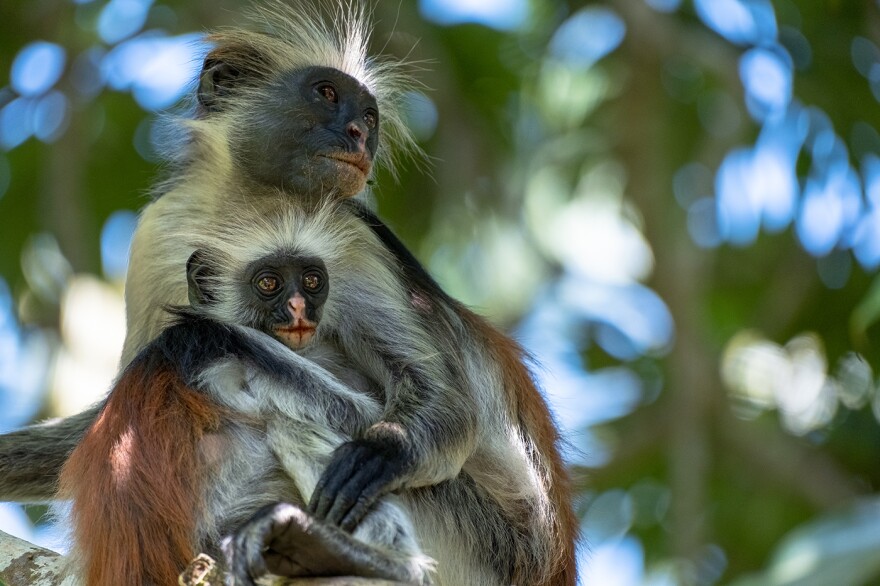
An adult and a young red colobus monkey hold each other atop a branch. The Zanzibar red colobus monkey is the only primate, except for humans, known to eat charcoal in the wild. (Jozani Chwaka Bay National Park, Zanzibar, Tanzania)
Taylor John Turner, Courtesy of Passion Planet Ltd.
2 of 9
Scientist Antonia Musso searching for invasive mountain pine beetles in the trunk of a pine tree. (West Central Alberta, near Drayon Valley/Minnow Lakes, Canada)
Courtesy of Passion Planet Ltd.
3 of 9
A young chimpanzee feeling the heat. During Fongoli's dry season, temperatures can reach as high as 48 C (120 F). (Fongoli, Senegal)
Courtesy of Passion Planet Ltd.
4 of 9
Scientist Anthony Herrel studies a silver key anole on North Caicos. (North Caicos, Turks and Caicos Islands)
Courtesy of Passion Planet Ltd.
5 of 9
A silver key anole climbing a tree branch - these so-called 'hurricane lizards' have developed longer forelimbs and stickier feet, increasing their chances of surviving extreme weather events. (North Caicos, Turks and Caicos Islands)
Courtesy of Passion Planet Ltd.
6 of 9
An Alaskan humpback whale swimming through the shallows near Hidden Falls Hatchery in Alaska. (Hidden Falls Hatchery / off Baranof Island, Chatham Strait, Alaska, USA)
Courtesy of Passion Planet Ltd.
7 of 9
A sea lion swims beneath a fishing boat in the waters of the Galapagos; fishermen have observed extraordinary cooperative hunting behavior in sea lions around the shores of Isabela in the Galapagos. (Galapagos, Ecuador)
Courtesy of Passion Planet Ltd.
8 of 9
Marine biologist Greg Lewbart holds a marine iguana - these remarkable reptiles have adapted to shrink their body length when food is scarce during El Nino events, increasing their chances of survival. (San Cristobal, Galapagos, Ecuador)
Courtesy of Passion Planet Ltd.
9 of 9
Saddlebag Lake, the location of a key Edith's checkerspot butterfly study site for scientists Camille Parmesan and Michael Singer. (Saddlebag Lake, Calif., USA)
Courtesy of Passion Planet Ltd.
“As an evolutionary biologist and professor, I enjoy exploring new ways to help people understand and get excited about the changing world around us,” said Dr. Campbell-Staton. “I am grateful for another opportunity to share my expertise on PBS platforms and to inspire exploration into our planet’s unique and awe inspiring ecosystems.”
Camille Parmesan gives us an insight into the lives of the climate sensitive Edith's Checkerspot. She tells us the story of how this climatic connection led her to discover a survival pattern across The Rockies. The butterflies were moving up the mountains and away from the equator, seeking environments with cooler climes. This was a key cog in helping reveal the secrets of our changing climate.
Heading out across the globe to distant wilds and modern urban environments, five episodes track how animals migrate, ingeniously adapt their behavior and even evolve in accelerated, unexpected ways. Documenting this rapid change are the scientists, filmmakers, and local communities recording the animals’ stories. EVOLUTION EARTH tells a tale of resilience that redefines our understanding of evolution and hints at how nature can show a path towards a sustainable future for Planet Earth.
On the Galápagos Islands, Greg Lewbart and his team are trying to catch a marine iguana. Their goal is to study the iguana’s unusual adaptation. They have evolved the ability to shrink and regrow their vertebrae in response to changes in food availability. These conditions arises when the Pacific Ocean that is home to the algae they feed on warms, a result of the weather system known as El Niño.
The debut episode “Earth” showcases the phenomena of evolution and adaptation to Earth’s extremes. From marine iguanas in the Galápagos shrinking their actual skeletons in response to extreme conditions to the Fongoli chimps living at the very edge of existence in a rapidly heating world, animals are acting as sentinels and helping to unlock the riddles of a changing planet.
We follow Jill Pruetz through the dry Senegalese landscape of Fongoli. Tracking alongside the local troop of critically endangered western chimpanzees, as they walk for miles to find water. Once at the dried riverbed, the chimps dig to find fresher water, this is one of the only groups in the world that does this.
The subsequent episodes of focus on evolution stories at the frontiers of the changing planet forged by the forces of the environments they are set in, and allows viewers to witness nature’s remarkable resilience.
In the Negev Desert of Israel, rising temperatures mean longer droughts, more intense heat waves, water sources drying out, and valleys turning to dust. With a loss of vegetation and water, the Nubian Ibex are migrating their country lifestyles to the big city. The ibex are boldly taking over the city to adapt to their needs.
EPISODE GUIDE:
Episode 1: “Earth” Encore Thursday, Sept. 5 at 7 p.m. on KPBS 2 - At Earth’s extremes, animals are reacting in surprising ways. With animal’s homes changing around them at superspeed, the debut episode follows remarkable stories of resilience and hope. From humpback whales to tiny butterflies to ingenious savanna chimpanzees.
At Earth’s extremes, animals are reacting in surprising ways. Animal homes are changing around them at superspeed. Follow remarkable stories of resilience and hope. From humpback whales to tiny butterflies to ingenious savanna chimpanzees.
Episode 2: “Islands” - Islands are like miniature simplified Earths, where evolution is playing out at super speed right before one’s eyes. Journey from the Galapagos to the edge of Antarctica to seek out animals responding to the changing planet in extraordinary ways.
Islands are like miniature simplified Earths, where evolution is playing out at super speed right before our eyes. Journey from the Galapagos to the edge of Antarctica to seek out animals responding to our changing planet in extraordinary ways.
Episode 3: “Heat” - Travel to the hottest and driest extremes to see animals go to extraordinary lengths to survive. From the Sahara Desert to Australia, animals provide new clues about the changing planet and what it will mean for the future of our heating world.
Travel to the hottest and driest extremes to see animals go to extraordinary lengths to survive. From the Sahara Desert to Australia, animals provide new clues about our changing planet and what it will mean for the future of our heating world.
Episode 4: “Ice” - At the planet’s frozen extremes, shifts in animal movement and behavior reveal vital information about our future world. Examine polar bears in the Arctic, penguins in Antarctica and other animals surviving in icy worlds.
At the planet’s frozen extremes, shifts in animal movement and behavior reveal vital information about our future world. Examine polar bears in the Arctic, penguins in Antarctica and other animals surviving in icy worlds.
Episode 5: “Grasslands” - Grasslands are one of the planet’s most important, yet most overlooked habitats. In the final episode, follow scientists as they discover animal species with the power to transform and restore the grasslands, turning them into carbon sinks that could slow climate change.
Join The Conversation: Viewers are encouraged to engage in online conversation about the series by tagging @PBS and using #EvolutionEarthPBS on Facebook and Instagram.
billy barr looks through the logs he's been keeping for almost 50 years. He explains how the glacier lilies emergence is becoming more and more out of sync with the broad-tailed hummingbirds arrival after their long migration up from Mexico. When billy started keeping his records in the 70s they arrived on the same day, today the lily is flowering three weeks before the hummingbird arrives.
Credits: Produced by PASSION Planet in co-production with PBS, Love Nature and ARTE. David Allen is co-series producer; Oliver Twinch is director for “Earth” and “Islands” episodes; Charlotte Lathane is director for “Ice” and “Grasslands” episodes; Rachelle Keeling and Nick Stringer are producers and directors for “Heat” episode; and Shari De Silva is line producer for PASSION Planet. Dr. Shane Campbell-Staton narrates. Executive in charge for PBS: Bill Gardner.