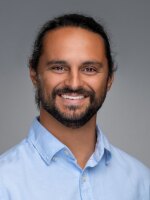
Sitting in a park in the Mexican border city of Tecate, Norma Meza Calles can hear the sound of border wall construction crews pulverizing boulders on Tecate Peak, about a half mile away.
To Meza, each pebble that crews chip away from those boulders is an insult to her and the rest of the Kumeyaay people. That's because the peak, which is also known as Kuchamaa Mountain, is a sacred place.
“They’re destroying it,” Meza said in Spanish.
Meza said the mountain is like a therapist for the Kumeyaay. Generations of Kumeyaay on both sides of the border have hiked up the mountain to meditate while sitting on the smooth white boulders that have been there for more than 100 million years.
As a little girl, Meza remembers seeing adults — grieving the loss of a loved one or coping with divorce — spend days in silent contemplation on some of the very same boulders that are now being ripped apart so President Donald Trump’s border wall can be extended.
“That’s where you go for a cleanse,” she said. “Because you have to release all of that sadness from your mind.”
Kuchamaa Mountain, which sits on both sides of the border, is protected in the National Register of Historic Places. Yet, this construction project was approved without the formal review typically required by the National Environmental Policy Act.
But, in the name of national security, the Trump administration has waived those reviews for multiple projects along the border.
Have a tip? 📨
The Investigations Team at KPBS holds powerful people and institutions accountable. But we can’t do it alone — we depend on tips from the public to point us in the right direction. There are two ways to contact the I-Team.
For general tips, you can send an email to investigations@kpbs.org.
If you need more security, you can send anonymous tips or share documents via our secure Signal account at 619-594-8177.
To learn more about how we use Signal and other privacy protections, click here.
“The Department of Homeland Security has been able to secure successfully through legal means waivers on some of these border projects, and Congress authorized multi-year funding for the border fences, which has allowed some of these projects to be fast-tracked,” said Richard Kiy, president of the Institute of the Americas.
The administration waived a similar review process for another construction project near Big Bend National Park in Texas. The project faced multiple protests this year.
Kiy worked on cross-border affairs for the U.S. Environmental Protection Agency during the Clinton administration. He said the stones on Kuchamaa Mountain might have been saved had there been a review.
“That would have allowed more for public consultation,” he said. “That would’ve allowed for considerations related to the cultural significance of Mount Kuchamaa, it would’ve taken into account some of the environmental impacts including wildlife corridors.”
That said, every project has some environmental impact, and it is not accurate to believe a review would have mitigated all those impacts, Kiy added.
Nonetheless, Kiy said an extensive environmental review could’ve incentivized the federal government to come up with new building methods. For example, the Indian government has experimented with a laser fence along its border with Pakistan.
“In the 21st century, I think there are ways to explore technology solutions so that we can have a secure border but at the same time address some of the biodiversity concerns and cultural heritage concerns that exist in a place like the Tecate border,” Kiy said.
As someone who worked on border projects for the EPA, Kiy understands why the administration waived these requirements. The process can take years and derail projects. For example, he said, it took the EPA 10 years to complete its review of the CBX airport border crossing in Otay Mesa.

While there has been no environmental review on the U.S. side, several Mexico-based organizations have conducted their own.
The Rancho La Puerta Foundation, an organization that helped establish a conservation easement for Kuchamaa Mountain on the Mexican side of the border, coordinated an independent review, said Demien Vega, an institutional development coordinator with the foundation.
The 280-page study identifies several species of plants and animals that will likely be impacted by the new wall. For example, mountain lions cross from the Mexican side to the U.S. side to access their main source of water. The report also flags the risk of mudslides in Buena Vista, one of Tecate’s oldest neighborhoods, which sits at the foot of the mountain right along the border wall.
“Everything will wash down with a Super El Niño here in Tecate and this neighborhood can suffer the consequences,” Vega said.
Part of what makes the current reality so heartbreaking for the people of Tecate is they thought they’d done enough over the years to protect the mountain.
In the early 2000s, Kumeyaay representatives and Mexican conservationists worked with their U.S. counterparts to expand the environmental protections north of the border.
“Through an MOU with the Bureau of Land Management and the Forestry service, we convinced them to protect the land and we all agreed – both nations,” Vega said. “So all of the mountain is protected in terms of nature and biodiversity.”
In Mexico, the controversy surrounding the project has reached the highest levels of government.
Last month, Baja California’s Secretary of Culture formally asked the U.S. to stop detonating explosives on the mountain. When asked about it by local reporters, Mexican President Claudia Sheinbaum said her office is aware of the situation.

Back in Tecate, Meza doesn’t expect construction to stop.
She respects U.S. sovereignty and its right to defend its border. She said that section of the border can be dangerous because of drug smuggling. But she knows the border could be secured – perhaps with cameras or motion sensors — without destroying a heritage.
She views this as one more indignity in a history full of them.
“We’ve always been stepped on and discriminated against,” she said. “And we’ve resisted. The mountain will resist too.”
- After Trump ends protected status, San Diego’s Haitian community is struggling to adapt
- California lawmakers revoke charity tax breaks for Imperial County ICE detention center
- Immigrants are losing due process rights because of Laken Riley Act, lawyers say
- Last year they cut librarian jobs. Now the Grossmont Union High School Board is adding millions to the athletics budget