
An El Cajon City Council meeting was once again the setting for a public clash over immigration.
Following the recent killings of U.S. citizens Renee Good and Alex Pretti by federal agents in Minneapolis, El Cajon residents on Tuesday protested outside council chambers and continued their outcry during the public comment section of the meeting.
“I was born and raised in East County… and these are not our values,” El Cajon resident Alicia Aguayo said. “They're trying to get the attention of this federal administration and they're out here in office, not to serve the people, but to serve their own goals.”
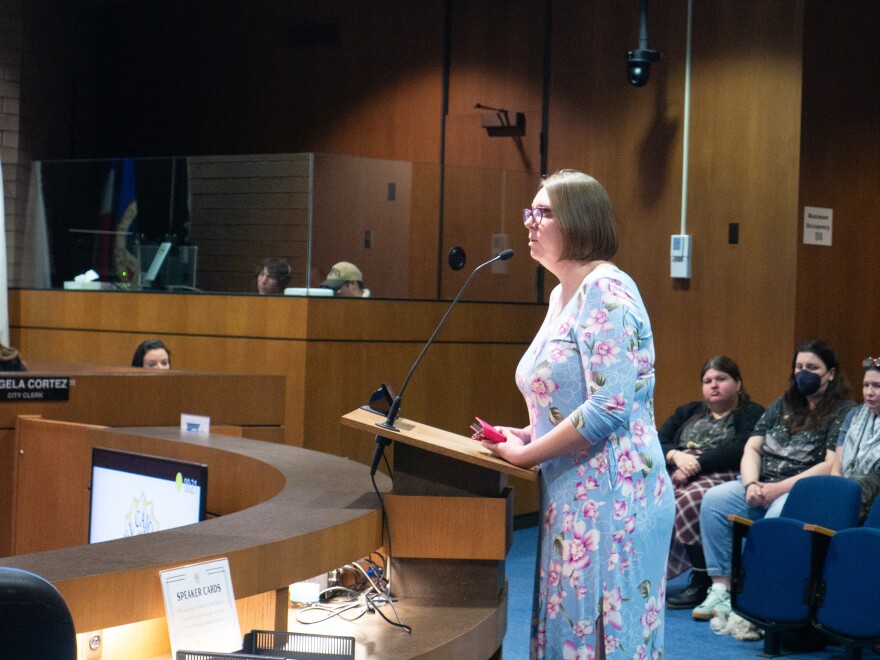

Another El Cajon resident, Crystal Abrahim, said she felt called to attend the meeting.
“I hate seeing violence being perpetuated, our communities being terrorized,” Abrahim said. “Press conferences like this, I feel like the least I can do given the situation of our country right now.”
Last February, councilmembers, in a 3-2 vote, approved a resolution declaring El Cajon is not an immigrant sanctuary city, despite San Diego being a sanctuary county and California being a sanctuary state.
The majority who approved the resolution included councilmembers Steve Goble, Phil Ortiz and Mayor Bill Wells. El Cajon is so far the only city in the county to adopt a measure of this kind.

Less than a month after the resolution passed, dozens of federal agents raided an industrial paint shop just outside the city and ICE arrested 26 immigrants.
KPBS reporting also revealed that out-of-state police agencies routinely tapped into El Cajon’s automated license plate reader (ALPR) data last year for immigration-related searches – sometimes on behalf of federal agencies.
Last year, California Attorney General Rob Bonta filed a lawsuit against the city of El Cajon regarding its ALPR data sharing.
Councilmember Gary Kendrick, who voted against the city’s resolution, joined Tuesday’s protest by community members. He spoke of the state’s immigrant sanctuary law, known as Senate Bill 54.

“SB 54 was passed in the first Trump administration and the federal government at that time sued the state of California… in federal court,” Kendrick said before the meeting. “And the state won, so it is the law of the land.”
While most speakers at the meeting were against the resolution, a handful voiced their support.
“I want to thank you for cooperating with all of our law enforcement agencies. Thank you for cooperating with ICE, DHS, Border Patrol and our local police and sheriff,” one speaker said in public comment.
In an interview with KPBS after the meeting, Mayor Bill Wells said critics are mischaracterizing the resolution.
“We're not asking our police officers to break the law,” Wells said. “What we did was we voiced our opinion that the federal law supersedes the state law. That's it.”
The Council has not made any plans to address the resolution at future meetings.


