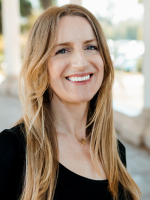
When Paola Capó-García began her term as poet laureate in January 2025, she knew it would be a rollercoaster.
"But I didn't expect it to be quite as intense as it has been," she said. "Which is a beautiful thing, right? That a lot of places in San Diego want to do poetry events. I didn't expect that."
She also continues to work full time as an educator. The poet laureate role comes with a stipend, but she said it's just enough to cover the costs of a signature project.

Similar to her work as an educator, Capó-García brings poetry into classrooms, community centers and other spaces throughout the region. She said teaching poetry is not only about demystifying the art form, but also helping students recognize their own lives in a poem.
She recommends a few go-to poets for people who may feel skeptical about poetry.
"I will always go to Gwendolyn Brooks. I will always go to Ilya Kaminsky. I will always go to Claudia Rankine," Capó-García said. "And I will always go to Lucille Clifton. Clifton's way of writing, I think, is so historically important, but in a contemporary way so, so visceral and relevant. I think her language is so accessible. Whenever I teach Clifton, people — their eyes light up."

A new poem Capó-García has added to her teaching repertoire is "History Class," by the Palestinian poet Mosab Abu Toha.
"That poem is so short, so steeped in metaphor, but so accessible. It's about the ways in which the past, present and future imprison us in different ways, depending on where you come from, who you are, the decisions you've made in your life. And it does this all in the context of the history classroom. And the students are the past, present and the future. There's both a literalness and an abstraction in that poem that I think hits really hard for a lot of people when they read it — and works for so many different age groups," she said.

Capó-García recently launched her poet laureate project, "Apertura." The word means an opening.
"It's an invitation to people to experience poetry in a different way, and to open themselves up more to the possibilities of poetry," she said.
“Apertura” includes a video poem exhibit that will launch in October at the Athenaeum Art Center in Logan Heights. The idea of bringing video poetics into her laureateship was first inspired by classroom projects during her years teaching at High Tech High, based on the moving portraits of photographer Robert Wilson.
She was also inspired by an art exhibition at the Museum of Contemporary Art in her native Puerto Rico, particularly a video work called "Becoming Wind and Current" by La Vaughn Belle.
"She centers herself, her body, in floating water in an area called Loíza in Puerto Rico. And she's talking about migration, and she's also talking about the legacy of slavery in the Caribbean and sort of migrating bodies from one area to another, and the ways in which enslaved people would escape captivity through that by using water and the currents to get to different islands," Capó-García said. "I was so moved by that piece, the way she used her body, her voiceover with the poem, which is so gorgeous."
She said she instantly knew that would be the project she would pursue during her laureate term.

"This is what I want to elevate, because this is a way to also get people interested in poetry who maybe normally wouldn't be interested in poetry — through the visuals, through the storytelling, and bringing something on the page to life that way," she said.
The “Apertura” video poetics workshops took place in May, and the resulting video poems will be shown at the Athenaeum Art Center.
“Apertura” also includes a zine component. In collaboration with Burn All Books, Capó-García will publish three zines: one zine is all youth poets, another features Latino and Filipino voices and a third showcases work by people and their families impacted by the justice system.
The zines are open to the public within each category, and submissions are due Sept.1, 2026.

She also worked with Project PAINT (Providing Artists in Nurturing Transformations) and Poetic Justice to bring poetry workshops to men's and women's prisons in the region.
"If I think back on what I think are the most meaningful experiences I've had during my tenure, I want to keep coming back to the work I've been able to do inside prisons. That has completely changed my life," she said.
Ultimately, Capó-García said she's found this year of civic poetry to be a kind of proof for her mission.
"It has affirmed to me, or confirmed really, my suspicion that a lot of people want and need poetry in the city,” she said “And that I do think that it is for everyone."