


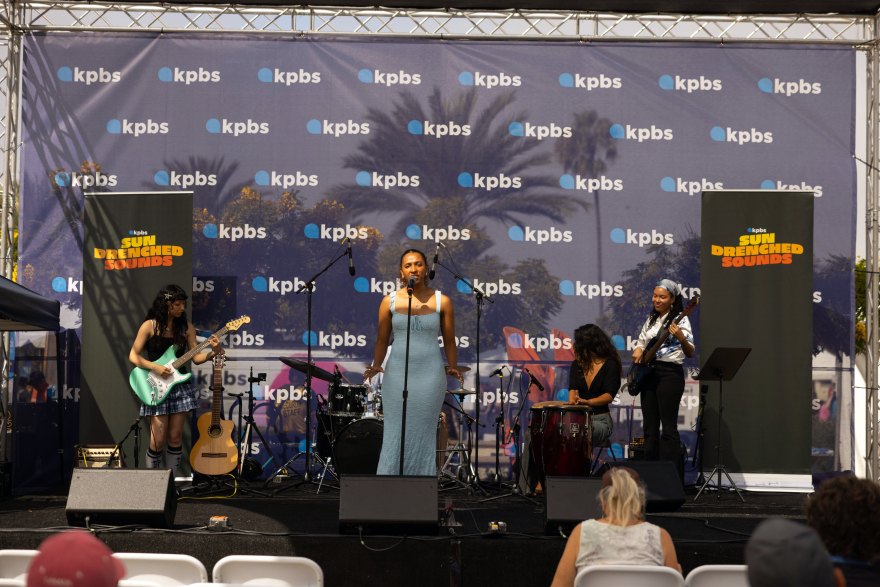


San Diego musician Nicole Hernandez grew up in Tijuana with a Cuban father and a mother from Sinaloa, Mexico. The music she heard growing up, from salsa and reggaeton to hip-hop, now finds its way into her sound. After discovering Nicole through the NPR Tiny Desk Contest, we invited her and her band to perform at the KPBS San Diego Book Festival. After the performance, Nicole joined us in the studio to talk about her debut album, "Layers," writing in English and Spanish, the stories behind songs like "Viste" and "Rina," and how she brought together an all-women band of musicians from around San Diego.
Watch Nicole Hernandez's full live performance:
Guest:
- Nicole Hernandez, musician
Nicole's band for the Sun Drenched Sounds live performance:
- Drums: Sarah Brew
- Congas: Sahar Malik
- Bass: Angelica Yumi Pruitt
- Guitar: Athalia Rodriguez
Sources:
- Nicole Hernandez's Tiny Desk Contest submission, "Viste" (2026)
- Nicole Hernandez, "Pa Ya" official music video), from "Layers"
- Daddy Yankee, "Gasolina" (2004)
- Havana D'Primera, "Pasaporte" (2013)
- How Tijuana Went From Stopover to Destination (Frankie Mills, New Lines Magazine, 2026)
- 10 standout San Diego artists from the 2026 NPR Tiny Desk Contest (Julia Dixon Evans, KPBS, 2026)
Julia Dixon Evans: Every year, we get a list of the local artists who entered the NPR Tiny Desk Contest, and we watch them all. This year, one video really stood out to me. The song was called Vista, sung in Spanish, and it's a mesmerizing blend of Afro-Cuban influences, Latin jazz, R&B, electro pop, and soul. And it was performed by Nicole Hernandez and her band of seven talented musicians, all of them women
Nicole Hernandez: I focused my energy on finding different women instrumentalists and like little by little, like I, I always say it as like collecting like the Infinity Stones.
Evans: We had to hear more, so we invited Nicole's band to perform at our KPBS San Diego Book Festival in August. Are you my shade? After the show, she stopped by the KPBS studio to chat with us. I feel like fusion is kind of like the future of music, and everybody's just like, like mixing sounds and creating new genres out of it, and that's honestly like what I love and I want to continue to expand into myself.
Evans: We learned how Nicole gathered her Infinity Stones band, picking up musicians all over town. And we heard the stories behind her songs, and how her sound comes directly from her own cross-border upbringing. Paying homage to certain parts of my lineage, and I really try to incorporate them into my music as best as I can.
Evans: Last year, she released her debut album, Layers. Its sound quite aptly captures the growing diversity in our region. Tijuana has increasingly become a multicultural mecca, a destination for migrants from all over Latin America, Africa, and beyond. Nicole grew up in Tijuana, surrounded by a fusion of genres from the very beginning.
Evans: Her father is from Cuba, and her mother is from Sinaloa, Mexico. And now, as she launches her own music career, she's bringing her unique sound and perspective to the world from right here in San Diego
Hernandez: My name's Nicole Hernandez, and I'm a musician based out of San Diego, California and I sing and produce, and the music that I make is just kind of like a melting pot of my heritage and a lot of the sounds and influences that have inspired me throughout my life.
Evans: From KPBS Public Media, this is The Finest, a podcast about the people, art, and movements redefining culture in San Diego. I'm Julia Dixon Evans
Evans: So I wanna start with going way back, like, with your background in music. Do you remember what the music in your house was like when you were a kid? Like, what did your parents listen to, or what kind of stuff was played in your home? Yeah. well, growing up, my parents would play all kinds of music.my dad...
Hernandez: One of my earliest memories is, like, him playing, like, Gasolina by Daddy, my Daddy Yankee.
Hernandez: We would have, we lived in this, like, small apartment in Tijuana in Playas, and my crib was right next to the speaker. So, I d- there's, like, this video he has, like, on, like, his, like, camcorder- Mm-hmm ... of, like, that song just, like, blasting, and I'm just, like, dancing, like, up and down, like, listening to the song
Hernandez: A lot of reggaeton, a lot of salsa growing up, but also, like, a lot of rap and hip hop. My dad just, like, loves all kinds of styles of music, and I feel like he has been a huge reference of inspiration for me, just, like, all the different styles that he plays. Yeah. What does your dad think about your music?
Evans: Oh, he, he, he enjoys it. Yeah. He enjoys, like... Just yesterday actually at his birthday party they were, like, playing my album, and, Aw ... and, like, my entire family was there. And, it played all the way through, like, three times. After the third time, me and my sister were like, "OK, guys, like, let's play, let's play, let's play something else."
Hernandez: I know we've got to give it a listen, but no, he definitely is supportive. And every time that he, like, meets anyone, he's like, "Oh, like, my daughter makes music. You should listen to the music," or he'll just play it. Mm-hmm. So I'm like, I'm like, "Shout out my dad." He's, he's extremely supportive. Both my parents are, thankfully.
Evans: Mm-hmm. Do you have any, like, specific artists that you can point to, like, especially if you remember them, like, from your childhood or something coming from your father? Yes. I would say Alexander Abreu. he has a salsa group,, called Havana d'Primera. They're based out of Cuba, and he's an amazing trumpet player, arranger, composer, band leader.
Hernandez: And it's a lot of, like, traditional,Cuban style salsa. and just, like, the arrangements are just, like, crazy.
Hernandez: My favorite album by him is called Pasaporte, and I would say that that is an album and an artist that just has, like, been a huge influence in regards to, like, the Afro-Cuban sound that I try to put into my music
Nicole singing: It's not within me to run game, but I could do it if I tried, or if I really, really tried hard to OK. I wanna ask you about the song you played called Rina. Oh my gosh, Rina. Tell me what that song means to you. Oh my gosh, I love Rina. That, that's one of my favorite, favorite songs from the album. It's the way of my persuasion.
Nicole singing: Don't have the time, the energy, or resources to spare. I put it at the end of the album because it's kind of like an understanding of just kind of like I can't pour out into other things or other people what I can't, give and pour to myself first, and this whole, like, empty cup analogy of giving what one doesn't have.
Hernandez: And these are all still things that I'm very much still understanding and trying to get better at There's kinda like this moment where it like it flips over onto the bridge. It just kinda like breaks loose, and it opens up, and it's this kinda like musical party that's going on. yeah, I, I love Rina
Nicole singing: Pensamiento no gasta mi tiempo con eso fui preso, no gasta mi tiempo
Evans: "Rina" is a song that, like, starts out in English- Mm-hmm ... and then you finish in Spanish. Yes. Can you talk about writing in two language? Like, how do you find or, or, like, assign a language to a song, or even, like, verse to verse? Yes. You know, I feel like sometimes it's a bit of, like, my, my no sabo brain peeping in, in which, like, there's, like, certain words that I feel like can be better translate what it is I'm trying to say in either Spanish or English.
Hernandez: but very intentionally, I do want to continue, like, writing in both. and, like, a big influence of mine that, like, I feel like weaves really well out of both languages is someone like Kali Uchis, or someone like Selena too, like, she would do that all the time. But I think honestly it just comes down to me, trying to, like, represent and evoke a specific emotion, and sometimes I feel like one language is better at, like, getting that across than the other.
Hernandez: And it's, it's all... And it's very much like a feel depending on what and how it is that I'm trying to say it, too. So you were in Tijuana when you were a baby. Yeah. Like, how long did you live there? Oh, I lived there until I was seven. OK, so you grew up there. Yeah, yeah, we grew... yeah, I grew up in Tijuana Playas.
Hernandez: Then we came over here, and then I did elementary and middle school and high school over here. And, did you play music in school? Yeah, yeah. So, growing up, my parents, they had put me and my sister into La Mesa Arts Middle School, and that honestly built a lot of, like, our musical foundations from a very young age.
Hernandez: It just created access to these, like, programs that my family wouldn't have been able to, like, pay for otherwise., and I was part of their, like, ensembles, their choirs, and we would perform all around town. I think that, like, the access that I had to the arts in my public education was a big pillar in my artistic evolution.
Hernandez: Yeah. Growing up, I'd always been very academically driven, and for a long time, I, I had the aspirations of, like, wanting to become a lawyer. Then around the age of 14 is when I, like, figured out that I wanted to... I didn't wanna live with, like, the what if, and I was like, "You know, if I want to at one point go back to school and give another career, like, a try, like, school will always be there."
Evans: So Nicole got serious about studying music and learning to express her feelings through sound. She left home to attend the Berklee College of Music in Boston, where she pieced together that debut album, Layers
Evans: One of the standout tracks on that album, and the one we first heard in her Tiny Desk Contest video, is Viste. It's the only song on the album that's fully in Spanish, so I- I'm talking a lot about, like, a passive-aggressive, like, emotion towards someone, just kind of being like, "Look, this is what could have been, but this is what it was, and there's nothing that can get us to what it was anymore, 'cause this is what it is."
Hernandez: Viste, like, as the word itself means look. It's a term normally used in Cuba that's just kind of like, viste, like, look. I- I don't know how to explain it. It- it's kind of like slang, kinda... Like, you know those words that depending on, like, the inflection of how you're saying it, they mean different things?
Hernandez: It's one of those words.
Hernandez: The song starts very, like, timidly almost, and it's, it's kind of like it's, like, brewing, and eventually just kind of, like, explodes fully at the end
Hernandez: I think that, at least in the way that I've experienced a lot of my own passive aggressiveness, it starts off with, like, me, like, sending, like, well wishes and all of these different things, and then eventually, like, the act comes down, and it's like, "Forget all of that. Screw you." but, and I think that that's kinda why I wanted to introduce the movement at that moment of when those lyrics come down, where the walls are also coming down.
Hernandez: No te quiero más. Tú te vas y te fuiste. Te me fuiste.
Evans: Coming up, Nicole scours the city to assemble her dream band. Stay with us
Evans: Nicole's band has some serious chops. The group skillfully pulls off some fairly complex compositions. They sound like they've been studying and practicing music for decades. But most everyone in the band, including Nicole, are around the same age, in their early 20s. And in jazz circles, what's possibly even more remarkable is that they're all women.
Evans: Call on the deuce.
Hernandez: When I decided to come back to San Diego and, continue to play the music live, I wanted to really intentionally focus on creating a band that was all women. I don't know, when people normally think of musicians, they just, like, normally think of men for the most part. And, I think that, like, both women and men have the same capability to, like, play instruments and are so, like, extremely talented, and I just, like, really wanted to have an all-women band.
Hernandez: So when coming back, I focused my energy on finding different women instrumentalists and, like, little by little, like, finding them, like it was in the most, like, random of ways. Like,the original pianist that I started working with at an Apple Store, and I had noticed that she had, like, a piano on her, on her lock screen.
Hernandez: and I was like, "Oh my gosh, do you play the piano?" And, from that conversation, eventually we, like, met up and, like, talked about it, and she had originally had joined the band. And then, like, one of the drummers that I work with, I had met her on this, like, app where you can, like, meet musicians. And, and this other girl, I had met her, like, I saw her playing in an Instagram post, and I had, like, reached out to her.
Hernandez: So little by little, started to put the band together, and now we've been playing together since 2025, May. Since May, we've been playing together and just doing different shows locally, and they've honestly changed my life. Playing with them has been, like, such a blessing. It's all just mirrored. Can't you see?
Hernandez: A lot of the, the girls in the band, like, they play m- multiple instruments. they also have, like, their own original music. Sarah, for example, at the gig she was playing the drums, but she normally plays the guitar for most of the shows. Nina plays a lot of other instruments. She plays the bass, the guitar.
Hernandez: She has her own original music. Angelica plays the bass, and Sahar plays the congas. Itali also plays the guitar. And I think it's just, like, it's a lot of different synergies.
Hernandez: Now, when it comes to playing the music live, I always tell any of the musicians that I work with that, like, I want them to feel like they can, like, add their own element and own spice into what it is that they're playing. I don't want it to sound like an exact replica, because if that was the case, then I would just play with the track.
Evans: I want this for everyone. Yeah. I want everyone to have their own girl band. Yes. I agree. I agree. More divas. We need more divas playing. We really do. How could you tell me now? How could you figure out? How could you tell me now?
Evans: What is it about music that keeps you going? Like, why do you keep making this art? Yeah. I would say the thing that has always drawn me to music is the way that you can impact and share a message with so many people in such a universal way. The expression of singing is something that has just always brought me the utmost joy.
Hernandez: So in whatever it is that I do in my life, I, I, I never plan to stop singing. I've always described it as, like, pretty yelling. So picture you walking away
Hernandez: Yeah. So I, I think that being able to enact emotions in different people, it, and to me it feels like magic. it feels like magic in, in real life. the creation of it, the sound, and it's fleeting, but it's important. I just wanna keep making music that I feel connected to and music that I, that I like.
Hernandez: Music that I like and that feels like me, and hopefully that, radiates and connects with whoever it's supposed to resonate with. Yeah.
Nicole singing: Dime algo que no sé, algo que no entienda
Evans: Special thanks to Nicole Hernandez and her band, and a big thank you to the Sun-Drenched Sounds team at KPBS and to everyone who helped out with or attended the KPBS San Diego Book Festival. Keep an eye out for a video of Nicole's performance on our website and social media. And thank you to the NPR Tiny Desk Contest for putting so many great local artists on our radar every year
Hernandez: Thank you guys so much. You guys have been such an amazing crowd so far. Thank you, guys. Again, my name's Nicole Hernandez.
Evans: The Finest is a production of KPBS Public Media in San Diego. I'm your host, Julia Dixon Evans. Our producer is Anthony Wallace, who also composed the score. Ben Redlawsk is our engineer, and Chrissy Nguyen is our editor. This episode was written and researched by Anthony and me.
From KPBS Public Media, The Finest is a podcast about the people, art and movements redefining culture in San Diego. Listen to it wherever you get your podcasts or click the play button at the top of this page and subscribe to the show on Apple Podcasts, Spotify, Amazon Music, Pocket Casts, Pandora, YouTube or wherever you get your podcasts.
Have feedback or a story idea? We'd love to hear from you. Email us at thefinest@kpbs.org and let us know what you think.