







What's growing in your backyard?
In San Diego, one of America's most biodiverse regions, the answer is more complicated than you might think. It's home to roughly 3,000 plant species, with many still undocumented.
This episode follows hikers, students and nature lovers using the free app iNaturalist to photograph plants and animals, contribute to a global biodiversity database and help scientists protect fragile ecosystems. Some discoveries are extraordinary, like seeing your name on a scientific paper after spotting a plant never recorded in the county before.
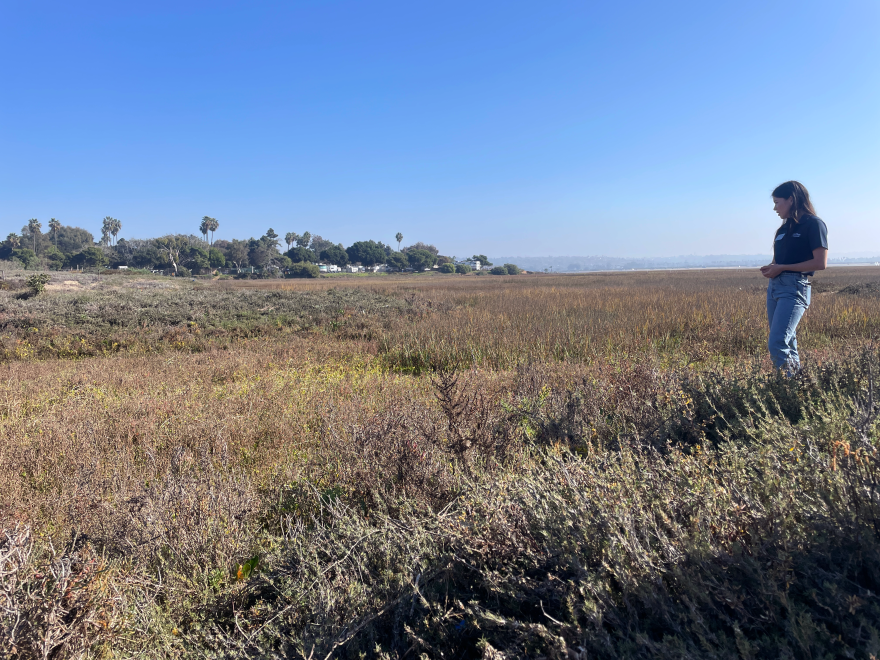


We visit the San Diego Natural History Museum, head into a rare salt marsh along Mission Bay and join a community identification party to see how this grassroots effort is reshaping science in real time.
Researchers and volunteers say this kind of "citizen science" is no longer a side project — it's essential. Because when it comes to protecting ecosystems, the first step is simple: knowing what's there.

Guests:
- Jon Rebman, Ph.D., curator of botany at SDNHM
- Becky Escalante, citizen scientist spifferella on iNaturalist, dental assistant
- Stephanie Crawford, citizen scientist aneclecticenthusiast on iNaturalist
- Kellie Uyeda, Ph.D., executive director of UC San Diego's Natural Reserve System
- Clarissa Rodriguez, Ph.D., reserves director of UC San Diego's Natural Reserve System

Sources:
- Margie Mulligan, botanist, department associate at SDNHM
- Becky Escalante's Great Valley Phacelia (Phacelia ciliata) discovery on iNaturalist
- Noteworthy Collections for San Diego County, California (J. P. Rebman and M.R. Mulligan with L. A. Johnson, F. Melgert, C. Hoegen, J. Asmus, J. Ayon, M. Basden-Thomas, S.Crawford, B. Escalante, L. Hendrickson, O. Singh, and K. Uyed, Crossosoma Journal of the Southern California Botanists, Inc., 2022) — scientific paper with Becky Escalante and Stephanie Crawford listed as co-authors
- San Diego Plant Atlas website
- Map San Diego and Imperial Plant Species in the SDNHM Herbarium Collection


- Kendall-Frost Mission Bay Marsh Reserve (University of California)
- What is a salt marsh? (National Oceanic and Atmospheric Administration)
- Vanishing Saltmarshes Threaten Climate Progress (Geographical, 2025)
- Understanding the Importance of Salt Marshes (Pei Xin, Alicia Wilson, Zhenming Ge and Isaac Santos, Eos, 2022)
- Parish's Glasswort — iNaturalist observation at Kendall-Frost Mission Bay Marsh Reserve
- Coastal Goldenbush — iNaturalist observation at Kendall-Frost Mission Bay Marsh Reserve
- Ridgway's Rail (CornellLab) — endangered bird that lives in salt marshes in and around San Diego
- Dodder timelapse videos: growing / choosing its host
- Stephanie Crawford's Karoo Tulp (Moraea polystachya) discovery on iNaturalist
- Daniel Cleveland (1838-1929) (San Diego Natural History Museum) — citizen scientist and lawyer who helped start SDNHM's plant collection
- Ethel Bailey Higgins (1866-1963) (San Diego Natural History Museum) — citizen scientist who helped create one of San Diego's first comprehensive checklists of species found in the region
- City Nature Challenge: San Diego
Episode 35: iNaturalist Transcript
Julia Dixon Evans: San Diego County is home to about 3,000 plant species that we know of.
Jon Rebman: I mean, we have so far to go yet to really understand what is around us.
Evans: That's Jon Rebman, botanist at the San Diego Natural History Museum.
Rebman: And I will probably be hit by a bus or drop over dead before I can get everything named and described. There's that many species yet to describe in our region, in Baja California and in Southern California.
Evans: And if we don't actually know what's growing out there, it's pretty hard to protect it.
Rebman: There's a lot, yeah, we do not know about this entire kingdom that is essential for every one of us here. And we're just behind, so it's gonna take the public to be able to help us with this.
Evans: And now the public is helping, dramatically changing the field of botany with the help of a certain app.
Becky Escalante: So I'm Becky Escalante. On iNaturalist I'm known as spifferella, and I am a dental assistant slash student.
Evans: Some people obsess over their Spotify Wrapped or maybe even their Strava Year in Sport. For Becky, it's her iNaturalist Year in Review. iNaturalist is kind of like Shazam for wildlife.
Escalante: Last year, my Year in Review stats are 1,730 observations, 689 species and 4,385 identifications.
Evans: But of her many observations, Becky had a standout. One that shows how this app turns everyday people like Becky into scientists with their names cited as authors in scientific papers.
Escalante: It is probably the coolest thing I've ever done.
Evans: Becky lives in Jamul with some of the most rugged and untouched San Diego mountains in her backyard.
Escalante: So I was hiking kind of behind my house, the Lawson Peak Trailhead area.
Evans: This was 2021. A wildfire had recently come through the area.
Escalante: So I was looking for some of our fire-following wildflowers.
Evans: Wildfires can actually create perfect conditions for flowers to sprout in the ashes, even species that nobody knew existed in the area. And she stumbled upon a striking purple bloom.
Escalante: I happen to find this one phacelia. It was beautiful and big and it caught my attention, and I kind of went off the trail a little bit and I kept wondering. I was like, you know, I can't quite place this one. And I thought, oh, I'll look it up later. I'll put it on iNaturalist to see if anyone else can figure that out.
Evans: When Becky uploaded her observation to iNat, it crossed Jon Rebman's desk and caught his eye. He left a comment, which was a little mindblowing for Becky, a plant enthusiast who sees Jon as something of a rockstar.
Escalante: Kind of it was like meeting celebrities, like, oh my god, Jon Rebman, curator, botany. And he, he thinks my observation is interesting, and I was like, whoa, they're bringing in the big guns.
Evans: Becky's flower turned into something much bigger than just another observation on her favorite app. Her name and her iNat handle ended up in a scientific paper, and she's not the only one. And scientists are pretty happy about this trend because the first step to conserving the world around us, is understanding exactly what's in it.
Rebman: Maybe this will give us that new avenue to get people really enthusiastic about plants and keep us up to date on the biodiversity that's around us. Because it's changing, so it takes people to understand what those unique things are and protect them or they just won't be here.
Evans: From KPBS Public Media, this is The Finest, a podcast about the people, art and movements, redefining culture in San Diego. I'm Julia Dixon Evans.
[Theme Music]
Evans: Becky's 4,000-something identifications on iNat are impressive, but Jon’s are on a different level.
Rebman: I seem to have a little addiction to iNaturalist as far as identification.
Evans: Producer Anthony and I visited him at the San Diego Natural History Museum where he opened a browser window, queued up iNaturalist and walked us through the process.
Rebman: So let me give you an idea. You go in and you say, identify observations and I wanna identify everything. And I have already done this today. So…
Evans: He scrolled through thumbnails of thousands of pictures of plants from San Diego and Imperial County and Baja California. And using his expert knowledge, he identifies the species. He's done a lot of these.
Rebman: OK, it says 1,037,960 — that's how many IDs I've done. They have a world leaderboard for identifications. Then I am number one in plant IDs.
Evans: That's number one in the world. iNat is in line with, and certainly critical to, his everyday work, but he talks about it like it's a guilty pleasure. When other people might be scrolling social media or binge watching reality TV, Jon is on iNat.
Rebman: So I'm not a good sleeper and so I do a lot of it late at night. Or I do it first thing in the morning. Or if I have meetings and then I have a 20-minute break and then another meeting and another, I will sit dow…
Evans: Most plants on his screen are routine, but some are entirely unexpected.
Rebman: You'd be surprised, it happens quite a bit.
Evans: He still remembers Becky's flower.
Rebman: Becky, she found phacelia ciliata, and I know that from Baja and north of us, but never been found in our county before.
Evans: So the celebrity, Jon Rebman, entered the chat. He started commenting on the post, asking Becky about the flower.
Escalante: And I was like, well, what is going on here? Why, why is he so interested in it? And it turned out this was the first one anyone had seen in the county. For some reason it, I guess, had just skipped San Diego County, or no one had ever seen it. They didn't have any records of it being observed here.
Evans: The next step, returning to the site and carefully collecting a small sample of phacelia ciliata.
Escalante: And now there's a specimen of it in the museum with my name on it.
Evans: And later, Becky's name appeared right next to her iNat handle, spifferella, in a scientific paper listing plants newly discovered to be in San Diego County.
Rebman: We published a paper with all of these observers, right, that are on there because they, they gave us something. They gave us something really important.
Escalante: It meant a lot to me being in a scientific paper, having my name on a specimen voucher in a museum. That makes me feel like I do make a difference in the world.
Evans: This is undeniably cool for Becky, but even without the accolades, everyday observations on the app are also a big deal for Jon and his fellow researchers.
Rebman: So I'm gonna show you the power of iNaturalist.
Evans: Jon pulls up a map on the screen. It's a satellite view of the area around the Anza Borrego Desert State Park in the eastern edge of San Diego County.
Rebman: Like here is ferocactus cylindraceus.
Evans: This cactus is commonly known as the California barrel cactus, fairly short and wide, surrounded by a tangle of pinkish colored spines.
Rebman: And you can map it out with our specimens, and we have 59 records of that. That's pretty good.
Evans: The map shows 59 stars, the known locations of specimens that the San Diego Natural History Museum has officially collected and recorded. But then Jon checks the box labeled, “Map iNaturalist Observations.” These are geotagged photos from users.
Rebman: So 59 specimens. What about iNat? 6,500.
Evans: The desert area is now blanketed with stars showing how much more data we have with public help.
Rebman: That really changes our knowledge of what is where. So, look, nobody had ever collected a specimen in these mountaintops over here or in this valley, and it really gives us knowledge we had no idea as far as distribution. So that's a cactus, but imagine that with all 3,000 of our plants out here.
Anthony Wallace: It’s like a hundred times more dots or more.
Rebman: It's crazy. Crazy amounts of data. So that's why I do it, so that we better understand that diversity where it is and we can use that to better protect the species there.
Evans: There are a lot of plants left to find. It doesn't have to be in the far reaches of the desert. Citizen science is valuable even in the city limits.
Rebman: And so I've been shocked at, we don't even know what plants are in these canyons. I mean, it is shocking to me. There are not complete lists of everything hear, so I've added hundreds to canyons. I mean, that's crazy. This is our backyards and they're open spaces in our backyard.
Evans: Talking with Jon, we were surprised at how little we humans know about the plants that surround us. He said, our scientific understanding of plants is way behind where we are with animals. Botany still feels like a science on the verge. Jon told us about how they're just finishing the new edition of the San Diego County checklist, which lists every plant species known to be in the area. In the last decade or so, that list has grown significantly.
Rebman: We added about 255 new records to the county of both native and non-natives. However, of those new records, 21 of those were new to science that are occurring in our county in the last 11 years.
Evans: So not only are there a bunch of plants previously unknown to be here, like Becky's phacelia ciliata flower, the region added 21 new species previously unknown to science. All of this work at the onset of a discovery, the groundwork of thousands of users out and thousands of miles of wilderness, it's hard to imagine it happening without iNaturalist.
Rebman: So in a 150 years that we've been here documenting San Diego County, we have a little less than 120,000 plant specimens, which is really damn good. But in just a few years with iNaturalist, I think we're just about to 1.4 million plant observations in our county alone. So the difference in knowledge and what is where is just, it's an exponential difference.
Evans: More points on the map help scientists know how the environment is changing. Jon gave us an example of how murky things may have been with limited data.
Rebman: I have some older volunteers here. They will tell us stories that they were born and raised here and they say, when I was a kid, we would go running through the hillsides and there were chocolate bells. This species called fritillaria biflora, and these are cool lilies that are kind of chocolate-colored. And they said, they were everywhere. Well, today they're hard to find, but I can't tell you the amount of loss because we never documented all of that then. But at least from here forward, hopefully we're getting a better like snapshot to look at change over time. And then we have to figure out why that change is happening. Is it because of fire frequency changes? Is it because of non-native competition? Is it because of people? I mean, who knows?
Evans: Non-native, or invasive plants, are one of the biggest threats to our ecosystem. They're everywhere, and sure some of them are pretty, like that splash of yellow mustard flowers on a hillside. But invasive plants can suffocate or steal resources from other native plants trying to grow in the area. And that starts a domino effect of changes to the ecosystem that can also interrupt food sources for wildlife. The extent of the impact is dire and plant people are very passionate about this.
Rebman: That's a serious issue. Over 900 of our plants here in San Diego shouldn't be here — 900. They are not native to our area, and they are competing with what is left of our native diversity.
Evans: So that's almost a third of our total species in the county. One of the few downsides to iNat encouraging people to explore the county's wild spaces can be spreading invasives. And that's where Jon says biosecurity comes into play. Basically, cleaning your clothes and hiking gear before heading into a new area.
Rebman: Every person that walks on a trail is spreading a weed. Maybe it's on the bottom of your shoes, you don't even realize it. Maybe it's in your socks, maybe it's on your backpack, your walking pole, whatever it is.
They are really good at what they do, and we spread them.
Evans: There's also loving a place to death. Everyone flocking to a trendy nature spot for photos and trampling the area in the process. For that, it's best to stay on trails, but Jon is clear that the good outweighs the bad with iNat, even when it comes to non-native plants. Jon told us a story about a measurable way that iNat users are fighting the battle against invasive plants.
Rebman: Somebody picked up a thing called stipa capensis, which is a horrible invasive grass from the Cape region of South Africa. And it's already taken over in like Palm Springs area. Well, people are out iNat-ing in Borrego Palm Canyon 'cause a desert bloom, everyone likes to go out into the field. But somebody took a picture of that species along the trail in Borrego Palm Canyon. That night, myself and others were on there. My gosh, this is a new record and this is a horrible invasive. The next day there was a group of volunteers that went and bagged every single individual on that. So that it is now not a problem. It has not been able to take off because we're aware of it, and that's because of inaturalist, and then also because of these volunteer forces that are out there doing amazing things like weed removal. But if we can detect those things early on, we have a chance of actually stopping them from spreading.
Evans: After the break, we go to an iNat identification party, try the app ourselves and meet another community scientist with another serendipitous discovery. Stay with us.
[Music]
Evans: Producer Anthony and I arrived at Kendall-Frost Mission Bay Marsh Reserve on a sunny Tuesday. On the north side of Mission Bay along Pacific Beach Drive, tucked between the condos, resorts and manicured parks is a slice of how the entire bay might look if it were wild and untouched. Kendall-Frost is a salt marsh habitat. It's a 16-acre expanse of coastal sagescrub, small ponds and hundreds of different plants, bugs, birds and aquatic animals. Salt marshes are buffer zones that protect the inland area from flooding and with all their water logged soil, they store up to five times more carbon per acre than forests. Experts estimate that half of the world's salt marshes have already been lost. But this little pocket, this unique and protective border zone between land and sea, is still here — for now.
Clarissa Rodriguez: And it's actually the last remaining 1% of salt marsh in San Diego bay. And so it's a nice snapshot of what the bay used to look like before the post-World War II development.
Evans: That's Clarissa Rodriguez, part of a team at UC San Diego that manages four reserves, including Kendall-Frost. Kellie Uyeda is the executive director of UC San Diego's Natural Reserve System.
What is your favorite wild place in San Diego?
Kellie Uyeda: Oh, I mean, I might be a little biased in saying, I love this reserve, Kendall-Frost Marsh. I love that it’s so scrappy, has hung on. It's the last tiny little fraction that's left after everything else was dredged and filled. So it's a little, just a little postage stamp of a salt marsh compared to what it was. You know, a just great, great place for birds, great place for plants, and who doesn't love mud? You walk out in the marsh and you just get to play in the mud. It's fun.
Evans: But not only does Kellie love Kendall-Frost, just like Jon Rebman, she loves iNaturalist.
Uyeda: People are finding like a new species that's new to science that you know, happens pretty often on iNaturalist, that there's new species you know, that have never been described before.
Evans: To get more people appreciating and documenting the wildlife around them, Kellie decided to host an iNaturalist Identification Party.
Uyeda: Welcome everyone. We're about to get started here. Thanks so much…
Evans: About 30 people filed into the small classroom in Kendall-Frost's education building at the edge of the reserve.
Uyeda: The workflow is, I'm gonna give a little presentation on iNaturalist identifying, and then we'll send about half of you on a little hike.
Evans: There were people of all ages, all united by a zeal for an app.
Uyeda: The top reason to use iNaturalist is for you as an individual, right, to learn more about the community that you live in, to learn what that cool bug you saw was. But a really important secondary use of iNaturalist is building this massive biodiversity database, and so it's really useful.
Evans: Kellie walked us through identifying, observing and making annotations. Anthony and I logged into the app and set off on the trail into the marsh to try it out.
Wallace: OK, I'm using my iNaturalist camera thing for the first time.
Evans: Salicornia or…
Wallace: Amaranth pickleweeds,
Evans: …Parish’s glasswort. I also got that for this one.
The app instantly suggests the species name with a percentage of confidence. Of course, you need a human identifier to verify it.
Wallace: OK. That does it live. Like you don't even have to take the picture — it just tells you what it is. That's cool.
Evans: Sea heaths, genus frankenia.
Wallace: Sea heaths.
Evans: 91.4% confidence.
Wallace: It's a very, specific percentage.
Evans: Let’s try the…
There was Parish’s glasswort with its green segmented fingers that look like little caterpillars and the bright yellow flowers of coastal golden brush. We marveled at the abundant life in the salt marsh and the ability to quickly look up facts about something you see all the time.
This is more sagebrush, but you rub your fingers and it is a very like strong sagey, licoricey smell.
Wallace: Oh yeah. Dang, that's good.
Evans: One of our favorites was dodder. Clarissa stepped down towards the mud to show the class.
Rodriguez: Does anybody know what this orange twisty, viney thing? Dodder. Dodder, right? It's a native parasitic plant. And so it's orange. It's a plant that's not green because it doesn't make its own photosynthates.
It gets its photosynthates from growing on other plants. And so you see it wrapped all around our pickleweed there, but it has these beautiful white flowers. We love it. It's native.
Evans: Dodder is a great example of how intertwined and mysterious the ecosystem is.
Rodriguez: Yeah, no, parasitic plants are amazing. I feel like there's a lot more we need to learn about them.
Evans: When you see dodder grow in a timelapse. It reaches its noodly body all over, probing and searching for the right host plant to coil around and feed from. Scientists still don't really know how it makes its decision. The marsh is covered in strange, ingenious organisms like this — unknowns waiting to be fully studied and understood. But they'll only stay there if we protect them. Down at the salt flats overlooking the marsh, one of our hiking mates asked Clarissa about all the clover covering the area.
Rodriguez: Yeah, that clover's all invasive. And so twice a month, we have Wander the Wetlands where we open our gates to the public and every fourth Saturday we have Work Party and the community comes out and they help us pull all of the invasive plants.
Evans: Salt marshes are such a specialized and rare ecosystem, so the species that exist here are adapted to this unique environment. Invasives threaten to push them out of the remaining marsh. And of course, it's not just plants that need the marsh. There's a federally endangered bird, the Ridgway’s rail, that calls these last little bits of salt marsh in our region home. This small patch of wilderness is a fragile, complex community and our phones help document it so we can try to keep it alive.
Rodriguez: So we know we have fungites. They're really cute. We have mudsuckers, we have stingrays we've seen before. I'm pretty sure we've seen eels before. On iNaturalists we have an observation of a California king snake. Watch your step. But yeah, and so that's another reason why I love iNaturalist. You know, I'm still learning what lives in these ecosystems and so every time folks snap a photo, it helps me understand what lives here.
Evans: Everyone went inside to compare observations and practice identifying others. That day we all officially became a part of the human effort to understand our natural world. And one of the participants in the iNat Identification Party was a co-author on that paper about the new plant discoveries in San Diego, along with Becky.
Stephanie Crawford: My name is Stephanie Crawford, and I don't know, I'm Stephanie, I'll be honest.
Evans: What's your iNaturalist username?
Crawford: My iNaturalist, I think it's aneclecticenthusiast.
Wallace: OK.
Crawford: And I think I have currently about 577 observations and I've been using it for nine years.
Evans: Like Becky, Stephanie isn't a scientist by trade, but she's loved nature her whole life. Her childhood was split between San Diego and the Central Valley. Things at home weren't great and nature became her refuge.
Crawford: That was my getaway because you either went to school for safety or you went in nature. You don't go home, and so I just became obsessed with learning. Science became my obsession and just learning everything. If I could be outside, the better. Plants, the better.
Evans: She always dreamed of becoming a scientist, but a series of bad breaks and family tragedies kept her from a formal career in science.
Crawford: I've applied for more jobs and just, I have too many gaps because I have become, I'm the caregiver. So when anything happens in the family, you call Stephanie. So iNaturalist kind of became the, well, how can I do plants if I'm not working in plants or in nature? So I'm always just like, well, I don't necessarily have it as a job, I'm just gonna keep doing it as a community member.
Evans: And one day in 2021, she went out just near her house.
Crawford: Yeah. I was walking with my dog and we decided let's go up a hill for something different. We always love the wild flowers that we find up there, and that would boom there. I'm looking down in an area we kind of ignore because it's some oak trees. It's the last shade before you go up the hill. So we're just sort of hovering from one moment and then I look down and I'm like, wait, I don't know this plant. Has this always been here?
Evans: The flower is purple with long pointed petals, each with a distinct yellow circle at the base. She uploaded to iNat and from there it was the same story as Becky: Jon Rebman commented, asking her to bring in a specimen and a new record was added to San Diego County. This one is called a Karoo tulp in the iris family. It's from South Africa and it's a bit of a mystery how it got here — it seems a little far to have escaped from a garden. But even five years later, Stephanie still keeps tabs on the patch.
Crawford: I went and checked on it yesterday and there they were. And they've changed, actually. They now have more branching. And they've gotten bigger.
Wallace: You take pictures of it?
Crawford: Oh, tons. Yeah. She, I mean, she's beautiful. It's a gorgeous plant.
Evans: So this has become sort of like you are now, you feel almost like a responsibility to this.
Wallace: You’re like the leading expert on this plant in San Diego.
Crawford: Sort of…
Evans: While she might earn a salary doing something else, Stephanie is a scientist. Citizen scientists, or community scientists, have always played a huge role in botany. Jon showed us the herbarium at the Natural History Museum, started by lawyer Daniel Cleveland. We even saw some of the plants he collected and pressed himself. They're still there for studying to this day. On our way out, Jon showed us a display dedicated to his favorite citizen scientist, Ethel Bailey. During the Great Depression, she lost her entire life savings. She started photographing plants and selling prints to get by. And in her 60s, began a new career at the San Diego Natural History Museum. She worked into her 90s, making major contributions, including making one of the first comprehensive checklists of species in the area. Everyone has the chance to go down in botanical science history. Everyone has a chance to help unlock the mysteries of this biological web.
What's one thing that you wish more people knew about the natural environment?
Crawford: Oh, how wonderful it is. Just get to know what really is nature because I think people forget we are nature. There's not, we are not disconnected. You are nature just as much as the plants are.
Evans: Love that.
Crawford: Everything decomposes. Like we all, everything lives and everything dies, so why not grow together?
Evans: We talked to Stephanie on the deck by the Kendall-Frost classroom. The iNat party had wrapped and all the citizen scientists were wandering back to their normal lives. But some lingered, like us, not quite ready to tear our eyes away from the marsh and its strange creatures — all of which we helped document together, so hopefully it'll survive a little longer.
Can you like look out here and describe what we're seeing?
Crawford: It's beautiful sunshine, it's nature. All these native plants, you know, from the yellow flowers you see these little water pockets that I feel like we definitely do not see enough throughout California. It's just, it's stunning. You can see sprinkles of like even pink flowers out in the distance. I just see landscape like as it should be, where it looks like it's more of a mutual living with people. Being able to see birds just dive up and back down is incredible. I'm obsessed. I would be outside all the day, every day if I could. Goals.
[Music]
Evans: A special thanks to Jon Rebman, Becky Escalante, Stephanie Crawford, Kellie Uyeda, Clarissa Rodriguez, Margie Mulligan, everyone at the San Diego Natural History Museum and our classmates at the iNaturalist Identification Party.
If you’re interested in trying iNaturalist yourself, a great place to start is the Worldwide City Nature Challenge happening April 24 through the 27. By joining the 2026 City Nature Challenge San Diego County iNaturalist Project, your contributions could help make San Diego the top city for observations in the world — something John really wants.
And thank you so much for listening. If this episode resonated with you, please subscribe, leave a rating or comment. It makes a real difference and helps stories like these reach more people.
The Finest is a production of KPBS Public Media in San Diego. I'm your host Julia Dixon Evans. Our producer is Anthony Wallace, who also composed the score. Ben Redlawsk is our engineer. Leslie Gonzalez is our illustrator, and Chrissy Nguyen is our editor. This episode was written in researched by Anthony and me.
This transcript has been edited for clarity and conciseness.
From KPBS Public Media, The Finest is a podcast about the people, art and movements redefining culture in San Diego. Listen to it wherever you get your podcasts or click the play button at the top of this page and subscribe to the show on Apple Podcasts, Spotify, Amazon Music, Pocket Casts, Pandora, YouTube or wherever you get your podcasts.
Have feedback or a story idea? We'd love to hear from you. Email us at thefinest@kpbs.org and let us know what you think.