








Pokémon started as something simple: trading cards on the playground, Game Boys passed around between friends and the dream of catching 'em all. Thirty years later, it's the highest-grossing media franchise in the world — and Pokémon cards have become big business.

In this episode, collectors, card shop owners, Pokémon GO players and lifelong fans reflect on what Pokémon means to them and how the culture around it has changed. From crowded Pokémon GO meetups at parks to local card shops struggling with scalpers and rising prices, this episode looks at how scarcity and speculation transformed Pokémon cards into valuable commodities. Along the way is a bigger question: Can a franchise built on adventure, friendship and connection hold onto those values in a billion-dollar marketplace?

Guests:
- Steven Chung, lifelong Pokémon fan
- Courtney Mifsud Intreglia, writer
- Oliver Soufi, Pokémon Master
- Jake Federicks, manager at Supreme Card Shop
- Jason Huggins, co-owner of Tito Rick's Garage
Sources:
- LIFE Pokémon: 30 Years (Courtney Mifsud Intreglia, LIFE, 2026)
- How Pokémon Conquered America (Courtney Mifsud Intreglia, TIME, 2024)
- How Pokémon became the biggest media franchise on Earth (Lucy Tobin, The Times, 2026)
- 'Kids can't buy them anywhere': how Pokémon cards became a stock market for millennials (Daniella Lucas, The Guardian, 2025)
Episode 41: Pokémon Transcript
Julia Dixon Evans: When California local news fellow Audy McAfee joined our KPBS arts team last fall, she told us a little story about moving here for the job. It was kind of an offhand comment, but it sent us down a rabbit hole into the world of the best-selling media franchise of all time.
Audy McAfee: Getting this job at KPBS was very, like, sudden.
Like, I knew I was gonna be a part of the fellowship, but I didn't know where I was gonna be placed. So then when they were like, OK, you're moving to San Diego, I'm like, Great, but, like, how am I realistically gonna do this after just graduating from master's school and probably being, like, the brokest I've ever been? We did what we could in terms of pulling together money. But we were like, we know that there's this market out there, not really sure how it works, but we know we can make some money from it, so we just did what we had to do.
Evans: It turned out Audy and her boyfriend had something pretty valuable on their hands.
McAfee: I sold all my Pokémon cards, as well as all my boyfriend's Pokémon cards. So we all together had probably about 100 cards to sell, and that came out to about a grand. It was a bummer, but, like, we had this idea in the back of our minds that we would get back into it eventually. We just needed to get settled to our new place.
Evans: What was your most valuable card?
McAfee: It's actually a card I pulled just before I had to sell everything. It was around my birthday. My boyfriend, Miles, bought me two Destined Rivals packs, and the first one, it was nothing, and we're like, OK, well, the second one's probably gonna be nothing. And so then I pull out this card, and I'm literally losing my mind. And that one, I think, goes for $500, but yeah.
Evans: What was the card?
McAfee: So on the card, it's Mewtwo, and then it has, Giovanni, which is one of the trainers, and he looks all menacing, and it's, like, a kind of, like, darker colored card, and it was just really cool, and I really miss it, and I still pull packs to this day trying to chase it.
Evans: So you're still buying cards, like, even after you've moved, you're back into it?
McAfee: Yes, so I'm back collecting. We've, like, explored our area, and we know what kind of card shops around us. But it's definitely not as lucrative in terms of pulling as it used to be. The market almost changed overnight in between us moving, and things got super expensive really fast, and so we were feeling really discouraged. At a point, my boyfriend was like, We're done. We're not collecting anymore. I give up. And I was like, I don't know," like, I feel like there's still a chance. And when I got here, it made me wanna look more into it of, like, why that happened and what was actually going on with the Pokémon market.
Evans: So you also started digging in a little bit, like, this time as a reporter.
What was something that surprised you in this?
McAfee: I would say, like, the kind of shadow economy of cards. 'Cause for me, it was just, you know, you sell cards, and that's it, or you get cards, and that's it, but it's much deeper than that. One of the people that we interviewed had mentioned that it was kind of like Team Rocket, and if you don't know anything about Team Rocket…
Evans: Yeah, tell us. What's Team Rocket?
McAfee: Team Rocket is three individuals, one of them a Pokémon. Jesse, James, and Meowth, and they go around the land essentially kidnapping Pokémon to have for themselves so they'll be stronger or to sell them. And so in the shadow economy, if you think about it, people will kind of exploit these Pokémon cards, knowing that people want them so bad
and then hike the price, and when there's only so many in the market, people are gonna pay that price.
Evans: This year marks the 30th anniversary of Pokémon. As a video game, trading cards, TV show and app, it's ignited the imagination of millions of kids and adults alike, bringing families together. It's also generated more than $100 billion in revenue. By some estimates, that's double what the “Star Wars” franchise has pulled off and three times that of Marvel. Pokémon has seen such a resurgence in recent years that the cards have become serious commodities. Audy brings us along to card shops and Pokémon GO meetups and introduces us to Pokémon historians and superfans, and she meets the people following in the footsteps of Ash Ketchum, the 10-year-old protagonist in the fictional world of Pokémon.
They're pushing back against the Team Rocket mentality to keep Pokémon accessible and fun.
Steven Chung: There is an incredible irony to the lessons that Pokémon is trying to teach. Trying to just go outside and trying to treat the world in a respectable way, not trying to extract its resources. It's meant to be a community hobby.
Evans: From KPBS Public Media, this is The Finest, a podcast about the people, art and movements redefining culture in San Diego. I'm Julia Dixon Evans.
[Theme Music]
Evans: Before we hand it over to Audy, she had one question for all of the people she interviewed for this story and I wanted to turn the tables around and ask it of her.
What's your favorite Pokémon?
McAfee: I'm in between two. I have tattoos of both of them. One is Gengar and another one is Psyduck. I love Gengar 'cause he's just this silly little dude. He always has a smile on his face. He was, like, abandoned by his trainer, and yet, like, he still has this, like, happy-go-lucky demeanor about him, and, like, he just makes me feel like everything's gonna be OK. On the flip side, Psyduck, he doesn't really do much. He actually has this, like, mechanism where he gets too stressed, he kind of explodes, and it affects everyone around him, and I feel, like, very relatable. So it feels like the two sides of me, of, like, everything's gonna be good, and it's like, I can't take this anymore. So I like both of them.
Evans: I love that.
It turns out you can learn a lot about someone by their favorite Pokémon. Audy takes it from here.
McAfee: The infamous question is…
Chung: OK ...
McAfee: What is your favorite Pokémon and why?
Chung: Oh, dear. Oh, dear. OK. I will have to say right now, Wooper…
McAfee: That is interesting.
Chung: ... has taken my fancy. OK. He's characterized by the way that he bobs his head and the little dots for eyes that he kinda has.
McAfee: Steven Chung has been a Pokémon fan since basically the beginning. Originally, there were 151 Pokémon. Now, there's over 1,000. At this point, there's a Pokémon for every mood and personality. Steven's been there through the whole evolution and Pokémon's been with him through every stage of his life.
Chung: I didn't really find Pokémon. I think Pokémon kinda found me and I, for lack of a better term, maybe have been slightly indoctrinated at a young age. It really, truly became a family affair for me.
McAfee: Steven grew up in California but has a lot of family in Hawaii. Pokémon, like a lot of Asian imports, reached the islands before the mainland.
Chung: So we go back to Hawaii, I sit with all my older, super cool cousins and everyone has one of these figures. And I looked at them, I said, Wow, those are way cooler than my trains.
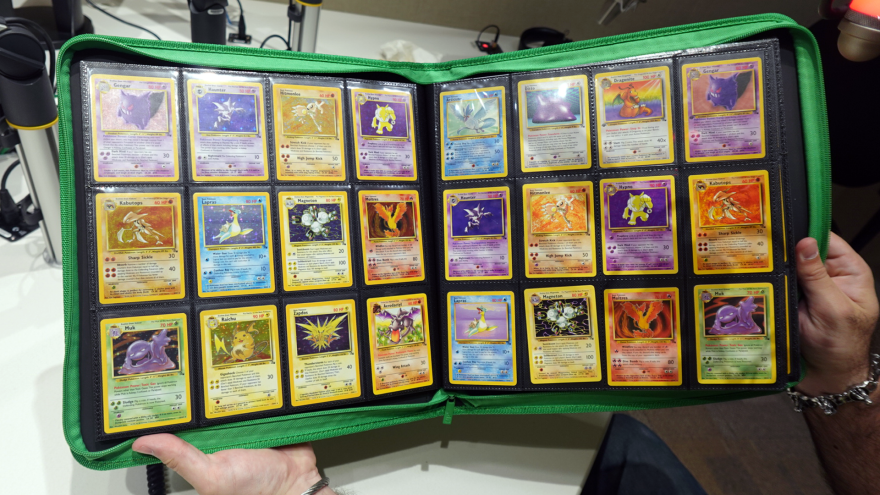
McAfee: Steven still has those figurines. He brought them into our KPBS studio to show me and producer Anthony, along with his meticulously-organized card collection.
Chung: So I guess this one's binder 1 of 2 'cause I didn't wanna bring my whole collection.
McAfee: That’s OK.
Chung: Each one of these cards really was kind of a fortune even back then, even if it's, like, 50 cents or, like, $10. But each one of it really meant that my mom really respected that we liked these things, and that she would go out of her way to buy it for us. If I were to be really honest with you, I wouldn't sell these for the world.
McAfee: Steven's family didn't just collect figurines and cards. They also had Pokémon Red and Blue on the Game Boy. Steven and his brother noticed his dad borrowing it from time to time.
Chung: I remember one time my dad brought the game back to my brother. He had all these level 100 Pokémon. He had all of these, like, items I'd never seen before. So we eventually realized that my dad wasn't just playing the game because he was trying to be a good dad. He was playing the game because he actually really liked the game.
McAfee: When Steven was a kid, Pokémon was about family and today he plays Pokémon GO with his wife.
Chung: And really, that has always been the spirit of the Pokémon franchise. And why the games were designed in the way that they were, so that people could interact with one another, you know, be able to trade or to battle or just, you know, to talk.
McAfee: Within a few years of Steven seeing his cousin's figurines, Pokémon became a global sensation. Producer Anthony and I wanted to know, how did that happen? So we called a Pokémon historian.
Courtney Mifsud Intreglia: I was fully hooked on the phenomenon of Red and Blue before it even hit stores. My poor parents waiting forever in Best Buy to get myself a copy.
McAfee: As an adult, Courtney Mifsud Intreglia has written extensively about Pokémon for Life and TIME Magazine. She told us the franchise's origin story. Pokémon's founder, Satoshi Tajiri, had two major passions: collecting bugs in Japan's rural countryside and video games. When he was in his 20s, he became enamored with Nintendo's new Famicom gaming console. But Satoshi and a few of his enterprising friends weren't impressed by the games that were available.
Intreglia: So they take apart a Famicom, teach themselves how to develop games.
McAfee: It was a ragtag group of friends working out of an apartment, and Satoshi's big idea had to do with his bug-catching days.
Intreglia: He really wanted something that spoke to the care, the commitment to the collecting and the pace that he was used to in this rural Japanese suburb that he grew up in. So that really, in 1990, they started the bones of what Pokémon Red and Green, which would release in six years later in Japan.
McAfee: At some point, they got some support from Nintendo, which was huge. But still, by the time they finished the game...
Intreglia: You have this game releasing on already aging software, and really nobody thought it was gonna do very well. Luckily, as a bit of a prank they ended up with 300 bytes of space after the debugging process in the final game. As a little inside joke, they put in a 151st Pokémon.
McAfee: That bonus Pokémon was Mew. When the early internet caught wind of this mythical Pokémon, people couldn't stop talking about how to find it.
Intreglia: Instantly kind of went viral in a time where viral really wasn't happening, but in these online message boards of, Wait, they said 150 Pokémon. Did you find this 151st Pokémon?
McAfee: So from the start, Pokémon was a grassroots phenomenon fueled by a quirky community excited about fantastical pocket monsters. Then came TV shows, trading cards and movies.
Clip: Pikachu.
McAfee: Even with all of that, the hype around Pokémon eventually faded.
Intreglia: By 2004, only the nerds are playing Pokémon, basically.
Chung: And that continued on into high school. And I think for a lot of people who are engaging into Pokémon now, that it's so widely accepted, don't remember that there was a really awkward phase of Pokémon where people just didn't really want to admit that they still liked it.
McAfee: It wasn't until the release of Pokémon GO in 2016 that there was a true resurgence of the franchise.
Archival news clip: The smash hit mobile game app Pokémon GO has already got millions following their smartphones to the most random places.
Archival news clip: Pokémon fever is back and it's everywhere.
Archival news clip: Finally, the quest to catch them all continues. Take a look at this crowd. This is unbelievable.
Chung: And with that explosion in popularity and notoriety, you saw the jumpstart of the Pokémon collecting craze again that, you know, kinda carried on through the pandemic and to modern day.
McAfee: Steven's favorite place to play Pokémon GO is at Kit Carson Park in Escondido. There you can find him frequently leAudyng Pokémon catching raids. On some weekends, there's over 100 people participating.
Chung: It truly is a community out there where anyone can come in, you know, whether you're five years old or 55 years old. You know, you can come out and you can enjoy your time out there.
McAfee: Although Pokémon GO is thriving, Steven says that with the franchise's resurgence, the card-collecting scene has changed in a big way.
Chung: It became pretty insane. To be honest, personally, that was around the time when I completely quit cold turkey.
McAfee: Steven quit buying cards because as the craze rose, so did the prices. Take Elite Trainer boxes as an example. Those are the really popular card drops. They have nine packs and other items to play the game. Their suggested retail price is $50, but those seem to be out of stock often. You can find them at local card shops for a lot more than that, some for more than $200. Steven worries this prices out the next generation of Pokémon lovers.
Chung: If Pokémon doesn't have an opportunity to reach the younger audiences, then Pokémon as an IP doesn't really have a future. And I think it says something where there is a commodification of an IP that's really supposed to be about going out and exploring, spending time with your friends, being like the Ash Ketchum of their world or the Satoshi of their world, and just trying to do good and treat people fairly.
McAfee: After the break, producer Anthony and I visit some card shops to figure out why the price of Pokémon cards has gone out of control. Stay with us.
[Music]
McAfee: The massive hike in card prices is largely due to a kind of shadow economy of Pokémon that many people don't understand. There isn't necessarily anything illegal happening, but the Pokémon card market today has, in many ways, been hijacked by resellers
Jake Federicks: How's it going? Jake.
McAfee: Audy. Nice to meet you.
Anthony Wallace: I'm Anthony.
Federicks: I thought it was a Psyduck tattoo.
McAfee: Yeah.
Federicks: There you go. Anthony, Jake.
McAfee: We met with Jake Federicks, one of the managers at Supreme Card Shop in La Mesa. He immediately spotted my Psyduck tattoo — a true Pokémon fan.
We have to ask everyone that we're interviewing, what is your favorite Pokémon and why?
Federicks: Dachsbun. And it's funny, it's, like, all created around, like, food, which I also don't mind, right? So I used to work in kitchens, so that kind of resonated with me more than anything else. So I always joke about, you know when you're a kid and you're like, oh, where do you see yourself in 30 years? Did I see myself collecting Pokémon? Probably not.
McAfee: But Pokémon collecting today is a whole different ballgame than when Jake was a kid.
Federicks: You go down to, like, the Dollar Tree, and you grab a pack of cards for a dollar. You grab, like, you know, Sour Patch Kids and you open it up and you put all your greasy mitts on the cards and shove them in your pocket and that was your day.
McAfee: Today, it's really hard to find cards at Dollar Tree at retail price. Major stores like Dollar Tree and Target and Walmart do get some stock, but those are quickly bought up by scalpers. Think third-party Pokémon card dealers.
Federicks: If I can't get prices decent enough and I have to go buy it from the second, third party who has it, you know, something that starts out as simple as $50 becomes $70, becomes $100, becomes $120 on our shelves. So that looks from a very, black-and-white aspect like we're the scalpers, like we're the problem, right?
McAfee: I won't lie. I, too, was one of the frustrated consumers, not understanding why the cards I wanted were so expensive. It almost felt like the card shops were Team Rocket, just trying to make a quick buck off of Pokémon. But speaking to card shop owners, I realized it wasn't that simple.
Federicks: Scalping, in general, is tough because there's no way for us to really directly combat it except for not buying from anyone at all, but that might close us off in a way. You can't, it can't be that black-and-white 'cause if I tell enough people that we're not buying product at all and I run out, well, then I'm out of product.
McAfee: So with scalpers buying up all the cards, Jake's left with only one real option: buy from them at a high price and pass that on to his customers. To help kids get into Pokémon, Jake steers them into buying single cards, not gambling on super expensive variety packs that may or may not contain a valuable card. But even single cards can be pricey, especially the graded ones for collectors. YouTuber Logan Paul famously bought a single Pikachu card for $5 million a couple years ago. And the card prices shift all the time, like stocks. Jake monitors them several times a day on an app. Anthony and I saw it happen in real time. Jake picked up a card with a $300 price sticker on it.
Federicks: I constantly reprice stuff, up or down, not always up. This card is not this price anymore. This card is now $700.
McAfee: Wow.
Wallace: Wow. So you have to put a new sticker on that?
Federicks: Yep. New price.
Wallace: So can you tell us which card that is?
Federicks: The Rainbow Pikachu VMAX. This is an older set, 2020, from Vivid Voltage. The booster box price of that is actually less. You could get two booster boxes for the price of this card on the 10 now.
McAfee: A booster box holds 36 packs, and still, you might not pull that Pikachu, which is why sometimes it makes more sense to buy singles instead of a sealed product. But every now and then, you'll get lucky, like when I pulled Giovanni's Mewtwo out of a random pack. Yes, that is one of the cards I sold. No, I don't wanna talk about it
My favorite shop I found since moving to San Diego is Tito Rick's Garage in between Logan Heights and Grant Hill. It's about a 30-minute walk from my place. Jason Huggins is the owner, and they've only been open for about a year now.
Jason Huggins: I like Mimikyu, Garbodor, Skuntank. I like all the, like, stinkies. I feel like Mimikyu is kind of like a misunderstood character with his rivalry with Pikachu and he feels sort of fraudulent. It's weird that I can connect with a Pokémon character like that, but yeah.
McAfee: Jason says that as a newer store, they struggle to get product from the official Pokémon wholesalers, so they don't get cards at a price that would allow them to sell to consumers at manufacturer's suggested retail price, or MSRP.
Huggins: People hope for MSRP, but we're almost in a place where that doesn't exist for mom-and-pop shops because I don't have a vendor that's giving me enough product that allows me the ability to sell it at MSRP. Like, if I was getting 1,000 units of something, then for sure it would make sense, but they're giving me three. Like, how am I gonna make my margins or make any kind of money?
McAfee: And becoming a hobby shop owner has become more dangerous. With people catching on to how much money can be made from trading cards like Pokémon, these shops are being robbed on a large scale.
Archival news clip: This was the dramatic scene at a card collecting shop in New York City on Wednesday. Shattering a glass display case, the robberies come amid a massive run-up in Pokémon card values.
Huggins: I'm thinking about the customers, I'm thinking about my guys that are working, and so I'm putting, like, store security in place, you know? What am I gonna do, you know? I put bars on my windows. I have security cameras everywhere in the store.
McAfee: Jason told us that just a week ago, a local shop had Pokémon cards stolen.
Huggins: I mean, Slims Rips just got broken into last week. They busted through the front door. Yeah, and it's sad. And they hit 'em for a bunch of ETBs, expensive ones and stuff. It's just, it just sucks, dude.
McAfee: Whether it's through literal theft or gaming the system as resellers, if there's money to be made, some Team Rocket out there will figure out a way to do it. This whole thing really comes down to a supply and demand problem. There aren't enough Pokémon cards out there right now. Jason says he thinks the only thing that could truly help the problem is if Pokémon stepped in.
Huggins: If they had more product and it was more readily available, it's gonna lower the price of things, but maybe the market will stabilize to, like, whatever retail market should be, and people will be less likely to rob stores, but I don't think that's ever gonna happen.
McAfee: The Pokémon card economy is mostly out of Jason's control and he's just doing his best to run a business in it. But for him, a hobby shop isn't just about making money, it's about building community.
Huggins: We host a tournament every Monday. We host a monthly trade night, which is predominantly Pokémon focused. Having customers come in here that are super excited about the hobby, super excited about Pokémon and getting into it, and we're just like, OK, let's help them with that journey.
McAfee: Oliver Soufi is a district translator and interpreter for San Marcos Unified, helping Spanish-speaking kids and their parents. But he also identifies as a Pokémon master. His favorite Pokémon is Mewtwo.
Oliver Soufi: And he's just like big and hunched over, and I'm like, What? He was created by Team Rocket, and he, you know, basically goes on a revenge spree of like, Hey, like, I was created to be a weapon. I don't feel like I'm a weapon. And it's like this, this guy. I like this one. This one. This is my favorite now.
McAfee: He's pretty sick.
Soufi: Oh, yeah. There's a Pokémon for everybody.
McAfee: Like Steven, Oliver is in his 30s and Pokémon has been there with him almost his whole life.
Soufi: And I remember begging my dad for weeks, Dad, please, please, please, please, please, please, please buy me the game. Buy me the console. Buy me the... And my dad's like, Sure, yeah, you get straight As on everything, I'll buy you the Game Boy, and I'll buy you the game.
McAfee: Like Ash, whose mother supported his Pokémon journey, so did Oliver's dad.
Soufi: He always shared in the joy that I had with stuff.
McAfee: Oliver and his dad built an impressive Pokémon card collection together that includes the full Base, Fossil and Neo Sets.
Soufi: You know, I didn't, we didn't grow up with a lot of money and my dad was a single dad, so it took a lot of money and there were things that we had to limit ourselves on.
McAfee: If he sold his collection, he could easily get a few thousand dollars, but he says he'll never do that because it reminds him of his father.
Soufi: I have this permanent fixture, this thing that's palpable and I can touch it that's like a living embodiment of the relationship with my father when I was younger. So to me, that's, you know, it's very important.
McAfee: Pokémon became even more meaningful to him when he moved in with his mom at 13 — only three years older than Ash was when he left on his journey.
Soufi: So even when I went to Spain and I took my Pokémon cards with me, I kind of like had my dad with me. So it was always great to have him around and like think about that and, you know, make new friends because of these cards and because of the connections that Pokémon brings. Some of my friends from Spain when I grew up there, because we shared Pokémon and because we shared the interest, we're still friends to this day.
We're talking 20 years later. It brings people together.
McAfee: He says it's up to his generation to make space for the younger people who want to start collecting.
Soufi: I think like where a lot of us fans, older fans need to kind of step up and be like, all right, hey, like if you don't have access to Pokémon cards, maybe I can give you one for free. Or, hey, you don't have access to Pokémon GO or you're in a rural area, I'll trade you one.
McAfee: I've seen what Oliver's talking about firsthand, card sellers gifting kids Pokémon cards when they can't afford it — just like when Ash gave away his Beedrill to his friend Casey because she loved yellow and black striped Pokémon. I did some trading myself when I met up with Steven and Oliver at Kit Carson Park to play Pokémon GO. Oliver ended up trading my Pikachu for his Gengar with a little party hat, which is exactly like my tattoo.
Soufi: There we go. So see how it says 10,000 stardust? We confirm it. It's a special trade because they have costumes. And now you have your tattoo.
McAfee: Yay. Thank you so much, Oliver.
Soufi: You're very welcome.
McAfee: Yay!
Steven also helped me with my first raid.
Chung: So what I'd recommend that you go ahead and feed it one of those berries.
Soufi: Yeah.
Chung: You can see that golden raspberry right there.
McAfee: After the raid, it was up to me to catch the Pokémon, and let's just say I didn't have the best aim. Both of them didn't let me give up, though, kind of like how Ash would never give up on his friends or his Pokémon.
Soufi: OK, one, two, three. You got it.
Chung: You got it. There you go!
McAfee: Thank you, guys.
Soufi: There you go. See?
McAfee: Oliver says no matter how popular Pokémon gets, it's important to always remember it's rooted in connection.
Soufi: That's the whole thing about the community. I think, like, what Satoshi Tajiri, the creator of Pokémon, when he was catching bugs, I imagine that's what he wanted, is for people to kind of get together, share these experiences, have the same fun that he was having and be able to indulge in catching little critters where he was catching bugs.
McAfee: In a world where it can sometimes feel like there are more Team Rockets than Ash Ketchums, I hope we can be reminded through people like Oliver, Steven, Jake and Jason that it's not just about catching them all. It's about how to be real friends to one another and take care of a world we all share.
Evans: That was Audy McAfee, KPBS arts and culture reporter. Special thanks to Steven Chung, Courtney Mifsud Intreglia, Oliver Soufi, Jake Federicks from Supreme Card Shop and Jason Huggins from Tito Rick’s Garage.
And before we go, as we worked on this episode, we joked that some Pokémon names sound kind of like pharmaceuticals, so we asked Audy to quiz us. Play along: Is it a Pokémon or a prescription drug?
McAfee: What I'm gonna do is I have 10: five of them are Pokémon, five of them are drugs. OK.
Evans: Anthony can go first.
McAfee: All right, first one, Bactroban.
Wallace: Bactroban?
McAfee: You first.
Wallace: Pharmaceutical drug.
Evans: Yes, pharmaceutical.
Ben Redlawsk: That's, that’s a drug, yeah.
McAfee: It is a drug.
Evans: Yes!
McAfee: Nice, guys.
Wallace: What does it ban, though?
McAfee: I don't know.
Wallace: Bacteria?
Evans: Bactroban.
McAfee: Yeah.
Wallace: Yeah.
McAfee: Yeah. Alright, two. Reuniclus.
Evans: I'm gonna go. Reuniclus? Nucleus or niclus?
McAfee: Niclus.
Wallace: Language of origin, please.
Evans: Can you use it in a sentence? I'm gonna go Pokémon.
McAfee: OK.
Redlawsk: I think I'm gonna go Pokémon, too.
McAfee: OK.
Wallace: I think Pokémon.
McAfee: It is in fact a Pokémon.
Evans: Yes.
McAfee: Alright number three, Nihilego.
Wallace: Ben starts.
Redlawsk: Pokémon.
Wallace: Pokémon
Evans: Yeah, Pokémon.
McAfee: It is a Pokémon. Alright.
Wallace: Perfect three for three.
McAfee: Alright. Ebglyss.
Wallace: Pokémon.
Evans: I want to say Pokémon, but I feel like for the bit I'm gonna say pharmaceutical.
McAfee: OK.
Wallace: Our first divergence.
Redlawsk: I think I've seen an ad.
Evans: Oh.
McAfee: And?
Redlawsk: Not for the Pokémon. I'm gonna go pharmaceutical drug.
McAfee: It is a pharmaceutical.
Evans: Yes!
McAfee: And that's where I got it from was an ad.
Redlawsk: OK, there we go.
McAfee: Alright, this one should be pretty straightforward: Cresselia.
Wallace: Pokémon.
McAfee: OK.
Redlawsk: OK, Pokémon.
McAfee: OK.
Wallace: Cresselia?
McAfee: Cresselia.
Wallace: Sounds more like a Pokémon to me.
McAfee: It is in fact a Pokémon.
Wallace: OK.
McAfee: How about Skyrizi?
Redlawsk: I've also seen that ad.
McAfee: You know, you shouldn't say that part.
Redlawsk: I'm sorry. No, I shouldn't say that. No, I've seen an ad for the Pokémon.
McAfee: Right. Right. OK. Well, it's a drug, so.
Redlawsk: Sorry.
Wallace: Drug. OK, we all got that one.
McAfee: Alright. Virizion.
Wallace: I could really see it going either way. Rizion?
McAfee: Virizion.
Wallace: Virizion.
Evans: With a V?
Wallace: I was actually reading about how drugs like to use the letter V because there's research that people find them more effective if they have a V in them.
Evans: And this has a Z. It has the word riz. I think that would be a cute Pokémon.
Wallace: This one really could go either way. I'm gonna say Pokémon.
McAfee: OK.
Evans: I'll go pharmaceutical.
McAfee: OK.
Redlawsk: I think I'm gonna go Pokémon just because I feel like it's too close to Verizon.
McAfee: Fair enough.
Redlawsk: And that it would have like a brand…
Evans: Oh, you're right. No focus group would get…
Redlawsk: Yeah...
McAfee: It is a Pokémon.
Evans: Wow.
Wallace: Ben’s perfect so far.
McAfee: Alright, Rapamune.
Wallace: Just straight up the word immune in it?
Evans: No, it's an A. That's what I was asking.
McAfee: In a way.
Evans: Is it immune? Or A?
McAfee: Amune.
Evans: I'm gonna go Pokémon.
McAfee: OK.
Redlawsk: I can't get immune out of my head. I think I'm gonna go pharmaceutical.
McAfee: OK.
Wallace: I'm gonna say drug.
McAfee: Drug. Two more. Dupixent.
Wallace: Dupixin?
McAfee: Dupixent.
Wallace: Dupixent.
Redlawsk: I'm gonna go pharmaceutical.
Wallace: I'll say Pokémon so I can have a chance to tie Ben.
McAfee: OK.
Evans: I'm gonna say pharmaceutical.
McAfee: It is a pharmaceutical.
Evans: Yes! Just as long as I can beat Anthony at this point.
Wallace: Well then we're tied, Julia and I. But Ben basically clinched it.
McAfee: Alright. Blacephalon.
Wallace: Blacephalon. I think Pokémon 'cause that's too much of a mouthful for a pharmaceutical.
Evans: There's some mouthfuls.
Wallace: Yeah.
Evans: But that's a cute one, too. Yeah, Pokémon.
Redlawsk: I’m gonna go Pokémon.
McAfee: And fact.
Evans: Oh.
Wallace: Wow. 10 for 10.
Evans: Ben. Amazing.
Wallace: Ben. Wow. Good job.
Redlawsk: Let's go.
Wallace: You won.
Evans: Well, nice work. Ben rules.
Wallace: Congrats, Ben. Good job.
McAfee:Congrats.
Evans: The Finest is a production of KPBS Public Media in San Diego. I'm your host, Julia Dixon Evans. Our producer is Anthony Wallace, who also composed the score. Ben Redlawsk is our engineer and Chrissy Nguyen is our editor.
This transcript has been edited for clarity and conciseness.
From KPBS Public Media, The Finest is a podcast about the people, art and movements redefining culture in San Diego. Listen to it wherever you get your podcasts or click the play button at the top of this page and subscribe to the show on Apple Podcasts, Spotify, Amazon Music, Pocket Casts, Pandora, YouTube or wherever you get your podcasts.
Have feedback or a story idea? We'd love to hear from you. Email us at thefinest@kpbs.org and let us know what you think.